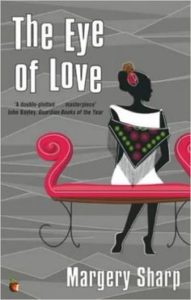
From the 1957 Little, Brown edition of The Eye of Love by Margery Sharp: She was his lovely Spanish rose, the most beautiful woman he had ever beheld. He was her bluff King Hal, tall and handsome, the masterful lover of her dreams.
Only Margery Sharp, author of Cluny Brown and Britannia Mews could have written this civilized, witty, and wise story of Harry Gibson and Dolores Diver, a pair of lovers who always saw each other — no matter how others might see them — with the eye of love. Read More→
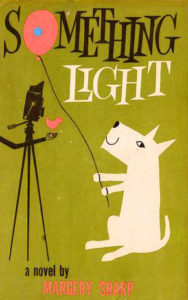
From the 1960 Little, Brown edition of Something Light by Margery Sharp: Something Light is the story of Louisa Mary Datchett, who was “very fond of men” — indiscriminately fond of men, in fact.
Men, for their part, seemed to recognize this in her and took advantage of it — and of her — when they needed listening to, when they needed prescriptions filled, employment found, socks washed, suits fetched from the cleaners, or musical instruments got out of hock.
“She was constantly being either send for, like a fire engine, or dispatched, like a life boat, to the scene of some masculine disaster.” Read More→
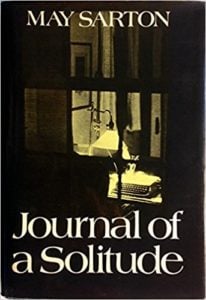
Journal of a Solitude by May Sarton is this multi-faceted writer’s 1973 follow-up to Plant Dreaming Deep, in which she continues her search for self.
Published in 1973, Journal of Solitude would later become a key text in women’s studies courses. Like her other books, both memoirs and novels, this one explores isolation, solitude, love, relationships, sexual orientation, success, failure, gratitude, love of nature, the seasons, and the struggles of a creative life. Read More→
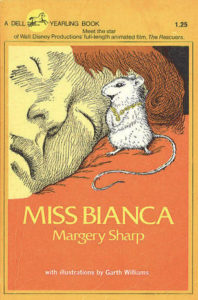
From the original review of Miss Bianca (book #2 in The Rescuers series) by Margery Sharp in The Anniston Star, November, 1962:
What a joy it is, in the harsh literary wilderness of earnest tragedy and frantic sophistication, to find an occasional fairy tale, all delight and whimsy and otherworldliness!
Margery Sharp gave us this pleasure several years ago with her wonderful little book, The Rescuers, the stirring tale of the Mouse Prisoners’ Aid Society and its daring rescue of a Scandinavian poet from the gloomy dungeons of the notorious Black Castle. Read More→
Learning how to stay disciplined, grappling with doubt, failure, and rejection, finding one’s voice, struggling to stay solvent—we’ve all dealt with these issues. It’s comforting to know that classic women authors like Charlotte Brontë, George Sand, Louisa May Alcott, and others did, as well — and their advice on writing also applies to many life situations as well.
In the end, it’s not so much about facing obstacles that matters — everyone experiences bumps in the road — but overcoming them with grace and courage.
While researching The Literary Ladies’ Guide to the Writing Life, I delved into the letters, journals, and memoirs of classic women authors. I found that certain challenges were just as universal among those who eventually became literary icons as they are among today’s writing women, whether seasoned or aspiring. Read More→
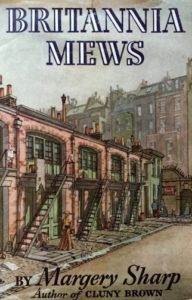
Britannia Mews by Margery Sharp is a 1946 novel that fits well into this British author’s skill for creating entertaining, lighthearted stories.
Known for her wit and wry wisdom about human nature, Britannia Mews chronicles lives spanning three generations.
The novel was adapted to a 1949 film, retitled The Forbidden Street. From the 1946 edition, the story is described in a nutshell: Read More→
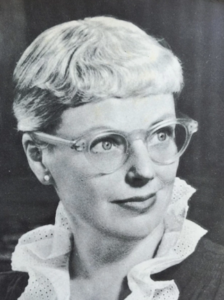
Margery Sharp (January 25, 1905 – March 25, 1991), born Clara Margery Melita Sharp in Salisbury, England, was a prolific British author of witty novels featuring offbeat characters. Several were adapted for stage and screen.
Though she wrote numerous books (many in the comic novel genre), her most enduring work is The Rescuers series for children, two of which were adapted into animated Disney films.
After completing a varied education in arts and languages, Margery started her career by getting her stories published in Punch magazine, at age 21. She continued to write for this and other major magazines in Britain and the U.S. Read More→
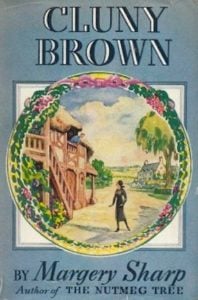
Possibly the best-known novel for adults by British author Margery Sharp, Cluny Brown (1944) is a comic novel following the title heroine’s quest for love, freedom, and experience.
Cluny Brown works as a parlor maid in a country inn called Friars Carmel and there, she encounters a motley cast of characters. The novel, aside from being great fun to read, is a satirical look at British high society in the mid-twentieth century.
The novel was plucked from its British locale and adapted into an American romantic comedy in 1946. It was produced and directed by Ernst Lubitsch (it was the legendary director’s last completed film) , starring Charles Boyer and Jennifer Jones. Read More→