5 Fascinating Mid-20th Century Women Novelists
By Nava Atlas | On August 2, 2022 | Updated August 2, 2024 | Comments (0)
While the writers highlighted here may not be obscure or totally forgotten (with the possible exception of Vera Caspary), they also may not leap to mind as the authors of our next great read. Let’s revisit these fascinating mid-20th century women novelists.
Midcentury is loosely defined here as 1940s and 1950s, and this is but a small sampling of writers of that era that I find fascinating — there are always others to discover and rediscover.
Ann Petry

Ann Petry (1908 – 1997) was the first Black woman in the U.S. to produce a book (The Street, 1946) whose sales topped one million. Ultimately it sold a million and a half copies.
Growing up, Ann was an avid reader who was taken with Louisa May Alcott’s fictional heroine Jo March as a role model for her writerly aspirations.
A high school teacher encouraged her to write, but in the depths of the Great Depression, Ann needed a practical profession. She went to pharmacy college and followed in her father’s footsteps, becoming a pharmacist in the family drugstore in Old Saybrook, Connecticut.
Moving to Harlem in the late 1930s opened Ann’s eyes to the challenges facing Black working class women whose lives were far less secure than what she had experienced. Witnessing their struggles firsthand informed her first novel, The Street. Published in 1946, it became a critically acclaimed bestseller.
Overwhelmed by the fame and notoriety that The Street brought her, Ann and her husband retreated to Old Saybrook, where she enjoyed the quiet writer’s life she preferred. Her books seem to have a revival every few years. The Street blew me away! Read more about Ann Petry’s life and work.
Ann Petry wrote a small number of books for children; these are her books for adults:
- The Street (1946)
- Country Place (1947)
- The Narrows (1953)
- Miss Muriel and Other Stories (1971)
. . . . . . . . . . .
Barbara Pym
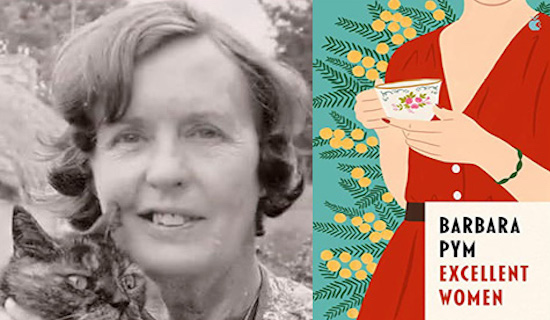
The novels of British author Barbara Pym (1913 –1980) explored manners and morals in English village life with subtle, understated wit. This wonderful writer was often called England’s “other Jane Austen.”
On the surface, her fiction seems to focus on lighter matters like whether to serve a rich fruit cake or a cake with a coffee icing, or who knits socks for whom. There are country vicars galore, cats, eccentric women young and old, and gallons and gallons of tea.
Literary Ladies Guide contributor Marcie McCauley writes, “Beneath these mundane details are deeper truths about how people forge and maintain connections, and what happens when those efforts fail and leave people to their solitary lives.”
A 2017 homage in the New York Times declared: “Barbara Pym, the midcentury English novelist, is forever being forgotten, and forever revived.” Let’s just revive her for good, shall we? Learn more about Barbara Pym’s life and work.
Here are a few of her midcentury works. There was a big gap when her novels fell out of favor; then, more of them were published in the late 1970s through mid-1980s, some posthumously.
- Some Tame Gazelle (1950)
- Excellent Women (1952)
- Jane and Prudence (1953)
- Less than Angels (1955)
- A Glass of Blessings (1958)
- No Fond Return of Love (1961)
Rumer Godden

British novelist and memoirist Rumer Godden (1907 – 1998) and her sisters were raised mainly in India at the height of British colonial rule. Her life was as dramatic and colorful as her stories.
Black Narcissus (1939), her first novel, set the stage for a succession of books defined by vivid settings, realistic characters, and masterful storytelling described by reviewers as “deceptively simple” and “subtle magic.” In This House of Brede was another of her many critically acclaimed novels. No less than nine of her novels were made into feature or TV films.
Though Rumer was passionately devoted to India, her outsider relationship with the culture was complicated. Yet she doesn’t seem to have been critiqued with the settler-colonial reconsideration as has Isak Dinesen and her memoir Out of Africa — unless I’ve missed something?
One of her favorite sayings, quoted in A House with Four Rooms is from an Indian proverb: “Everyone is a house with four rooms, a physical, a mental, an emotional, and a spiritual. Most of us tend to live in one room most of the time but unless we go into every room every day, even if only to keep it aired, we are not a complete person.”
Rumer Godden was incredibly prolific. In addition to some twenty-five novels, she wrote many works of nonfiction and memoir, along with two dozen children’s books. Read more about Rumer Godden’s life and work.
. . . . . . . . . . .
Grace Metalious
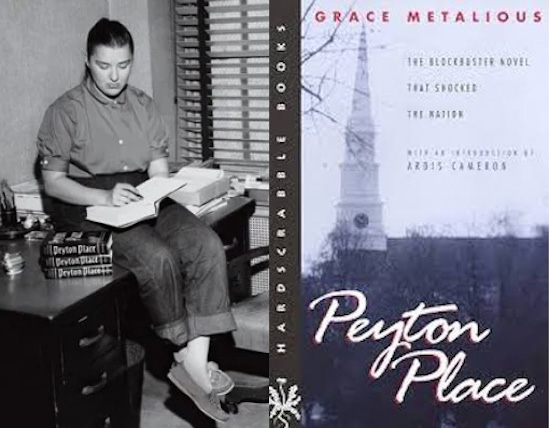
Grace Metalious (1924 – 1964) was an American author best remembered for her sensational 1956 novel, Peyton Place. Incredibly scandalous, it quickly became one of the bestselling books of the twentieth century.
More comfortable in denim jeans and boxy shirts, Grace showed no interest in conforming to 1950s ideals. “I did not like being regarded as a freak because I spent time in front of a typewriter instead of a sink.”
Peyton Place blew the lid off prim midcentury America. Critics denounced it as wicked, nasty, and squalid. That a young woman had dared to write frankly about rape, murder, and abortion made it all the more shocking. The love scenes and secret trysts considered racy at the time are pretty tame by today’s standards.
Many libraries and bookstores refused to stock the novel and it was banned in several countries, including Canada. Naturally, that made it even more popular. The publicity and the lure of Hollywood took a toll on Grace. She became dependent on alcohol and recklessly squandered the fortune she made.
The slightly sanitized Peyton Place film of 1957 was far better received than the novel. What killed Peyton Place was the nighttime soap opera of the same name that debuted in 1964; it had little to do with the book. That same year, Grace’s self-destruction was complete — at just thirty-nine, she died of cirrhosis of the liver.
I read/listened to Peyton Place twice last year. Is it sometimes overwrought? Sure. But it’s also an unsparing critique of hypocrisy and argues for female bodily autonomy, as urgent an issue today as it was in 1939 – 1940, when most of the story takes place.
Read more about Grace Metalious’s life and work. Her novels:
- Peyton Place (1956)
- Return to Peyton Place (1959)
- The Tight White Collar (1961)
- No Adam in Eden (1963)
Vera Caspary

Vera Caspary (1899 – 1987) was a remarkably prolific American novelist, screenwriter, and playwright. Over the course of her long career, she became known as a writer of crime fiction, though she created works in other genres.
Of more than twenty published novels, the best known remains Laura (1943). She also wrote numerous screenplays for Hollywood films, some based on her own works. If you’re a fan of film noir, you may have seen the 1944 film adaptation of Laura, or the well-regarded 1953 film The Blue Gardenia, adapted from her 1952 novel, The Gardenia.
Vera considered herself lucky to have lived during the “century of the woman,” and to have been part of the struggle that led to greater equality. Francis Booth, author of A Girl Named Vera Can Never Tell a Lie (the first work to examine all of Caspary’s novels) observed:
“Although she worked in Hollywood and many of her novels were published as pulp paperbacks with lurid covers and sensationalist blurbs, Caspary herself was a connoisseur of classic British literature. One Caspary woman calls herself Haworth after the Brontë Parsonage, Stranger Than Truth pays homage to Wilkie Collins’ The Woman in White, and Bedelia to Mary Elizabeth Braddon’s Lady Audley’s Secret.”
Francis contributed lots of Vera Caspary content to the Literary Ladies site. I’d never heard of her before, so thank you, Francis! Learn lots more about Vera Caspary’s life and work. Her bibliography and filmography is too long to list; see her entire list of works here.
A few more thoughts …
Lest you think I’ve forgotten Zora Neale Hurston, I haven’t! Though she and her work fell into nearly-complete oblivion by the time of her death in 1960, Alice Walker played a huge role in her rediscovery. Zora is no longer considered overlooked, with most or all of her works back in print. She sure could have used some of this recognition while alive, alas.
Gwendolyn Brooks is better known as a Pulitzer Prize-winning poet, but her semi-autobiographical 1951 novel (her only work of fiction) Maud Martha is such a gem.
I highly recommend the podcast Lost Ladies of Lit. I’ve learned about many forgotten authors from them. It’s entertaining as well as enlighting!
Two other hugely successful mid-century authors who are not as nearly widely read today are Pearl S. Buck and Edna Ferber. Let’s not forget the gently rediscovered Dawn Powell. Though sometimes considered underrated, English author (not the actress) Elizabeth Taylor has never lost her fiercely devoted following.
Leave a Reply