By Taylor Jasmine | On September 3, 2018 | Updated June 15, 2026 | Comments (0)
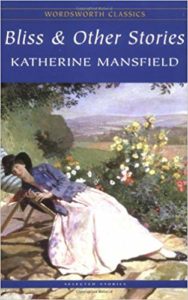
Bliss (1918) is a short story by Katherine Mansfield (1888 – 1923), the New Zealand-born British author recognized for revolutionizing the modern English short story form. This story is one of the works that put Mansfield on the literary map as a master of the genre.
Bertha Young, the main character, is a happy yet somewhat naïve young wife. The story takes place during a dinner party she hosts with her husband Harry.
One of the story’s themes is the classic one self-knowledge. But it was more of a rarity to explore queer themes in early twentieth-century literature. Mansfield herself was bisexual, and perhaps that was subtly alluded to with the character of Pearl Fulton, a guest to whom Bertha is drawn. Read More→
By Taylor Jasmine | On August 31, 2018 | Updated February 9, 2024 | Comments (1)
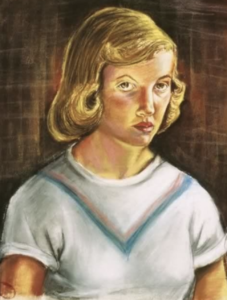
Sylvia Plath’s meteoric posthumous rise as a pre-eminent American poet has eclipsed the fact that she was a talented artist as well. When she initially enrolled at Smith College, her first choice of major was studio art. After discovering her talent for writing, her professors encouraged her to major in English instead.
It took a long time for her visual art to come to light. The Smithsonian National Portrait Gallery mounted a retrospective of her work in 2017, fifty-four years after her death.
A few of the works were self-portraits, including the one at right, and the first one, below. She also enjoyed making collages that were playful and satiric. Read More→
By Taylor Jasmine | On August 28, 2018 | Updated June 29, 2023 | Comments (2)
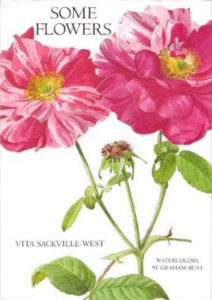
Vita Sackville-West (1892 – 1962), the British author known for All Passion Spent and The Edwardians (as well as for her great friendship with Virginia Woolf) was nearly equally known for her passion for gardening and garden design. Enjoy the selection of quotes by Vita Sackville-West on gardens and gardening in this post — they’re wonderful metaphors for life itself!
The gardens at Sissinghurst, the home she shared with Harold Nicolson, are masterful. Though she considered herself an amateur, she remains a respected name in garden design.
Vita had a voice that was at once authoritative yet never bossy, often acknowledging that the garden can become the master of its caretaker, rather than the other way around. Something that always comes through is her passion for gardens, gardening, and beauty in bloom. According to The Telegraph in a recent appraisal of Vita’s gardening legacy:
Read More→
By Nava Atlas | On August 25, 2018 | Updated December 28, 2023 | Comments (0)
In the American colonies and early days of the Republic, for a woman to dare enter public discourse was a radical act of rebellion. Following is an introduction to six of the most prominent early American women writers, all of whom deserve to be rediscovered and read.
To write and be published at a time when women had few legal or economic rights was just short of miraculous. To avoid censure, some occasionally wrote under pseudonyms, while others used their own names, consequences be damned!
In 1650, The Tenth Muse, Lately Sprung Up in America, a collection of poems by Anne Bradstreet, was the first publication in the colonies. From then on, women who wrote were criticized for being unwomanly and going against God’s teachings. Read More→
By Aiyana Edmund | On August 23, 2018 | Updated September 14, 2026 | Comments (0)
George Eliot, the chosen pen name of Mary Ann Evans (1819 – 1880), was an esteemed Victorian-era British author. Her writing was politically and socially perceptive and inventive. Following are some classic quotes from Middlemarch, a novel that has earned a place as one of the great works of English literature:
Middlemarch, The Mill on the Floss, and Silas Marner are considered some of the finest and most important literary works in British literature. In addition to these and other novels, George Eliot also wrote poems, short stories, translations, and essays.
Middlemarch (1871) follows the tale of Dorothea Brooke and Tertius Lydgate, two characters destined to enter marriages that are not only unfulfilling, but also conflict with their personal aspirations. Read More→
By Ruth Nestvold | On August 20, 2018 | Updated October 13, 2024 | Comments (3)
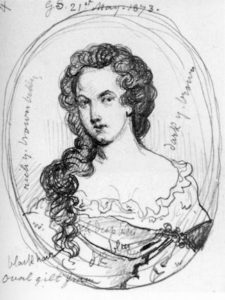
Aphra Behn (1640 – 1689) is a forerunner in English literary history in more ways than one; she is not only the first professional woman writer, she is also an important innovator in the form of the novel.
Using the epistolary form of Lettres Portugaises as a model and combining it with elements of the drama, with Love Letters Between a Nobleman and His Sister she created the first true epistolary novel.
In Oroonoko she used a narrative voice that combined proximity to her readers with an unusual wealth of detail, while the plot itself involves one of the first examples of the concept of the “noble savage” in literature. Read More→
By Nava Atlas | On August 19, 2018 | Updated October 1, 2026 | Comments (0)
Anne Bradstreet (1612 – 1672) was one of the most prominent early American poets, and the first writer in the American colonies to be published. Following is a selection of five poems by Anne Bradstreet, most written in the 1650s and 1660s.
At a time when it was considered unacceptable for women to write, Anne rejected the prevailing ideas of women’s inferiority. She endured criticism, not for the quality of her work, but that she, a woman, dared to write. Read More→
By Nava Atlas | On August 18, 2018 | Updated March 10, 2025 | Comments (0)
Mary Wollstonecraft Shelley (August 30, 1797 – February 1, 1851) born Mary Wollstonecraft Godwin, is renowned for her classic thriller, Frankenstein. Her work crossed several genres, including essays, biographies, short stories, and dramas.
Born in London, England, she was the daughter of Mary Wollstonecraft (early feminist best known for A Vindication of the Rights of Woman) and philosopher and political writer William Godwin.
She and her half-sister, Fanny Imlay (Wollstonecraft’s daughter from an affair she had with an American entrepreneur and adventurer) were raised mainly by her father; her mother, the early feminist and philosopher Mary Wollstonecraft, died days after giving birth to her. Read More→