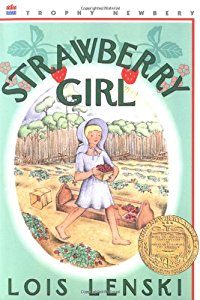
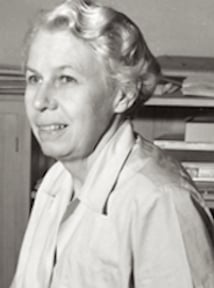
Lois Lenski (1893 – 1974) was an incredibly prolific author and illustrator of children’s books, many featuring regional themes. Children were often shown in terms of the work they did to help their families survive.
The series that put her on the map was the Regional Stories, which began with Bayou Suzette. Strawberry Girl (1945) was the second in the series, and the one for which Lenski is perhaps best remembered. She won the 1946 Newbery Medal for this book. Read More→
Lois Lenski (October 14, 1893 – September 11, 1974), American children’s book author and illustrator, was best known for realistic depictions of childhood in regional settings around the United States.
A Newbery Medal-winner, she secured a respected place in children’s literature for both her writing and art. She published nearly one hundred books in her career (as well as posthumously, starting with Skipping Village and Jack Horner’s Pie: A Book of Nursery Rhymes, both released in 1927.
Born in Springfield, Ohio, she was the daughter of a Lutheran minister, and with family, moved to a small village that was to be her home for the duration of her childhood. Growing up in this setting would eventually have a profound influence on her calling as a writer and illustrator. Read More→
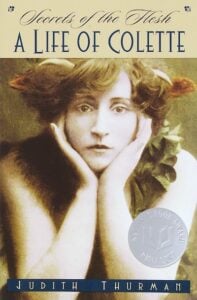
Secrets of the Flesh: A Life of Colette (1999) by Judith Thurman offers readers a thorough view of French author Colette‘s long and colorful life in this 600-plus-page biography.
Judith Thurman, author of the National Book Award-winning biography of Isak Dinesen produced what is considered a definitive English language biography of Colette.
Given the French author’s stature as a literary figure and feminist icon, along with her colorful life, this biography was welcomed and well-reviewed in such publications as The New York Times (which also excerpted the first chapter) and Salon.
Read More→
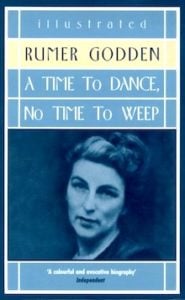
Rumer Godden (1907 – 1998) was a British-born author who spent much of her childhood in India. A Time to Dance, No Time to Weep (1987), which came out the year she turned eighty, was the first of a two-part memoir, followed by A House With Four Rooms (1989).
Her best-known novels, including Black Narcissus and In This House of Brede explore the religious life of nuns; many of her other novels, including The River, are set in India.
Godden lived a multifaceted life and wrote prolifically. Once, when Godden was a child, the Arabian pony she was riding bolted and threw her. The injuries she sustained included a concussion. But her father compelled her to get back on the horse as soon as she was able to, despite her fear. He told her: ”If you are frightened of anything, you must do it.” And that was exactly how she lived her life. Read More→
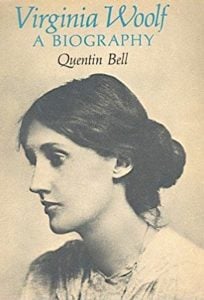
Quentin Bell (1910-1996), the author of Virginia Woolf: A Biography, was the son of Virginia Woolf’s sister, Vanessa Bell. He was an artist like his mother, working across several media, and like his father Clive Bell, he was a writer and art critic.
He once recalled: “Virginia Woolf was my aunt and as a child I illustrated and to some extent inspired some rather fanciful biographies of her friends and relations. Hence the fact that I am mentioned in the preface of Orlando as ‘an old and valued collaborator in fiction.’” Read More→
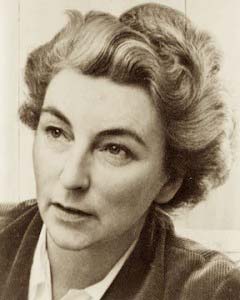
Margaret Rumer Godden (December 10, 1907 – November 8, 1998) was a novelist and memoirist born in Eastbourne, Sussex (England) and raised mainly in India at the height of colonial rule.
Her life was as dramatic and colorful as the stories she so skillfully wrote. Rumer Godden and her sisters spent an idyllic childhood in the Bengal region, now actually part of Bangladesh. (photo at right courtesy of Wikimedia Commons)
From an early age, she knew she wanted to be a writer. She was sent to Britain to be educated, as was the custom at the time, and traveled back and forth from England to India frequently. Read More→
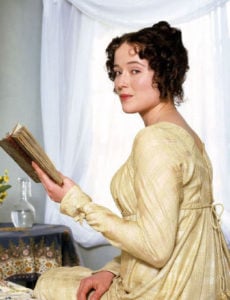
If you’re the kind of Jane Austen fan who reads Pride and Prejudice every year or two, chances are good that you’ve seen at least one of its miniseries or film adaptations.
Considering the unabated reverence for this novel, it’s somewhat surprising that there haven’t been more. For many devotees, there can never be Too Much Jane.
In addition to the miniseries and film adaptations of Pride and Prejudice listed here, there was also a 1967 British TV adaptation which seems to have been lost to time. Which of these have you seen? Which do you think is most faithful to the original spirit of the novel? Read More→
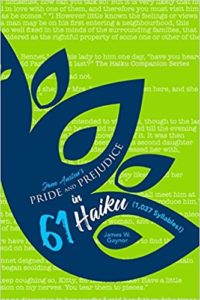
Contributed by James Gaynor, author of Jane Austen’s Pride and Prejudice in 61 Haiku (1,037 Syllables!): In my last post on this site, I shared three things I learned writing Pride and Prejudice in 61 Haiku (1,037 Syllables!) Shortly after that appeared, I was invited to Fordham University to talk to English Literature majors about my take on the poetry / intent of the 61 chapter-opening lines of Pride and & Prejudice.
I found the students particularly responded to my point about Austen’s use of “flutter” in the first line of Chapter 43. Read More→