Rereading Favorite Books from Childhood — Comfort Between Covers
By Taylor Jasmine | On February 11, 2026 | Updated June 15, 2026 | Comments (0)
Rereading favorite books from childhood as an adult is the literary equivalent of a warm bowl of comfort food or a soft blanket. Their nostalgic pull is undeniable, likely because the stories we wish to return to invoke a feeling of safety and predictability — the opposite of what adult life often feels like.
Here are seven such revisits, some focusing on single books, others on entire series. Let’s dive in with several by Literary Ladies Guide contributor Marcie McCauley, who is our resident expert on revisiting beloved children’s literature with an adult perspective.
These are followed by two others, one by Nancy Snyder and another by Jill Fuller. Here’s what’s ahead:
- The Ramona series by Beverly Cleary
- The Betsy-Tacy Books by Maud Hart Lovelace
- Tuck Everlasting by Natalie Babbitt
- Harriet the Spy by Louise Fitzhugh
- From the Mixed-Up Files of Mrs. Basil E. Frankweiler
by E.L. Konigsburg - Daddy-Long-Legs by Jean Webster
- A Wrinkle in Time by Madeleine L’Engle
- Little Women by Louisa May Alcott
How long has it been since you reread your favorite childhood book? Perhaps these musings will inspire you to pick one or two of them up again.
. . . . . . . . . . . .
Revisiting the Ramona series
by Beverly Cleary (1955 – 1999)
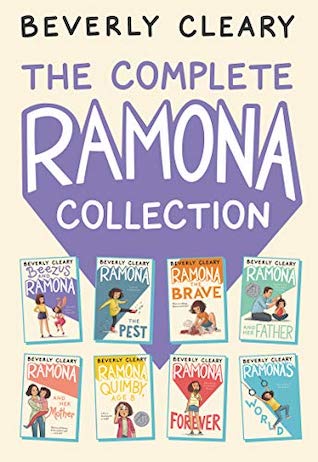
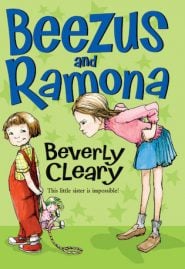
Marcie McCauley: “The sight of that smooth, faintly patterned cloth fills me with longing,” writes Beverly Cleary, recalling an early childhood memory of Thanksgiving. At first, a moment of calm for the young girl: anticipating relatives seated around the dining room table. Then, activity: she finds a bottle of blue ink, pours some out, presses her hands into it, then “all around the table I go, inking handprints on that smooth white cloth.”
You might guess that the lingering memory would be the moment of discovery. Instead: “All I recall is my satisfaction in marking with ink on that white surface.”
I also think of my fictional friend Ramona when I envision Beverly Bunn (the author’s pre-marriage name) sliding down the banister, trying to find the pot of gold at the end of the rainbow, pressing her nose against the barbershop window, yearning to look under the swinging doors of a saloon, feeling frustrated when the church ladies mistook her for a picture (a pitcher!) with big ears, and standing on the tilting seat of the fair’s Ferris Wheel.
The Ramona Quimby series kicked off in 1955 with Beezus and Ramona; the final entry in the series was Ramona’s World (1999.) Read the reset of Reading and Revisiting Beverly Cleary’s Ramona Quimby Stories.
. . . . . . . . . . . .
The Betsy-Tacy Books by
Maud Hart Lovelace (1940 – 1955)
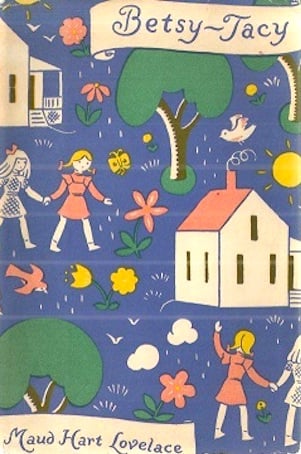
Marcie McCauley: Revisiting the Deep Valley novels by Maud Hart Lovelace (1892 – 1980) during the winter holiday season is a particular delight, though this American author’s stories can be enjoyed year-round.
Perhaps better known as the Betsy-Tacy books, the themes celebrated in these nostalgic novels for young readers are universal: friendship, devotion, love of home, ambition, and comfort. Though the novels were published in the 1940s, they take place in the early years of the twentieth century, when the author herself was growing up. (The first volume, Betsy-Tacy, begins in 1897, and the tenth, Betsy’s Wedding, takes place in 1917.)
The Betsy-Tacy books were based on her experiences growing up in Mankato, Minnesota. The Betsy-Tacy Companion by Sharla Scannell Whalen even contains a helpful chart that displays the names of the novels’ main characters alongside their real-life corollaries. But the enduring appeal of this series rests as much with their invented elements as their real-life, autobiographical links.
Read the rest of The Betsy-Tacy Books by Maud Hart Lovelace: An Appreciation.
. . . . . . . . . . .
On Rereading Tuck Everlasting
by Natalie Babbitt (1975)
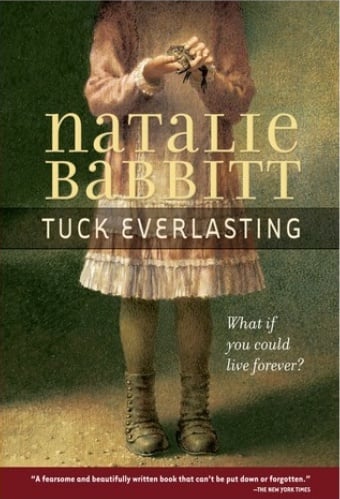
Marcie McCauley: When I first reread Tuck Everlasting, I was in my thirties. It was never one of my school texts: when I was a girl, it hadn’t yet achieved its iconic status. But the timing for me to rediscover this story, about how “dying’s part of the wheel, right there next to being born” was perfect.
Originally intended for middle grade children, this gracefully written story by Natalie Babbitt has resonated with readers of all ages. It explores the idea of eternal life, and its flip side, mortality. When 10-year-old Winnie Foster inadvertently comes upon the Tuck family, she learns that they became immortal when they drank from a spring on her family’s property.
They tell Winnie how they’ve watched life go by for decades, while they themselves never grow older. Winnie must decide if she’ll keep the Tucks’ secret, and whether she wants to join them on their immortal path. I had no idea that, when Tuck Everlasting was new, Michele Landsberg had heralded Babbitt’s exploration of death as “one of the most vivid and deeply felt passages in American children’s literature.”
Read the rest of Drinking from the Spring: On Rereading Tuck Everlasting by Natalie Babbitt.
. . . . . . . . . . .
Revisiting Louise Fitzhugh’s
Harriet the Spy (1964)

Marcie McCauley: Revisiting Louise Fitzhugh’s Harriet the Spy as an adult, I’m no longer convinced that Harriet and I would have been friends off the page. We would never have summered together in Water Mill, Long Island. We would never have had a sleepover on a Saturday night while her parents attended a white-tie-and-tails party.
On the page, however, we could be best friends. Like me, Harriet is “just so about a lot of things” and the only kind of sandwich in her world is a tomato sandwich. When she “didn’t have a notebook it was hard for her to think” and she gets a “funny hole somewhere above her stomach” when she loses the person in her life who knows her best.
And perhaps most importantly, when she plays Town, she plays so hard that even her friends are like characters in her life – impediments to and inspirations for – doing the work of telling stories. In that sense, Harriet and I have lived in the same Town from the moment we met, and, even still, that Town is a place I visit every day.
Read the rest of Playing Town: Revisiting Louise Fitzhugh’s Harriet the Spy.
. . . . . . . . . . .
Revisiting E.L. Konigsburg’s
Mixed-Up Files of Mrs. Basil E. Frankweiler (1968)
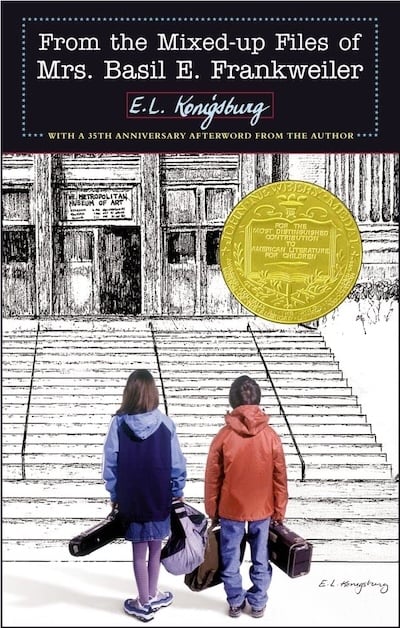
Marcie McCauley: E.L. Konigsburg summed up her stories as being about the “everyday, corn-flakes, worn-out-sneakers way of life” when she won the Newbery Award for her children’s novel From the Mixed-Up Files of Mrs. Basil E. Frankweiler in 1968. This prize-winning novel was a favorite of mine from the first reading—the first sentence, even — because it begins with Claudia’s failure.
She knows she’s never going to be able to run away in “the old-fashioned way”— in the “heat of anger with a knapsack on her back.” She reflects on her situation and makes a plan: she learns to rise to meet challenges in her own way.
… In her 2013 obituary in the New York Times, Paul Vitello writes that Konigsburg’s “upbringing in small-town Pennsylvania, where she did not have great expectations, helped her as a writer.” As a small-town girl who saw just enough of her childhood outside the city in Claudia, I was old enough to realize how Konigsburg had helped me as a writer too — by suggesting that real-world events from your everyday life could fill up a storybook. That they could be “enough.”
Read the rest of Overnight in the Museum: Revisiting E.L. Konigsburg’s Mixed-Up Files.
. . . . . . . . . . .
On Rereading Daddy-Long-Legs
by Jean Webster (1912)
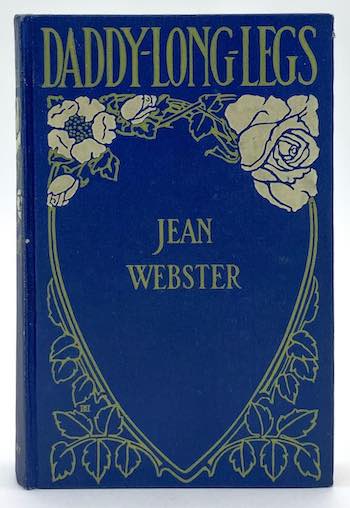
Marcie McCauley: The summer I was twelve, I pulled a well-read and worn book from the shelves of the public library and discovered a story that seemed to be told directly to me. Behind the deceptively dull cover of Daddy-Long-Legs by Jean Webster (1912) were letters and drawings that pulled me hard and fast into Judy Abbott’s life—an orphan at boarding school.
So many of my favorite things were combined in this book: orphans and lonely childhoods, girls succeeding against the odds with their studious natures, boarding school and class events, and perhaps most of all, the burgeoning writer’s sensibility that I also enjoyed in Louise Fitzhugh’s Harriet the Spy .
I borrowed and devoured Jean Webster’s Daddy-Long-Legs that very afternoon; I’ve revisited it many times. Judy’s orphan status reminded me of other favorite characters, from classics like Emily of New Moon (1923) by L.M. Montgomery, Ballet Shoes (1936) by Noel Streatfeild, and A Little Princess (1905) by Frances Hodgson Burnett.
Read the rest of Orphans and Boarding Schools: On Rereading Daddy-Long-Legs.
Another pair of grown-up revisits of childhood classics
. . . . . . . . . . .
On Rereading A Wrinkle in Time
by Madeleine L”Engle (1962)
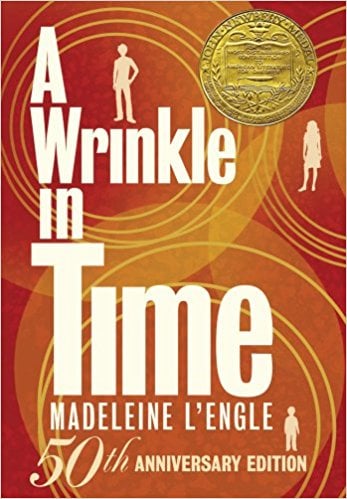
Nancy Snyder: I gave myself the best holiday present ever: rereading A Wrinkle in Time by our new Christmas tree. Rereading Madeleine L’Engle’s masterpiece was like visiting my oldest and dearest friend. A Wrinkle in Time is the book that ignited my reading obsession more than fifty years ago, and for that, I’m forever grateful.
… From my first reading decades ago to my most recent rereading, I have seen myself as Meg. I have stayed angry at the social and economic injustices that permeate our world, perceiving my anger as a necessary element to challenge and overcome such injustice.
Meg Murry is an incredible character. However, I also admire the skills of Calvin O’Keefe as a great communicator and an incredibly calm person. I also aspire to the great intelligence of Charles Wallace, but remember the warnings of Mrs. Whatsit. Charles’ magnificent mind may be accompanied by arrogance and pride, something we need to check ourselves of when we’re convinced our intelligence is infallible.
Read the rest of On Rereading A Wrinkle in Time: A Fifty-Year View.
. . . . . . . . . . .
Returning to Little Women by Louisa May Alcott
for Comfort and Guidance (1868)

Jill Fuller: I have always loved Little Women by Louisa May Alcott. There is no need for me to explain what it is about the writing and the characters that are so powerful and endearing, for I know that many, many readers have experienced it too. We laugh at Jo’s antics, feel Teddy’s heartbreak, and weep when Beth takes her last breath.
But with my most recent re-read of this classic, published in 1868 and beloved for generations, the book tugged at me a little bit more, pulled me in a little bit deeper, and spoke to me in a way it never had before … Perhaps it is because my husband and I read it out loud together. It’s amazing how much difference it makes to read with your voice, for it turns words from flat, two-dimensional blotches of ink into a conversation, a dream, a dramatic sigh.
The book took on a new life when I read it out loud, more real than before, more concrete, more alive. And sharing the reading experience together turned every evening into a literary date night. Now I will always have the memories of sharing Little Women (and all of the discussions and laughs and tears that accompanied it) with my husband.
Read the rest of Little Women: A Book I Come Back to for Comfort and Guidance.
Leave a Reply