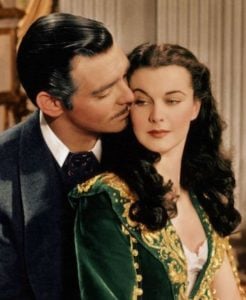
The story of the search for an actress to portray Scarlett O’Hara in the faithful 1939 film adaptation is excerpeted from The Story of Gone With the Wind by Bob Thomas, © 1967 Metro-Goldwyn-Mayer Inc. (National Publishers, Inc., NY).
“Scarlett O’Hara had an arresting face, pointed of chin, square of jaw. Her eyes were pale green, and above them her thick black brows slanted upward, cutting a startling oblique line in her magnolia-white skin …”
This search for an actress to portray Scarlett O’Hara in what was to become the 1939 film of Margaret Mitchell’s epic novel, Gone With the Wind, was born of necessity. Read More→
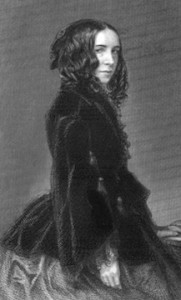
Elizabeth Barrett Browning (1806 – 1861), the English romantic poet, demonstrated an early aptitude for her future calling — she began reading novels at age six, and wrote her first significant poem at about age seven.
By age eleven, she wrote a four-volume poem, The Battle of Marathon (1820), privately published by her father.
At age fifteen, Elizabeth contracted the mysterious illness that would become her lifelong battle. It left her frail and in constant pain. It has been suggested by her biographers that the strong opiate medication given to her might have augmented her already fiercely vivid imagination that was evident in her evocative poetry. Read More→
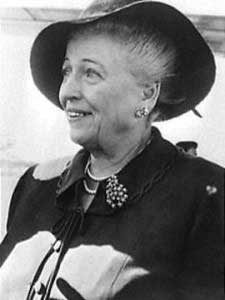
Pearl S. Buck (1892 – 1973) was the first American woman to win the Nobel Prize in Literature. As a child, she grew up in China, which influenced writings and world view. Always a humanitarian, ever a feminist, here are inspirational quotes by Pearl S. Buck for you to ponder and enjoy.
Pearl Buck started multiple foundations, including the East West Foundation, the Pearl S. Buck Foundation, and the Welcome House. (photo at right courtesy of Wikimedia Commons)
She received the Pulitzer Prize and Howells medal for her most widely read novel, The Good Earth. But it’s a disservice to readers to stop at this much-studied classic. See her incredibly prolific bibliography.
Read More→
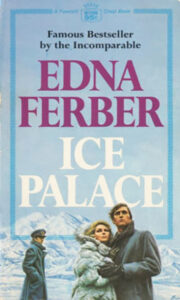
It’s always fascinating to come upon a review by one classic author of the work of another. In this case, Dorothy Parker’s review of Ice Palace by Edna Ferber (1957), one of her behemoth later novels, gets the acid-penned treatment.
Of the two authors, Parker is the one who has been more enduring; in their time, Ferber was one of the richest, most successful writers of the mid-twentieth century, something to which Parker hilariously eludes.
Keep in mind that when Ice Palace was published in 1957, Alaska was not yet a state (that would imminently happen in 1959). Read More→
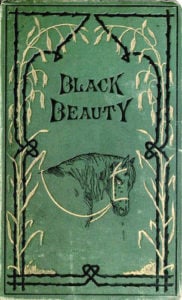
Anna Sewell (1820 – 1878) published only one book — Black Beauty — but what a book it was. At age 14, she fell while walking home from school and broke both of her ankles.
The treatment was shoddy, and she never fully recovered. For the remainder of her life she was unable to stand or walk for very long, and endured a great deal of pain.
Having become dependent on horse-drawn carriages to get around, Anna developed an empathy for the horses. Anna grew to love and care deeply about them, as well as that of all of animals. The treatment of horses she observed all around her was often less than humane. Read More→
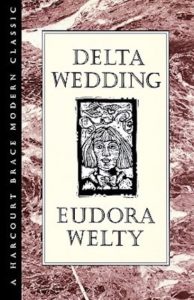
From the 1945 Harcourt, Brace, and World edition: In Delta Wedding, Eudora Welty brings into an immediate focus a memorable family, living in the rich Delta land Mississippi in the early 1920s.
“The day was the 10th of September, 1923 — afternoon. Laura McRaven, who was in nine years old, was on her first journey alone. She was going to visit her mother’s people, the Fairchild’s, at the plantation named Shellmound …”
Shellmound was the simple white house filled with the magnificent cousins, like a white bowl spilling over with bright flowers. Read More→
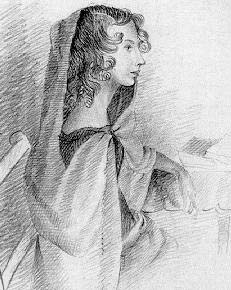
The Brontë sisters — Charlotte, Emily, and Anne — went through an arduous process in seeking publication for their first works — The Professor, Wuthering Heights, and Agnes Grey, respectively (The Professor was Charlotte’s first full novel, written before Jane Eyre, but published only after her death). Here’s the story of the Brontë sisters’ path to publication, steered by Charlotte’s unwavering persistence.
Before attempting to publish novels, Charlotte, who seemed to be the front person for the trio of sisters, undertook the task of finding a home for a collaborative book of poems. They took masculine, or at least indeterminate, noms de plume. Read More→
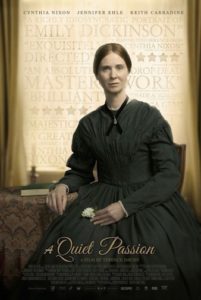
A Quiet Passion, the film biopic of beloved poet Emily Dickinson’s life was released in April of 2017 to nearly unanimous glowing reviews.
Directed by Terence Davies and starring Cynthia Nixon in the title role, here are snippets from the top reviewers — interestingly, more of the critics who fell in love with this film are men.
Viewers, especially true Emily Dickinson aficionados, have been much more divided, as you can see in the Amazon reviews. Some object to how she and her family are portrayed in the film, feeling that it took too many liberties. If you’re a literature lover, don’t miss this film — and decide where you stand. Read More→