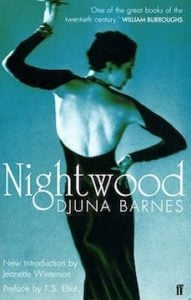
Nightwood is the best-known of the novels of Djuna Barnes, the American-born expat who spent much of her life among the lesbian circles in 1930s Paris. Published in 1936, it has long been considered her literary masterpiece, and is still regarded as one of the most influential works of modernist fiction.
This experimental novel explores the lives and loves of five eccentric and extraordinary people, and may be the first modern novel with a transgender character.
Nightwood was edited by T.S. Eliot. Barnes, then in her mid-40s, was still overwhelmed by the breakup with her lover, Thelma Wood. The novel follows the obsessive love affair of two women, which led to Barnes being called a “lesbian evangelist.” Despite the real-life parallel, Barnes despised and denied the label. Read More→
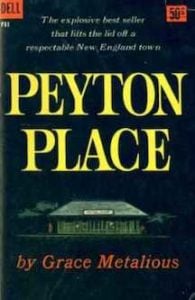
When Peyton Place by Grace Metalious was published in 1956, critics from coast to coast found the book scandalous. The book was vilified in the press and numerous attempted banned didn’t stop Americans from buying it in droves.
Canadians weren’t as lucky — it was banned countrywide.
A blockbuster bestseller, the novel by an unknown 34-year-old captured the public imagination. The fine yet somewhat sanitized film that was brought out following year (1957) cemented Peyton Place’s spot in the cultural conversation. The term “Peyton Place” quickly became synonymous with scandal and intrigue.
Read More→
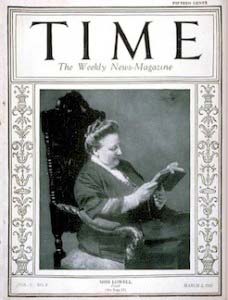
American imagist poet Amy Lowell (1874 – 1925) said of her works in vers libre (free verse) that its rhythms “have not been sufficiently plumbed, that there is in them a power of variation which has never yet been brought to the light of experiment.”
Expounding on her vers libre poetry, she wrote about this particular piece, “In ‘The Cremona Violin’ I have tried to give this flowing, changing rhythm to the parts in which the violin is being played.
The effect is farther heightened, because the rest of the poem is written in the seven line Chaucerian stanza.” This poem was originally part of Lowell’s collection titled Men, Women, and Ghosts (1916). Read More→
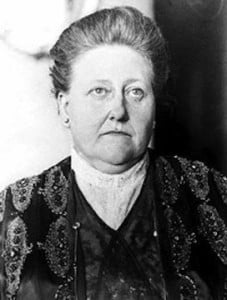
American poet Amy Lowell (1874 – 1925) was a master of imagist poetry. In an introduction to her “vers libre” poetry, she directs the reader of “A Roxbury Garden” to “find in the first two sections an attempt to give the circular movement of a hoop bowling along the ground, and the up and down, elliptical curve of a flying shuttlecock.”
This poem was originally part of a 1919 collection titled Men, Women, and Ghosts. Read More→
Prolific American poet Amy Lowell (1874 – 1925) was above all considered an Imagist, which in her definition was the “concentration is of the very essence of poetry” whose aim is to produce verses “that is hard and clear, never blurred nor indefinite.” Here are presented in her words, thoughts on her vers libre (free verse) poetry.
Lowell was kind of an evangelist of poetry, powered by her incredibly energy. She lectured tirelessly to promote poetry, and wrote ceaselessly — in addition to more than 650 poems, she wrote numerous essays, as well as works of criticism and translation. T.S. Eliot called her “the demon saleswoman of poetry.”
Here to shed more light on her work is the poet herself, from the Preface of Men, Women and Ghosts (1919): Read More→
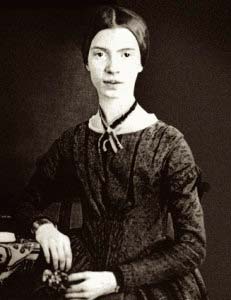
Emily Dickinson (December 10, 1830 – May 15, 1886) was a prolific American poet. Though she wrote some 1,800 poems, only a few were published during her lifetime. She is still something of a mystery, which fuels the continued fascination with her work and life.
“Tell all the truth but tell it slant —” is one of her famous lines, and the truths revealed in her poetic works are as individual as the person who reads them.
Dickinson grew up in Amherst, Massachusetts. She was born, lived, and died in the same house. While popular mythology has it that she rarely formed relationships with anyone outside her immediate family, this is not quite accurate. Read More→
Doris Lessing (1919 – 2013) was born in Persia, raised in Rhodesia and spent many years in London. Her first novel, The Grass is Singing, was published in 1950 and had a literary breakthrough with The Golden Notebook (1962), now considered a feminist classic.
When she won the Nobel Prize for Literature in 2007 the jury described her as “that epicist of the female experience, who with skepticism, fire and visionary power has subjected a divided civilization to scrutiny.” In 2008 The Times put her at number five in the list of “The 50 Greatest British Writers since 1945.”
Doris Lessing long used her platform as an outspoken opponent of apartheid in South Africa, and spoke regularly about the subject. Her brilliance runs through all her work; here are some quotes from her various works to prove the point. Read More→
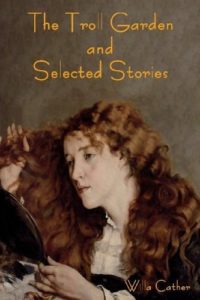
From the 1983 University of Nebraska edition of The Troll Garden by Willa Cather: Willa Cather’s first book of fiction, The Troll Garden (1905) is a collection of her earliest mature short stories. Well-crafted tales in their own right, they are important harbingers of her future novels and stories.
The precise language, profound psychological study, and finely honed plots that characterize her later work are prominent.
Some important themes are apparent here even more than in her later work: the conflict between East and West, art and the artistic temperament in America, the accommodations that the woman (or man) of sensibility must of does make with society and with idealism. The handling of these themes is as sophisticated and relevant today as ever. Read More→