Pregnancy in Classic Novels by Women Authors: A Transgressive Theme
By Nava Atlas | On March 3, 2022 | Updated October 8, 2025 | Comments (2)
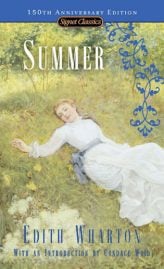
After reading a memoir of high-risk pregnancy by a friend (more about that ahead), I got to thinking about the prevalence of pregnancy in classic novels by women authors as a central theme.
Of course, there are many instances of female characters in novels (both by male and female authors) bearing a child or miscarrying, but pregnancy itself is rarely more than quickly touched upon.
Birth control methods were unreliable until relatively recently in human development; yet novels centering on pregnancy, other than the seduction and abandonment trope, aren’t all that common. Her First Time: Seduction and Loss of Innocence in 1920s Women’s Novels presents several classic titles in which the heroine becomes pregnant (usually outside of marriage), with various outcomes.
In a Guardian article titled “Why does literature ignore pregnancy?” Jessie Greengrass observed that while exploring pregnancy as a theme is more prevalent than it once was, it still seems transgressive:
“Women’s bodies can be many things. They can be mirrors, weights, rewards; but so often they are seen from outside. Experiences that are unique to them remain anomalous, smoothly impenetrable, like bubbles of water to which significance refuses to adhere. What could we possibly learn about being human from that which only happens to half of us?”
Even so, more contemporary novels than ever have presented the theme of pregnancy (sometimes in apocalyptic ways!) For more upbeat stories of pregnancy in fiction, one has to turn to romance novels. But I suppose there’s no drama in an uneventful pregnancy, is there?
. . . . . . . . . . .
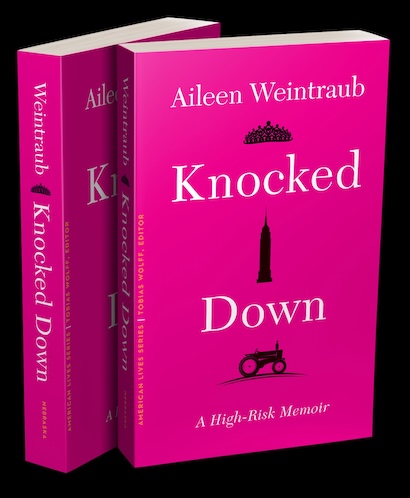
Knocked Down is available on Bookshop.org*
and wherever books are sold
. . . . . . . . . . .
That brings me back to the memoir by my friend and colleague, Aileen Weintraub. Knocked Down: A High-Risk Memoir, as the title implies, is about a high-risk pregnancy, but it’s much more than that. As I wrote in the blurb I provided for the book:
“Knocked Down poignantly and often hilariously reminds us that no one is exempt from life’s unexpected curveballs. Aileen Weintraub weaves her wry wisdom into this chronicle of how the choices we make can collide with circumstances beyond our control. This fast-paced memoir of a woman who is forced to slow down is proof positive that precarious situations can be overcome with family, faith, and especially love.”
In turns touching and funny, Knocked Down brought back memories of leaving NYC for the Hudson Valley, deciding to have babies after insisting that I didn’t want children, dealing with my Jewish Mother (and becoming one). It’s so much about what it means to be female — what we give up, what we gain.
It may not be a work of fiction, but Knocked Down was what sparked this train of thought about pregnancy as a theme in classic novels, a rabbit hole that was fascinating to go down. And now, on to the novels …
. . . . . . . . . . . .
Charlotte Temple by Susanna Rowson (1790)

Charlotte Temple by Susanna Rowson (1762 – 1824) was the best-known work by this American-British author. It was also America’s first best-selling novel. With its themes of seduction, abandonment and remorse, it sparked a great deal of controversy in its time. Yet it remained the most widely read novel of the first half of the nineteenth century.
The story is about the betrayal of Charlotte, who is just fifteen years old and a student in an English boarding school. She meets secretly with two British officers about to set sail for America to take part in the Revolutionary War.
The night before she is to return to her family home to celebrate her birthday, she is persuaded to go with the officer with whom she has fallen in love. He promises to marry her when they get to America. This promise, of course, is broken.
Laden with heavy moralizing, Charlotte is made to suffer and pay over and over for her unhappy adventure. In the end, she gives birth to a baby girl and dies of malnutrition. What’s even worse about this melodramatic plot is that Rowson claimed it was based on the true story of someone she knew. Read more about Charlotte Temple.
. . . . . . . . . .
Summer by Edith Wharton (1917)
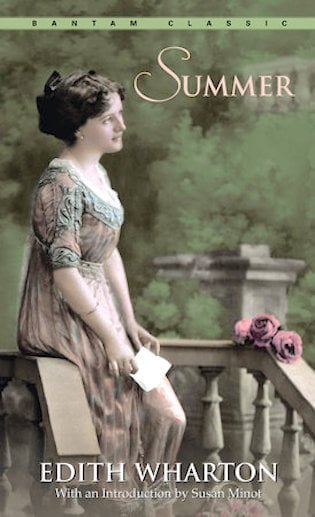
The novella Summer by Edith Wharton was one of this illustrious author’s personal favorites of her own works. She called it the “hot Ethan,” referring to her 1911 novella, Ethan Frome. It’s unclear if she was speaking of the book’s setting in the summer season, Charity’s sexual awakening, or both.
Charity, who was adopted by a small-town lawyer named Royall and his wife as a baby, continues to live with him after his wife passes away. He begins to look at Charity in a new light once she becomes a young woman (she is seventeen when the story begins), which deeply disgusts her. While working at the local library, she meets a young architect passing through. He seduces and abandons her, leaving her pregnant.
“Charity, till then, had been conscious only of a vague self-disgust and a frightening physical distress; now, all of a sudden, there came to her the grave surprise of motherhood.” Lawyer Royall, initially furious at the mess Charity finds herself in, becomes a comforting ally.
It has been rumored that Summer was banned from the library in Lenox, Massachusetts, where Edith had built her stately mansion, The Mount, when it came out in 1917. She had already moved to Europe by then. This turned out to be not quite accurate. According to The Mount’s website:
“Like many of Wharton’s works, Summer addresses issues such as premarital sex and abortion that remain contentious. Local newspapers initially reported that the Lenox Library refused to purchase it for being ‘a little tart in some of its picturings.’ However, a correction soon followed. “Edith Wharton’s new book, Summer, has not been excluded from the Lenox Library, simply, placed in a special department where it is not available to children.”
Read more about Summer.
. . . . . . . . . .
Bad Girl by Viña Delmar (1928)

Despite its provocative title, the forgotten bestselling 1928 novel, Bad Girl by Viña Delmar, centers on a humble heroine who is anything but. Dorothy, or “Dot,” as she’s familiarly called, has one instance of premarital sex, marries the guy (not a bad sort, but not very bright), and after a respectable period of time, becomes pregnant. She is all of seventeen when the novel begins.
There’s little that is scandalous about this middling novel (that was quite well reviewed in its time), but the realities of a young wife’s pregnancy and her experiences in a birthing hospital were enough to catch the eyes of The New England Watch and Ward Society, a New England-based organization whose mission was censorship of books and performing arts.
It’s hard to know if this censorship organization was more offended by her deliberations for or against having an abortion, which was quite dangerous and highly illegal at the time, or the pregnancy itself. The society was often cagey about what exactly they found offensive.
Being “banned in Boston,” as it was called, drove Bad Girl onto national bestseller lists and helped make its 23-year-old author an overnight sensation. The 1931 pre- Hayes Code film adaptation received great reviews, making the most of its thin material and breathing new life into the novel’s notoriety just a few years later. Read more about Bad Girl.
. . . . . . . . .
The Door of Life by Enid Bagnold (1938)
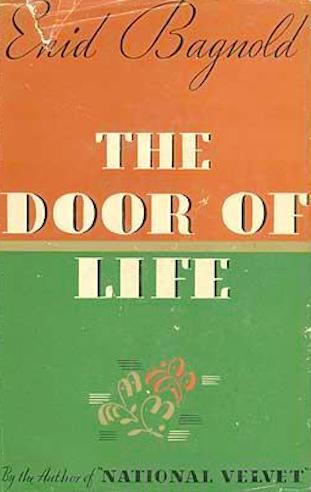
It’s surprising to discover that Enid Bagnold, the author best known for the classic horse story National Velvet, wrote what is considered one of the first novels centered on pregnancy and childbirth. Oddly titled The Squire when first published in England, it was recast asThe Door of Life for its American publication.
This semi-autobiographical novel is described as an almost meditative reading experience from the perspective of the expectant mother, who is soon to give birth to her fifth child. A 1938 review observed:
“Those to whom the act of giving birth to a new human is fraught with terror and dread will see here that it is possible for it to be a wonderful and moving experience. We have never before read of the birth of a baby where all anguish was removed and a deep, fundamental joy was put in its place.”
Even by today’s standards, that sounds so refreshingly positive! Read more about The Door of Life.
. . . . . . . . . .
The Tenth Month by Laura Z. Hobson (1970)

We’ll let the publisher of this 1970 novel about single motherhood describe it, since they did it so ably:
“In her first great best seller, Gentleman’s Agreement, Laura Z. Hobson dealt memorably with the prejudice of antisemitism. In The Tenth Month, Hobson deals with another kind of prejudice — one far more subtle, emotional, and pervasive — the prejudice that society is guilty of when it forces a single rigid code of morality on all human beings.
The Tenth Month is the story of Theodora Gray, a woman who has been told she can never have children, but now —after ten years of divorce and at the amiable end of one of her infrequent affairs —suddenly discovers that she is pregnant.
Dori Gray is not bothered by feelings of shame or self-reproach. She is delighted, and determined to have her baby. But another kind of dilemma poses itself: even before she is certain that she is pregnant, Dori falls in love with Matthew Poole, a lawyer who is married and a devoted father of two children.
Should she tell him she is pregnant by another man? If she tells him, how will he take it? Will Dori become another ‘problem case,’ or will Matthew’s strength and humanity prevail and let him respect the rightness of her decision to have her child?”
Laura Z. Hobson was a wonderful writer whose books deserve a fresh look. Read more about The Tenth Month.
*This is a Bookshop.org affiliate link. If a product is purchase after linking through, Literary Ladies Guide receives a modest commission.
This is a lovely article to read. I’ve been looking for books written by or about pregnant women and this is more like what I’m looking for. Thank you.
Thank you, Justine; I’m glad you found it helpful.