Ethan Frome by Edith Wharton (1911) is a somber tale indeed, but so beautifully told that many readers return to it again and again. An original review in the San Francisco Call from the year the book was published sketches the outline of the novella:
“Twenty years before the tale opens we learn that Ethan Frome has been crippled in a terrible accident … Ethan had his old parents to take care of and after their death he married the young woman who had helped him to nurse them … In a few years she needed assistance, so a young poor relation, Mattie Silver, came to live with them. Slowly she and Ethan fell in love. What happens next isn’t ‘happily ever after.’” Read More→
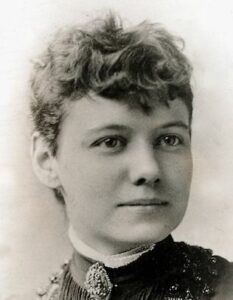
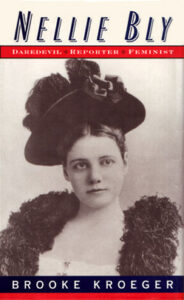
Excerpted from Nellie Bly: Daredevil, Reporter, Feminist by Brooke Kroeger, the most comprehensive biography to date on the pioneering investigative journalist, born Elizabeth Jane Cochran (she later spelled her name Cochrane) on May 5, 1864, in Cochran’s Mills, Pennsylvania:
Nellie Bly was one of the most rousing characters in the late nineteenth and early twentieth centuries. In the 1880s she pioneered the development of “detective” or “stunt” journalism, the acknowledged forerunner of full-scale investigative reporting.
While she was still in her early twenties, the example of her fearless success helped open the profession to coming generations of women journalists clamoring to write hard news. Read More→
From the Times Books description of Nellie Bly: Daredevil, Reporter, Feminist by Brooke Kroeger (1994): Nellie Bly was “the best reporter in America” according to the New York Evening Journal on the occasion of her death in 1922.
One of the most rousing characters of the late nineteenth and early twentieth centuries, Nellie Bly was a pioneer of investigative journalism.
She feigned insanity and got herself committed to a lunatic asylum to expose its horrid conditions. She circled the globe faster than any living or fictional soul. She designed, manufactured, and marketed the first successful steel barrel produced in the United States. Read More→
In the classic A Vindication of the Rights of Woman, Mary Wollstonecraft (1759 –1797) argued for equality of men and women — a revolutionary concept at the time.
Men and women, in her view, are born with ability to reason, and therefore power and influence should be equally available to all regardless of gender. This was a unique and radical view in 1792 when the book was first published.
A Vindication of the Rights of Woman: With Strictures on Political and Moral Subjects is considered one of the earliest works of feminist philosophical literature. Read More→
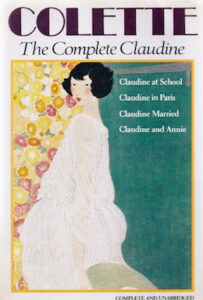
“My name is Claudine, I live in Montigny; I was born there in 1884; I shall probably not die there.” This iconic opening line from Claudine at School (Claudine à l´Ecole, first published in 1900) by French author Colette (Sidonie-Gabrielle Colette, 1873 – 1954) has become more familiar to English-speaking audiences thanks to the eponymous 2018 biopic.
In 1900, Colette began publishing the series of Claudine stories that defined the teenage girl of the era. In groundbreaking fashion, these books explored the sexual, mischievous, and independent side of a young woman coming of age. Read More→
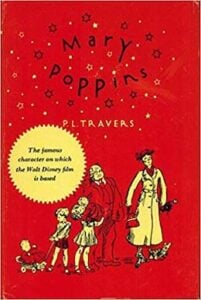
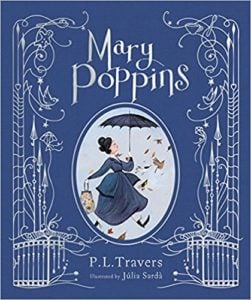
P.L.Travers (1899 – 1996) loved fairy tales and myths from childhood on, and no doubt reading them from childhood on fueled her imagination. Following is a selection of quotes from Mary Poppins and Mary Poppins Comes Back, two timeless children’s classics from the multi-volume series.
Her Mary Poppins series of books have entertained generations of readers, ever since the first volume was published in 1934. As one character in Mary Poppins Opens the Door says of the magical nanny, “She’s a fairy-tale come true.”
Mary Poppins was the basis of the beloved 1964 Disney musical film, which the famously testy author was none too happy with. Read More→
Mary Poppins, one of the best-loved characters in children’s literature, were inspired by stories that its author, P.L. (Pamela Lyndon) Travers made up while minding two young children. Here’s a rundown of the Mary Poppins books in the series.
Mary Poppins, the first book in the series, was published in 1934 to instant success and launched a series starring the magical nanny as the central character. In it, she’s blown to Number 17 Cherry Tree Lane, London by the East wind, and becomes part of the Banks family’s household.
There she takes charge of the children, changing their lives and that of their parents. The books, all illustrated by Mary Shepard, have been a mainstay of classic children’s literature from the time of their publication. Read More→
Flannery O’Connor (March 25, 1925 – August 3, 1964) was born Mary Flannery O’Connor in Savannah, Georgia. She was best known for her short stories — morally driven narratives populated with flawed characters sometimes described as grotesque.
O’Connor was viewed as a bit different by her fellow townspeople in Milledgeville, Georgia. She stood apart from the itinerant farm workers and country folk, becoming something of an observer. There was nothing she ever wanted to do other than write.
You may notice that some of her book covers feature peacocks, which is a nod to the fact that she helped raise the beautiful birds on her family’s farm.
Read More→