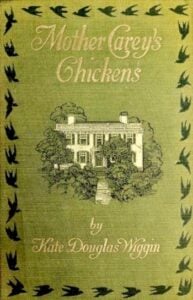
From the original review of Mother Carey’s Chickens by Kate Douglas Wiggin in the New York Times, September, 1911: Here is a tale of motherhood and childhood which will come close to the hearts of the multitudinous “common people” who are the salt and salvation of the American nation.
It is Mother Carey’s Chickens by Kate Douglas Wiggin. There is not a lord nor a villain in the story, nor a millionaire, nor a beggar. There is no study of society, nor any intrigues nor immorality. Read More→
Rebecca of Sunnybrook Farm by Kate Douglas Wiggin, published in 1903, is a classic American tale of an orphan girl coming into her own and finding her way in a world that’s indifferent to her plight.
Rebecca Rowena Randall comes to live with her two aunts in the fictional village of Riverboro, Maine. Rebecca’s spirit tries the patience of the more stern of her aunts but ultimately uplifts and inspires them. She faces many challenges, but along the way, learns from all of them on the road to young adulthood.
Rebecca of Sunnybrook Farm was a great success from the start. It was adapted for the the theater starting in 1910, and was filmed several times. The best-known film adaptation starred Shirley Temple (1938), with a plot rather freely altered from that of the book.
Read More→
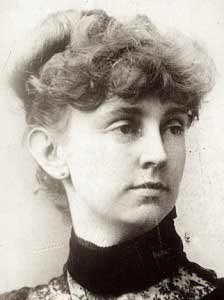
Kate Douglas Wiggin (September 28, 1856 – August 24, 1923) was an American author best known for children’s stories, particularly Rebecca of Sunnybrook Farm.
Wiggin was also active as an educator; aside from having founded the first kindergarten in San Francisco, she and her sister established a school for training kindergarten teachers.
Born in Philadelphia, she and her sister moved to Portland, Maine with their widowed mother. Her education was sporadic and didn’t include college, though this wasn’t unusual for girls in her era. Her mother’s second husband had a health condition that took the family to the warmer climate of the west coast, and she found her milieu in California.
Read More→
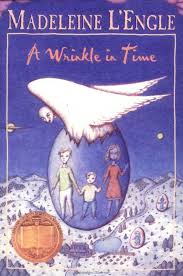
Madeleine L’Engle (1918 – 2007) was a prolific writer of fantasy and science fiction for young adults and children of all ages. A Wrinkle in Time and its sequels are perhaps her best-known works.
It may come as a surprise to those who cherish this series that she had quite a hard time finding a publisher for it. “A Wrinkle in Time was almost never published,” L’Engle later reflected. “You can’t name a major publisher who didn’t reject it. When we’d run through forty-odd publishers, my agent sent it back. We gave up.” Read More→
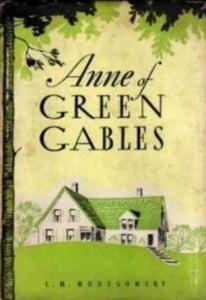
Like many authors battered by continual rejection of a manuscript, L.M. Montgomery gave up and placed the worn Anne of Green Gables manuscript in a hatbox and gave up. After it languished in a freezing attic for nearly a year, Maud, as she was known to her familiars, decided to give it one more shot, sending it to Boston publisher L.C. Page.
Serendipitously, there she had an ally—a Prince Edward Island expatriate named Miss Arbuckle. One of the company’s readers, she was enchanted with the novel’s romanticized Island setting.
Miss Arbuckle “quietly and persistently championed Anne to the other staff readers until several supported the novel,” according to Maria Rubio in Writing a Life: L.M. Montgomery.
Read More→
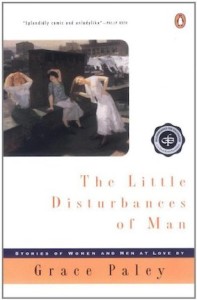
From the original review of The Little Disturbances of Man by Grace Paley in the Bridgeport Post Sun, April 1959: A collection of short stories is relatively unusual as a literary debut, but in the case of Grace Paley the choice was by and large justified.
Virtually all of these ten stories center around love and they are written in a style that is an odd mixture of matter of factness, subdued sentimentality, and hyperbole.
Love, the author seems to suggest most of the time, is really a pretty funny business, and the best way to approach it is to appear hardboiled, while hiding a smile up one’s emotional sleeve. Read More→
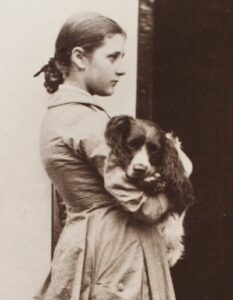
Just like the rest of us, famed writers loved their furry companions, amply illustrated by this roundup of classic women authors and their dogs.
Dogs, cats, and other companion animals (bunnies, domesticated birds, etc.) bring comfort and joy in good times and bad and can be good company whether the writing is flowing or comes with difficulty. At right, the young Beatrix Potter with her four-legged friend.
The unwavering love and devotion of dogs are much welcomed in a profession that can sometimes be lonely.
Read More→
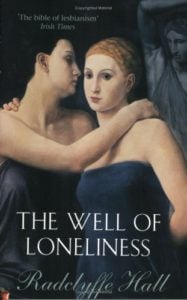
Radclyffe Hall (1880 – 1943) was a British author best known for her groundbreaking novel, The Well of Loneliness. It’s often described as the story of young woman’s coming to terms with her lesbian identity, but it’s more than that.
It’s also about a person born with a female body making sense of her maleness. It was certainly ahead of its time in expressing the concept of gender dysphoria without the vocabulary available today. Radclyffe Hall, in real life, wore male clothing, preferred to be called “John,” and wanted to be accepted by society as male.
Radclyffe Hall described herself as a “congenital invert,” a term that came from early 20th-century sexologist Richard von Krafft-Ebing and refers to a type of inborn gender reversal where women could be born with a masculine soul and vice versa — in contemporary terms, what is referred to as transgender. Read More→