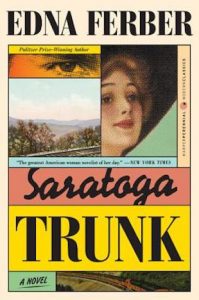
From the 1941 Doubleday, Doran edition: Edna Ferber’s distinguished novels of the American scene, Cimarron, Show Boat, So Big, and many others, she one special quality — they display at once he glamor and the strength of this country, and of the people who built it.
Saratoga Trunk is no exception. Its background, New Orleans and Saratoga in the eighteen eighties is one of the most picturesque America has produced.
But the theme behind the romance between Clint Maroon and Clio Dulling is that of the railroad builders, the men who flung across the land the roads of steel which united it, and toward that end were careless of the means they used. Read More→
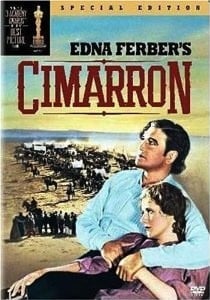
It’s surprising how many classic films are based on novels by women authors. One early example was Cimarron (1931), based on the 1929 novel by Edna Ferber, starring Richard Dix and Irene Dunne.
Centered on the story of the Oklahoma land rush that began in 1889, Cimarron was the first Western to have won Best Picture, and would be the last for nearly 60 years (until Dances with Wolves received the same honor). A true epic, the film was quite expensive to make and was more of a critical than commercial success. Here’s a small sampling of other notable films based on classic novels by women authors.
Read More→
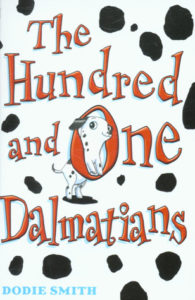
From the 1984 Viking edition of the 1956 novel for young readers, The 101 Dalmatians (originally published as The Hundred and One Dalmatians) by Dodie Smith:
Life was good for the Dalmatian couple Pongo and Missis. With the Dearlys to look after them, they lived in a comfortable home in London where they were able to start a remarkably large family.
Their fifteen beautifully spotted Dalmatian puppies became the talk of the town around Regent’s Park. But Cruella de Vil, a neighbor of the Dearlys, plans to cash in on these gems and their lovely coats! Read More→
Living in New York’s beautiful Hudson Valley gives me access to amazing array of day trips within a 2-hour radius, from the frenetic energy of New York City to the bucolic elegance of the Berkshires, where a group of culture-rich towns and villages are set amidst a modest mountain range in western Massachusetts.
As a semi-regular visitor to the Berkshires, one of my favorite places to visit is The Mount in Lenox, the stately mansion designed and built by Edith Wharton, who took possession of it in 1902.
Though she didn’t live here long — only ten years or so — it was in that interlude that she wrote her breakthrough first novel, The House of Mirth (1905) and the haunting classic, Ethan Frome (1911). Read More→
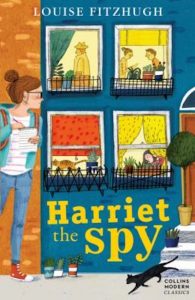
Harriet the Spy by Louise Fitzhugh, then an unknown author, burst on the scene as an instant classic when it was published in 1964.
The children’s novel, set in Manhattan’s upper east side, stars 11-year-old Harriet M. Welsch, who wants to be a famous writer when she grows up. To prepare, she keeps a notebook in which she records details of the world around her in minute detail.
Her observations of the people in her life are funny, poignant, and occasionally downright mean. When her sixth-grade classmates find her notebook and read its contents, Harriet’s world turns upside down. Read More→
Every year, as Halloween approaches, literary thoughts turn to Edgar Allen Poe, Bram Stoker, and Stephen King.
Roundups of classic haunting and thrilling stories that appear like clockwork in late October have been pretty male-dominated, even though women have been diving into the uncanny valley since the 19th century (see later in this post).
The following sampling of classic novels and stories by women (by no means exhaustive) will send shivers up your spine while giving your taste for great language a thrill.
Read More→
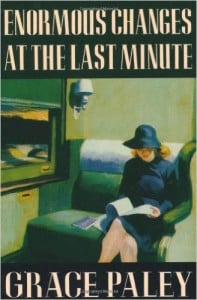
From the original review in the Indiana Gazette, April 1974. The seventeen short stories in Enormous Changes at the Last Minute, a collection by Grace Paley are not conventional ones, but for those interested in an impressionistic form of writing filled with lucid images and true dialogue, they are well worth the reading.
Miss Paley has chosen New York City to celebrate in her work, and it is her impressions of the many kinds of people who make up the city, as well as the city itself and the interplay between the two, which are distilled to make stories vivid.
As for the writing, it is often chatty, but never garrulous, saying exactly what the writer wants it to say and perhaps a little more to the reader who care to think about it a bit. Read More→
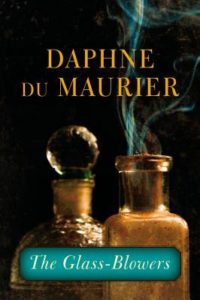
For The Glass-Blowers (1963), one of Daphne du Maurier’s later novels, the author drew upon her own family history. Her ancestor, Robert Busson du Maurier, who was in the glass business, escaped to London from France at the start of the French Revolution.
The story is through letters written by Sophie Duval, the sister of the fictional version of Robert (also so named). They follow the family trajectory from her mother’s marriage into the family of glass blowers in 1747 through Robert’s death in 1811.
Read More→