Adapted from the 1999 Little, Brown edition of An Unfinished Woman by Lillian Hellman: The plays of Lillian Hellman — The Little Foxes, Watch on the Rhine, The Autumn Garden, Toys in the Attic, and all the others — speak eloquently for themselves and for Miss Hellman’s life in the theatre. An Unfinished Woman speaks for her life in the world outside.
It is in no sense a predictable theatrical memoir. Instead, she offers a detailed, unsparing self-scrutiny and a passionate, sometimes comic, always candid account of her experience, whether in New York, New Orleans and Hollywood, in Spain during the Civil War, or in Moscow and Leningrad during the Second World War and twenty years later. Read More→
From the original review in the Daily Independent Journal, San Rafael CA, September 1967). In several respects, Those Who Walk Away by Patricia Highsmith is extraordinary. The scene is Venice.
The two protagonists are Ray Garrett, an American whose young wife has recently committed suicide, and his father-in-law, Ed Coleman, who blames his son-in-law bitterly for his daughter’s death.
It soon becomes apparent that Coleman’s embitterment has become a madness, and that he is determined to kill Garrett. This novel deals with the ensuing hunt. Read More→
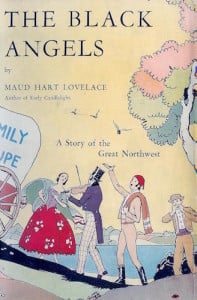
From the original review in The Oakland Tribune, Nov. 1926: In the eighties the theatre-loving world was on what might be termed a Pinafore jag. Light opera troupes, specializing in the presentation of the Gilbert and Sullivan musical hit, toured the land by the dozens. Some were good, many were bad, and a few were excellent.
The latter, however, never found their way back into the Middle West or back country sections, but the former did in scattered bands. And it is with this little known phase of early American middle western life that Maud Hart Lovelace deals in her novel The Black Angels. Read More→
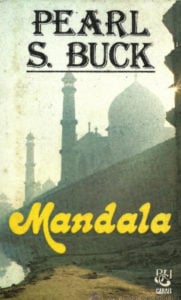
Mandala: A Novel of India by Pearl S. Buck (1970) is unusual among this author’s novels, which are most often set in China or the U.S. In this story, Maharana Prince Jagat and his wife, Moti, learn that that their only son, Jai, has been killed by the Chinese in a border dispute.
The distraught parents wish to bring their son’s spirit home. It’s an exploration of Eastern and Western thinking, how they overlap, and the ways in which they conflict. The plot weaves in the mysticism and mysteries of life in India in a time and place that was contemporary to when the author wrote this book.
Read More→
From an original review of the film, based on the 1950 book of the same title by Patricia Highsmith in The Bridgeport Post, July 1951:
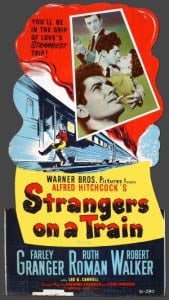
Warner Brothers presents Strangers on a Train, a screenplay by Raymond Chandler; from a novel by Patricia Highsmith. Starring Farley Granger, Ruth Roman, and Robert Walker. Directed by Alfred Hitchcock.
An offbeat story of murder, Strangers on a Train draws its appeal from the suspense it creates rather than from cold-blooded killing. The audience knows the slayer from the start, so interest is created through a series of tense situations and unexpected twists that keep the action moving toward the climax. Read More→
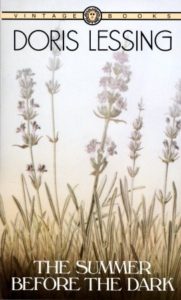
From the 1973 Alfred A. Knopf edition: As in The Golden Notebook, Doris Lessing is concerned with the situation of present-day women. In The Summer Before the Dark, her treatment of the emotional gulf that opens up before a forty-five year old woman no longer needed as a wife and mother is a starting point for much more — a confrontation with the threat of annihilation, the terrors alf old age and death.
Kate Brown is faced for the first time in twenty years with the prospect of being alone. Her children are grown; her husband, a successful neurologist, is off to America to work for some months in a hospital there.
Urged by him to take a job, she find herself acting as interpreter for an international conference on food, becoming substitute mother to all the delegates, flying off to Turkey for another conference, to Spain for an affair with a younger man — all the traditional outlets. Read More→
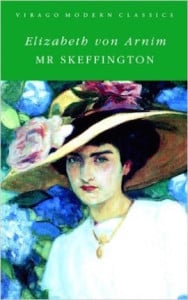
Elizabeth von Arnim’s 1940 novel (her last), Mr. Skeffington, tells the story of a woman’s rather desperate effort to grasp at her lost youth as she approaches the age of fifty. She has a hard time accepting middle age and yearns for the health and beauty she feels that she has been robbed of by the passage of time.
In a contrived plot, she encounters all the men whose hearts she broke in the bloom of youth. Spoiled, vain Fanny Trellis Skeffington, who had long since divorced her husband (Mr. Skeffington of the title), must come to terms with her life as it is, not as she wishes it to be.
This novel wasn’t as popular as the author’s debut novel, Elizabeth and Her German Garden (1898), nor as successful in literary terms as Vera (1922), it nonetheless became well known through its 1944 film adaptation. Elizabeth Von Arnim, who died in 1941, didn’t live to see this adaptation.
Read More→
In this site’s “Dear Literary Ladies” series, a challenge that’s universal to the writer’s life is playfully posed to a (departed) classic author. We find the “answer” in the author’s own writings about the subject.
Here’s what L.M. Montgomery, best known as the author of the Anne of Green Gables and Emily of New Moon series, has to say about something that most every writer experiences – rejection of their work.
Read More→