Zora Neale Hurston, Author of Their Eyes Were Watching God
By Nava Atlas | On March 20, 2018 | Updated February 16, 2026 | Comments (5)
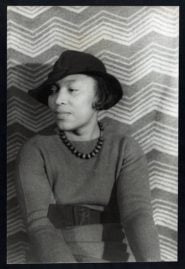
Zora Neale Hurston (January 7, 1891 – January 28, 1960), was a novelist, memoirist, and ethnographer best known for Their Eyes Were Watching God, her 1937 novel. (Photo at right by Carl Van Vechten.)
Her love of story would lead her not only to create her own, but to collect tales from the oral traditions of the African American South and the Black cultures of the Caribbean.
With her determined intelligence and irrepressible personality, she quickly became a big name in the Harlem Renaissance movement of the 1920s. She pursued a dual career as a writer (producing fiction, plays, and essays) and as an anthropologist.
Early life and education
Born in Notasulga, Alabama, she was the fifth of eight children. Zora’s parents moved to Eatonville, Florida in 1894, where her father became mayor. Growing up in this all-Black, self-sufficient small town in central Florida had a lasting impact on Zora as she came of age.
Her mother, a teacher died when she was only 13, which was devastating. Her father, a builder and preacher, remarried and she didn’t get along with her stepmother, causing a rift and forcing her to have to learn to fend for herself.
Some of her later stories took place in towns that resembled Eatonville. She described it as a town where Black people could live and work as they pleased — a very different scenario from other parts of the South.
. . . . . . . . . .

Zora as a student at Howard University
. . . . . . . . . .
Zora left Eatonville at age 14 for a rather itinerant life. She joined a traveling theater company, and earned money by working as a maid in the homes of white people.
One of her employers saw her talent and made it possible for her to attend high school in Baltimore. Though she was already twenty-six at the time, she claimed to be sixteen, and apparently it worked.
Shortly thereafter, in 1918, Zora began her college studies at Howard University in nearby Washington, D.C. There she studied philosophy and Black culture with Alain Locke, who was one of her first major influences.
While at Howard, Zora began writing and publishing her first short stories, drawing on her upbringing in Eatonville.
. . . . . . . . . .
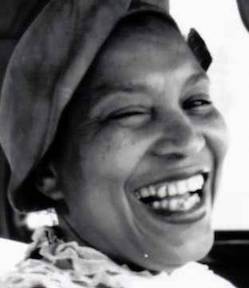
Quotes from “How it Feels to Be Colored Me”
. . . . . . . . . .
Harlem Renaissance
Zora moved to New York City in 1925, plunging into the fertile period of Black art, literature, and culture now referred to as the Harlem Renaissance (at the time, it was more commonly called The New Negro Movement).
Boisterous and outgoing, she met and befriended other talented writers, including Langston Hughes and Dorothy West.
She became an assistant to one of the most successful writers of the era, Fannie Hurst, who was Jewish. The two developed a deep, if sometimes complicated friendship. Zora’s reputation, of course, has far eclipsed Hurst’s.
Zora was an outspoken, outstanding figure in the movement. She displayed great style, loved to laugh, and had great pride in the Black race. Her work reflected her values, though beneath her joyous exterior, there was constant struggle — bad relationships, and never enough money.
Becoming an anthropologist
Zora was the first Black student at Barnard College, the women’s college connected with Columbia. There, starting in 1925, she studied with the noted anthropologist Franz Boas, who recognized her talent for storytelling and abiding interest in Black cultures of the American South and Caribbean. She was 37 when she graduated in 1928 with a B.A. in anthropology.
Zora’s writing and anthropological pursuits became intertwined as Boas urged her to pursue more research, something that she loved. A wealthy New Yorker named Charlotte Osgood Mason became Zora’s benefactress for a number of years, allowing her to travel through Florida and the Caribbean to collect stories to place among oral traditions.
In 1936, Zora received a Guggenheim fellowship, which allowed her to delve even more deeply into her research. She traveled to Jamaica and Haiti, with the grant, collecting stories and collecting material on African rituals and voodoo.
Her research resulted in two nonfiction collections about the culture and language of the peoples she researched — Mules and Men and Tell My Horse.
. . . . . . . . .
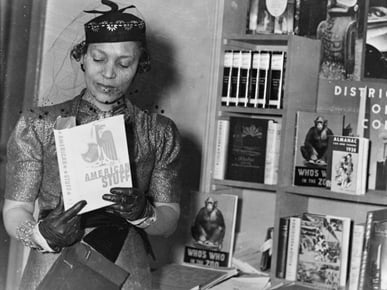
Zora’s famous essay, Crazy for This Democracy
. . . . . . . . . .
Jonah’s Gourd Vine & Their Eyes Were Watching God
Bertram Lippincott, the publisher, read Zora’s short story “The Gilded Six-Bits” in Story magazine in August 1933. He wrote her to ask whether she was working on a novel. She was not, but said she was, and buckled down to the task. The manuscript ofJonah’s Gourd Vine was sent to Lippincott by October of 1933 and was published the following May of 1934.
Jonah’s Gourd Vine, Zora’s first published novel, drew upon her own experiences. She set it in a Florida town with protagonists John Buddy Pearson and his wife Lucy, who may have been inspired by her own parents.
Zora also drew on her skill as a folklorist to tell the story. In a 1934 review in The Pittsburgh Courier, the eminent Black critic George Schuyler wrote of the book:
“Jonah’s Gourd Vine … is a first class novel by a brilliant young colored woman … this novel is a mine of folklore; a study of social life in the rural South, which the author knows so well … It is smoothly written, a finished piece of work, valuable alike as sociology and literature.”
Their Eyes Were Watching God (1937) is Zora’s most widely read work. It was produced in just a few weeks while she traveled in Haiti. It has become something of a feminist classic, with the heroine of the story, Janie, searching for independence, identity, and happiness over the course of twenty-five years and several relationships. This story is actually not unlike Zora’s own, though it could be argued that she never found true happiness.
. . . . . . . . . .
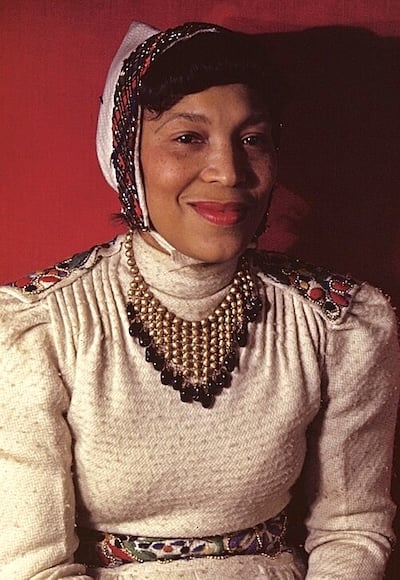
Zora Neale Hurston (1946), photo by Carl Van Vechten
(courtesy of Yale Library collection via Wikimedia Commons)
. . . . . . . . . .
Dust Tracks on a Road (1942)
Zora’s 1942 autobiography, Dust Tracks on a Road, has confounded readers and scholars since its publication, even as it has entertained and enthralled. Is it true memoir or partially apocryphal?
Was the story of her life, as she told it, impressionistic rather than realistic? We can only guess now, but it is still a wise, warm, and interesting read. In her Foreword to the 2006 edition, Maya Angelou wrote:
“Zora Neale Hurston chose to write her own version of life in Dust Tracks on a Road. Through her imagery one soon learns that the author was born to roam, to listen, and to tell a variety of stories. An active curiosity led her throughout the South, where she gathered up the feelings and sayings of her people as a fastidious farmer might gather eggs …
In this autobiography Hurston describes herself as obstinate, intelligent, and pugnacious. The story she tells of her life could never have been told believably by a non-Black American, and the details even in her own hands and words offer enough confusions, contusions, and contradictions to confound even the most sympathetic researcher.”
. . . . . . . . . .
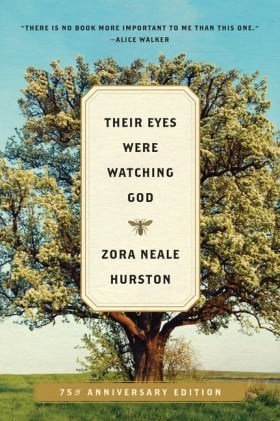
Zora’s best-known work: Their Eyes Were Watching God
. . . . . . . . . .
A life in decline and a sad death
In the course of her lifetime, Zora’s reputation began to decline. Though her books sold fairly well, and had many admirers, they had their equal share of detractors. Some Black writers objected to her use of dialect. Other contemporaries were troubled by her political conservatism.
By 1950, she returned to her home state of Florida. Though she continued to write, it became increasingly difficult for her to earn a living through writing.
She worked as a teacher, librarian, and finally, she returned full circle to working as maid. When found out by the media, Zora claimed that she was doing so because she needed a break from writing, and that she was doing “research” for a magazine she was planning aimed at domestics. Neither was entirely true; she simply needed to make money to live.
Beset by financial and health trouble, she lived her last years in poverty and relative obscurity. Though contrary to popular myth, she wasn’t entirely forgotten. In 1960, Zora Neale Hurston died of a stroke at age 69 while living in a nursing home.
Robert E. Hemenway, Zora’s primary literary biographer, encapsulated her life and decline in Zora Neale Hurston: A Literary Biography (1977):
“She was flamboyant and yet vulnerable, self-centered and yet kind, a Republican conservative and yet an early Black nationalist. Her personality could seem a series of opposites and her friends were often incapable of reconciling the polarities of her personal style. Aware of this, she came to delight in the chaos she sometimes left behind.
An unmarked grave is a romantic, poignant resting place, but it represents a human tragedy. Zora Neale Hurston was a nine tragic person, a woman who rejoiced in print about the beauty of being Black. When her blues came, she retreated into a privacy that protected her sense of self; publicly she avoided confrontation by announcing that she didn’t look at a persons color, only one’s worth.
She personally believed in an integrated society, but she spent her career trying to preserve and celebrate Black cultural practices. For her particular Black experience, butter career witnesses for contemporary Black authors.
Why did such a writer end up living on food vouchers from the state of Florida? Why did her body lie in wait for subscriptions to pay for a funeral? The answers are as complicated as her art, as paradoxical as her person, as simple is the fact that she lived in a country it fails to honor its Black artists.”
. . . . . . . . .

Zora in her later years
Photo courtesy of NYPL digital collection
. . . . . . . . .
Rediscovering and reviving a great talent
More than a decade after Zora’s death, her work was rediscovered and finally appreciated for its integrity and depth. The author Alice Walker played a great part in reviving Hurston’s reputation. It was a few years after Zora’s death that Walker read Their Eyes Were Watching God, which set her on the path of researching Zora Neale Hurston’s life and work.
In 1973, Walker placed a marker at the spot where Zora is believed to be buried. On the stone is written, “Zora Neale Hurston, A Genius of the South.”
In the essay “In Search of Zora Neale Hurston” (first published in Ms. magazine in 1975, later titled “Looking for Zora”) Alice Walker explored Hurston’s hometown of Eatonville, Florida, and came to understand that it was immensely influential to her works.
Zora’s books are now studied and appreciated far more than during her lifetime, having become staples of American literature and women’s studies courses. Of her many works,Their Eyes Were Watching God is arguably the most widely read and studied classic, and a masterpiece of that era of literature.
A last word on Zora’s final years, and resurgence, from Zora Neale Hurston: A Life in Letters, collected and edited by Carla Kaplan (2002):
“Although everything she wrote was out of print when she died, Hurston is no longer forgotten . . . Hurston is now among the most widely read and widely taught American authors. There are more than a million copies in print of her 1937 novel, Their Eyes Were Watching God. Numerous plays, documentaries, and educational short films are devoted to her life and work.
Her face appears on posters, coffee mugs, bookmarks, and calendars. She is at the center of literary study through conferences, seminars, graduate and undergraduate classes, anthologies, dissertations, critical articles, books, bibliographies, reading guides, textbooks for children, Hurston societies, and an annual festival in her hometown of Eatonville on the anniversary of her death. Hurston has become a model for many scholars and writers . . .”
. . . . . . . . . .
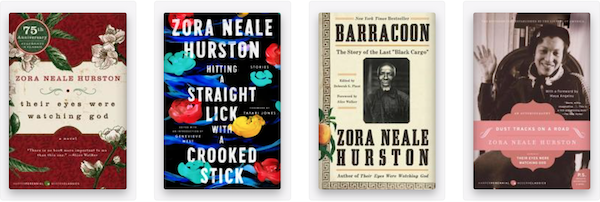
More about Zora Neale Hurston
On this site
- Dear Literary Ladies: Do I have enough wisdom to be a good writer?
- Zora and Me: How I Found Myself by Discovering Zora Neale Hurston
- Quotes and Life Lessons
- What White Publishers Won’t Print
- Crazy for This Democracy
- Fannie Hurst & Zora Neale Hurston, a Literary Friendship
- Zora Neale Hurston Interview (1934)
- Full text of “How it Feels to Be Colored Me”
- 5 Quotes from “How it Feels to Be Colored Me”
- 10 Fascinating Facts About Zora
- Books, Publishing, & Publishers
- Quotes from Their Eyes Were Watching God
- Books by Zora Neale Hurston: Fiction, Folklore, and More
- How Alice Walker Rediscovered Zora Neale Hurston
- The Literary Friendship of Marjorie Kinnan Rawlings & Zora Neale Hurston
Major works
Novels, nonfiction, and folk narratives
- Jonah’s Gourd Vine (1934)
- Mules and Men (1935)
- Their Eyes Were Watching God (1937)
- Tell My Horse: Voodoo and Life in Haiti and Jamaica (1938)
- Moses, Man of the Mountain (1939)
- Seraph on the Suwanee (1948)
- Every Tongue Got to Confess (2001, posthumous collection)
- The Complete Stories (1995)
- Barracoon: The Story of the Last “Black Cargo” (2018, posthumous)
- Hitting a Straight Lick with a Crooked Stick (stories, 2020, posthumous)
Short Stories
Some of Zora’s short stories have become well known and are still read and studied. Link to the full text of the following on this site:
- “John Redding Goes to Sea” (full text; 1921)
- “Spunk” (full text; 1925)
- “Sweat” (full text; 1926 and an analysis here)
- “The Gilded Six-Bits” (full text; 1933; and an analysis here)
Plays
Zora’s plays are far less known than her fiction and nonfiction works, mainly because most remain unpublished and unproduced. Still, they reveal another aspect of her talent and ambition. Most of the following plays can be accessed at the Collection of Zora Neale Hurston Plays at the Library of Congress:
- Meet the Mamma: A Musical Play in Three Acts (1925)
- Color Struck (1925)
- Cold Keener, a Revue (1930)
- De Turkey and de Law: A Comedy in Three Acts (1930)
- Mule Bone: A Comedy of Negro Life in Three Acts (1931; co-written with Langston Hughes)
- Forty Yards (1931)
- Lawing and Jawing (1931)
- Poker! (1931)
- Woofing (1931)
- Spunk (1935)
- Polk County: A Comedy of Negro Life on a Sawmill Camp
with Authentic Negro Music in Three Acts (1944)
Poems
- “Journey’s End”
- “Night”
- “Passion”
Biographies
- Dust Tracks on a Road: An Autobiography by Zora Neale Hurston (1942)
- I Love Myself When I Am Laughing … A Zora Neale Hurston Reader (Alice Walker, ed.; 1979)
- Zora Neale Hurston: A Literary Biography by Robert E. Hemenway (1977)
- Wrapped in Rainbows: The Life of Zora Neale Hurston by Valerie Boyd (2004)
- Zora Neale Hurston’s Finale Decade by Virginia Lynn Moylan (2011)
More Information and sources
- Zora Neale Hurston official site
- The Zora Neale Hurston syllabus project
- Wikipedia
- Reader discussion of ZNH’s books on Goodreads
- Zora on National Women’s History Museum
Nava, thank you for this post. It is very enlightening, and I had not seen some of these photos.
You’re very welcome, Robert. Zora is a writer to be remembered, honored, and above all, read!
Thank you for your comment and interest in looking me up. The website link after my comment above will reveal my art work, as it and my covers are my work. The parchment motif on the covers is not mine. Three of the covers are illustrated by our daughter, a professional painter and illustrator. She did the art for, ALL THE SCATTERED PIECES, EAST & WEST FROM TEXAS, and THOSE WHO TRESPASS. The image on …Scattered Pieces is her self portrait and …Trespass is Sunset Beach in Hawai’i. Others agree with you about THE STREET and THE NARROWS. Your endorsement of both writers further encourages me to get started on THE STREET. Since I had met a young Navajo/Aleut woman who looked like my Filipino wife and noticed the similarity between many Navajo women and Filipinas, I used a modified portrait of Maria for my signature heroine of several of the novels, Jóhonaá (Sunny) or Jóhonaá’éí.
I just received Library of America copies of Hurston’s three most important novels and Ann Petry’s two. I want to see how these two women in that era express themselves and describe their views and feelings and those of other African Americans at the time.
This is to help with my latest heroine in a World War II novel. Each author adds a perspective I need: Hurston, poorer Southern Black family; Petry, affluent Black family background. And both add the female perspective. All my novels have mixed couples in equal relationships in eras where whites and men had some level of dominance, just not in my couples’ relationships.
Historically, there were such couples. In previous books, though the hero is equally capable, the female protagonist sometimes becomes the main character, at least slightly. Often the native of the locale of the book (Philippines, American West, etc.) she has the greater knowledge and experience. I’m excited to start reading these two great writers’ books.
Robert, thank you for your thoughtful comment. I looked you up on Amazon and your books look fascinating. I wonder if you do the cover art for them as well. I love both Zora and Ann Petry. I recently re-read Their Eyes Were Watching God and have read a number of her essays, but I’d like to read more of her longer works. As for Ann Petry, The Street absolutely blew me away. However, The Narrows didn’t grip me as much.
In any case, these are two important writers, and while Zora has certainly been getting more of her due, I hope more people will rediscover Ann Petry as well. Good luck with your latest novel!