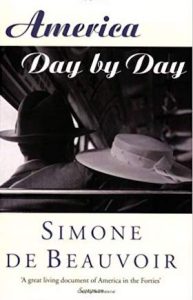
In January of 1947, Simone de Beauvoir, existentialist philosopher, novelist, and author of feminist classic The Second Sex, landed at La Guardia airport. From there she embarked on a months-long journey from one end of the U.S. to the other.
Immersing herself in American culture, customs, and vistas, she kept a detailed diary that was published in France in 1948. It was first published in an American edition in 1954.
The University of California Press published a more recent edition in 1999, describing it as “one of the most intimate, warm, and compulsively readable texts from the great writer’s pen.” The publisher’s description continued: Read More→
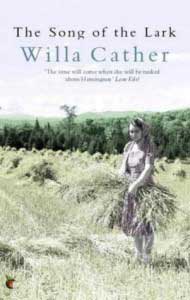
The Song of the Lark by Willa Cather, published in 1915, was the third of her twelve novels. It traces the artistic development of Thea Kronberg from Moonstone, her hometown in the desert of Colorado, to the stage of New York’s Metropolitan Opera House.
Thea Kronborg has a dream of becoming a world-class singer. Born into the family of a Swedish Methodist minister in the Colorado village of moonstone, she has a beautiful voice, a driving ambition, and an innate sense of what is true and fine. She sees the surroundings in which she is growing up in as cheap and tawdry, though it’s a part of the booming American West. Read More→
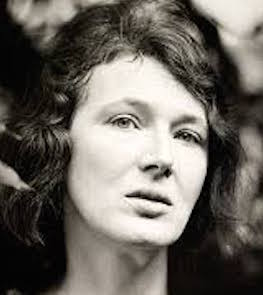
Angela Carter (May 7, 1940– February 16, 1992), born Angela Olive Stalker, was an English novelist, short story writer, and journalist. Born in Eastbourne, England, she is considered one of Britain’s most original writers for her eclectic range of themes and genres.
Her varied influences included fairy tales, gothic fantasy, Shakespeare, Surrealism, and the cinema of Godard and Fellini. Her work breaks taboo, often being labeled provocative. She was also a strong believer in women having control over their own narrative.
Carter is perhaps best known for The Bloody Chamber (1979), a sort of re-envisioned imagining of the classic European fairy tales.
Read More→
Angela Carter (1940 – 1992), born Angela Olive Stalker, was an English novelist, short story writer, and journalist. Known as one of Britain’s most original writers, she was best known for her eclectic range of themes and influences. Her work breaks taboo, often being labeled provocative.
Carter was a strong believer in women having control over their own narrative. Most famous for her 1979 collection, The Bloody Chamber, a re-envisioned version of the classic European fairy tales, she went on to publish dozens of books. Here are memorable quotes by Angela Carter from her novels and other literary works:
Read More→
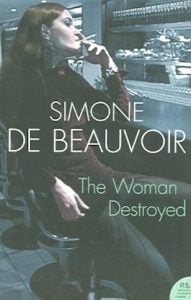
The Woman Destroyed by Simone de Beauvoir (1908 – 1986) published first in French in 1967 as La Femme Rompue, presents a trio of novellas (or, one could argue, long short stories).
The French author, existential philosopher, political activist, and feminist has remained best known for The Second Sex (1949). But de Beauvoir also put her social theories, especially those pertaining to affairs of the heart, into several works of fiction.
Upon the book’s 1969 publication in English, The Sunday Herald Times (London) wrote: “In three immensely intelligent stories about the decay of passion, Simone de Beauvoir draws us into the lives of three women, all past their first youth, all facing unexpected crises … suffused with de Beauvoir’s remarkable insights into women, The Woman Destroyed gives us a legendary writer at her best.” Read More→
Julia de Burgos, born Julia Constanza Burgos Garcia (February 17, 1914 – July 6, 1953), was a Puerto Rican poet and civil rights activist for women and African/Afro-Caribbean writers.
She was also an advocate for Puerto Rican independence and served as Secretary General of the Daughters of Freedom, the women’s branch of the Puerto Rican Nationalist Party.
Julia was born and raised in Santa Cruz, a poor area of Carolina, Puerto Rico where her father owned a farm in addition to working as a member of the Puerto Rican National Guard. Read More→
Though Jane Eyre was Charlotte Brontë‘s first published novel, The Professor was actually the first novel she completed. It wasn’t published until 1857, two years after her death, with her literary reputation secured.
The resounding failure of a book of poems she produced with sisters Emily and Anne in 1846 didn’t stop Charlotte from spearheading an effort to find a publisher for the novels that they had been working on.
They continued to use the assumed quasi-masculine names that appeared on their book of poetry, styling themselves Currer (Charlotte), Ellis (Emily), and Acton (Anne), all surnamed Bell.
Read More→
Anne Brontë (January 17, 1820 – May 28, 1849) was a British author born in Thornton, West Yorkshire, the daughter of Patrick Brontë, a clergyman, and Maria Branwell.
She followed in her older sisters’ (Charlotte and Emily Brontë) paths by delving into the literary world as a novelist and poet.
Along with her sisters and brother Branwell, Anne grew up in Haworth, an isolated town on the moors of Yorkshire. She was one of six siblings raised by her father after the death of their mother. Read More→