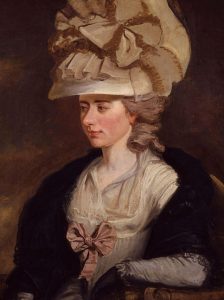
Fanny Burney, the British novelist and playwright best remembered for her first novel, Evelina (1778) was also an immensely prolific diarist. This introduction to the journals of Fanny Burney is excerpted from Killing the Angel: Early British Transgressive Women Writers ©2021 by Francis Booth. Reprinted by permission.
It has been argued that the diary is essentially a feminine form of writing; certainly, at one time writing a diary was far more likely to be done by a woman of a certain class than by a man.
Diaries are written for an audience of one though Fanny (Frances) Burney (1752 – 1840), later a wildly successful novelist, wrote in the first pages of her diary in 1768 that hers was for an audience of none. Her JUVENILE JOURNAL: ADDRESSED TO A CERTAIN MISS NOBODY, sets out to be: Read More→
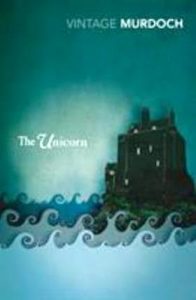
This musing on women’s spiritual journeys inspired by the sea is excerpted from the essay “Women Who Swim” by Evan Atlas. Featuring the iconic real-life swimmer Gertrude (Trudy) Ederle, it moves into parallels with Marian Taylor in The Unicorn by Iris Murdoch and Edna Pontellier in The Awakening by Kate Chopin:
The sea appears as this powerful source of perfection and self-transcendence in The Unicorn by Iris Murdoch (1987), whose character, Marian, is the subject of a sea-inspired spiritual journey. She arrives in an unfamiliar setting, immediately noticing that something is off: Read More→
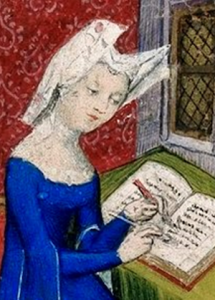
Christine de Pizan (1364 – 1430) the French writer, is best known for her seminal work of literature by, about, and in support of women, Le Livre de la Cité des Dames (1405).
Now known as The Book of the City of Ladies, it was first translated into English as The Boke of the Cyte of Ladyes and published in London in 1521, “in Paul’s churchyard at the sign of the Trinity by Henry Pepwell.”
This introduction to Christine de Pizan and The Book of the City of Ladies is excerpted fromKilling the Angel: Early Transgressive British Woman Writers by Francis Booth ©2021, reprinted by permission. Read More→
When I was a girl, the only parts of grown-ups’ movies that I enjoyed were the parts with children in them. So, the first few times I watched the Rodgers and Hammerstein musical (based on the 1944 book Anna and the King of Siam by Margaret Landon) The King and I, only “The March of the Royal Siamese Children” appealed to me.
As an only child, families with more than one child seemed remarkable; the seemingly endless stream of offspring, parading through the court in this colorful musical number, fascinated me.
And I was oblivious to the number of grown women—the mothers—also in attendance, felt no compulsion to multiply by nine, or to muse on multiple conceptions. Read More→
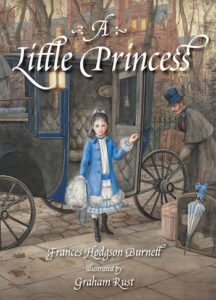
Frances Hodgson Burnett (1849–1924) was a poet, playwright, and children’s book author. She penned more than forty novels, plays, and dozens of poems and short stories throughout her lifetime. A Little Princess has endured as a timeless tale.
Beloved and quite successful in her time, she’s now primarily remembered as the author of A Little Princess as well as The Secret Garden and Little Lord Fauntleroy. Her prolific output went far beyond these now-classic stories for children of all ages, including books for adults as well.
The story of A Little Princess follows a young girl with a vivid imagination as she faces abandonment at a posh boarding school in London with a cruel headmistress. Read More→
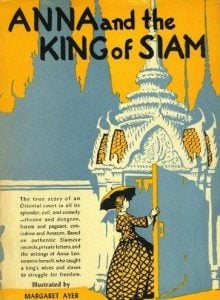
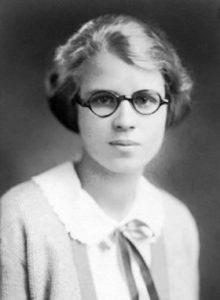
Famed for Anna and the King of Siam (1944), which inspired a variety of adaptations, including the musical “The King and I,” American writer Margaret Landon (September 7, 1903 – December 4, 1993) spent more than a decade studying Siam (now Thailand) and a lifetime writing about it.
Anna and the King of Siam was Margaret Landon’s crowning achievement. It sold over one million copies and has been translated into more than twenty languages.
Based on the true story of Anna Leonowens, who served as governess to the King Mongkut, in the 19th century, it introduced Western readers to a world of Asian culture. Read More→
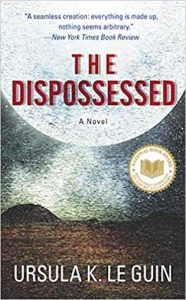
Ursula K. Le Guin is one of the most influential science fiction and fantasy writers of the twentieth century. Her 1974 novel, The Dispossessed, was written as a political tale, with themes that include freedom and the corruption of capitalist societies. It won the Hugo, Nebula, and Locus awards in 1975.
Le Guin uses her novel as a moral principle of anarchism based on political theories and ideas of collective societies to challenge modes of radical thinking. Discussing these philosophies will determine if she was successful in delivering a convincing narrative that overcomes conflicting notions of a perfect society Read More→
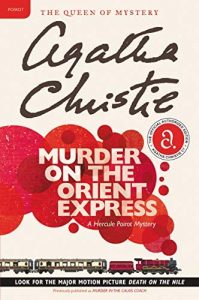
Agatha Christie (1890–1976) is the most widely published and bestselling author of all time. She authored sixty-six crime novels and short story collections, fourteen plays, and more. Murder on the Orient Express, an intricate tale of crime and intrigue, is one of Christie’s most iconic novels featuring the illustrious Belgian detective Hercule Poirot.
Murder on the Orient Express was first published in the United Kingdom in 1934, and soon after in the United States, retitled Murder on the Calais Coach. Christie drew inspiration for the plot from recent headlines.
Around the time when Murder on the Orient Express was published, the murder of Charles Lindbergh’s son had yet to be solved. This real-life mystery, coupled with Christie’s first journey on the Orient Express in 1928, inspired the iconic detective story. Read More→