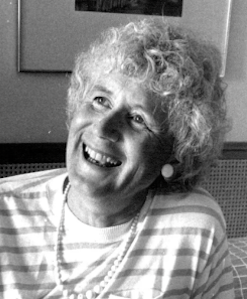
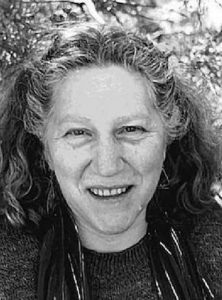
Jan Morris (October 2, 1926 – November 20, 2020), the historian and travel writer, was born and mostly raised in England, but identified as Welsh. Renowned for the Pax Britannica trilogy, a history of the British Empire, she was also esteemed for her intimate and insightful portraits of several great cities of the world.
Jan published under her birth name, James, before completing her transition to female in 1972. She was one of the first public figures to come out openly as transgender, making her a pioneer to the generations of trans writers (and others) who came after her.
This introduction to the ideas and accomplishments of Jan Morris is excerpted from Mightier Than the Sword; Rebels, Reformers, and Revolutionaries Who Changed the World Through Writing by Rochelle Melander, illustrated by Melina Ontiveros. Copyright © 2021 Beaming Books. Reproduced by permission. Read More→
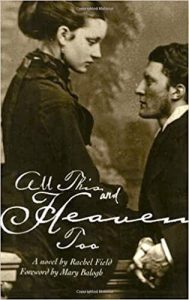
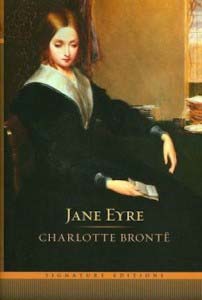
All This, and Heaven Too is the evocative title of Rachel Field’s 1938 historical novel, based on the life of her great-aunt Henriette Deluzy Desportes.
Though she passed away prematurely, Field manage to produce a prodigious array of works in several genres, including children’s books (notably the award-winning Hitty: Her First Hundred Years), poetry, plays, and novels.
If the title seems familiar, it may be in part thanks to the widely praised 1940 film of the same name starring Bette Davis in the role of the novel’s heroine. Read More→
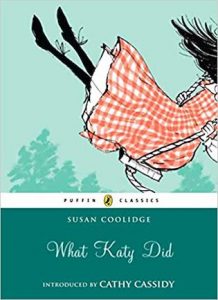
There are some books from one’s schoolgirl years that stay with you, and the What Katy Did series by Susan Coolidge (1835–1905) certainly falls into that category for me.
I read and re-read those books through many vacations. Before realizing it, the actions of favorite characters begin to have an effect on me, as the reader.
The American author of the What Katy Did series (five books in all) was born Sarah Chauncey Woolsey but gained fame with her pen name, Susan Coolidge. The first book of her Katy Did series was published in 1872. Read More→
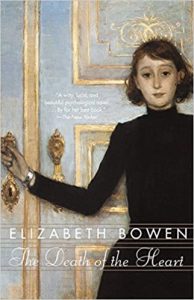
The Death of the Heart (1938) by Elizabeth Bowen is in many ways a traditional English 1930s novel, and a comedy of manners — the manners of pre-war, upper-middle-class London which Bowen (1899 – 1973) knew well. This analysis of The Death of the Heart is excerpted from Girls in Bloom: Coming of Age in the Mid-20th Century Woman’s Novel by Francis Booth, reprinted by permission.
The Death of the Heart is a coming-of-age novel, and its heroine, Portia Quayne, undoubtedly belongs in the literary realm of adolescent girls and their sexual experiences.
Portia does, in her way, come of age in the course of the story though she does not have the novel to herself. She is just one of a cast of unappealing characters examined in forensic detail by the witty, sardonic, and ruthless Bowen in this darkly witty chamber piece. Read More→
The extraordinary feminist and Beat generation poet Diane di Prima (August 6, 1934 – October 5, 2020) was an active participant in the cultural and political movements of the last half of the twentieth century. She embodied the awareness of a poet’s sensibility required for these political fights to evolve. Photo at right: Estate of Diane di Prima.
Di Prima wrote the poem following when she was named as the San Francisco Poet Laureate in 2009. In eight seemingly simple lines, she brings the credo of her life’s visionary work: Read More→
Many of us love classic books, so I thought it would be fascinating to discover a few contemporary writers’ favorite classic books by women authors. Leslie Pietrzyk, Stacy Hawkins Adams, and Kathryn Reid responded with thoughtful answers as well as short biographies.
As a contributor to Literary Ladies Guide, I (Tyler Scott), weigh in as well. When we write, when we read, it’s all about enlarging our circle. This brief survey proves that literature continues to connect us in our shared human experiences. Read More→
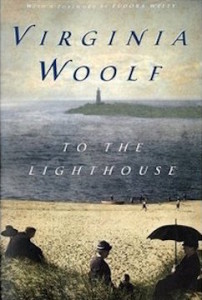
Virginia Woolf (1882 – 1941) is recognized as one of the most groundbreaking modernist authors of the twentieth century. She is perhaps most widely known for iconic novels like Mrs. Dalloway (1925) and her semi-autobiographical novel, To the Lighthouse (1927).
To the Lighthouse was Woolf’s fifth novel, and has remained one of her most highly regarded works.
Inspired by recollections of her childhood summers spent on the Cornwall coast, To the Lighthouse depicts the fictional Ramsey family and their assorted house guests spending a vacation in the Hebrides, on the island of Skye. Read More→
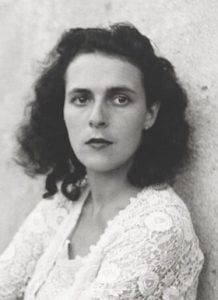
Leonora Carrington (April 6, 1917 – May 25, 2011, born Mary Leonora Carrington) was a British-born artist and writer who lived much of her life in Mexico City.
Best known for her surrealist paintings and artwork, and her prominence in the Surrealist group of the 1930s, she was also an accomplished author who published short stories, a memoir, and a novel.
One of Leonora’s recent biographers, Joanna Moorhead (also a distant relative on Leonora’s mother’s side of the family), wrote: “The key to Leonora was that she was a rebel, and a rebel to the very core of her being.” Even in early childhood, Leonora did not conform. Read More→