It’s a talented fiction writer who can make you believe that she has written your story. And what if you’ve been named for a fictional heroine because your father loved her character traits?
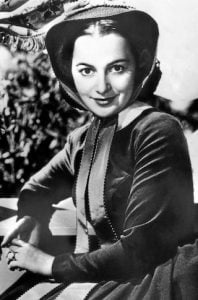
Then, it’s almost an umbilical cordlike connection that stays with you throughout your life. This is how I came to be named Melanie, after the character of Melanie Wilkes from Gone With the Wind.
My father had read the book in engineering college, when I was nowhere in the picture. He tucked the name away in his head for future use. After my birth, as is wont in families, many suggestions for names came up from family members. The name Melanie encountered a bit of resistance, being a Christian name in an Indian home, but my father stood his ground. Read More→
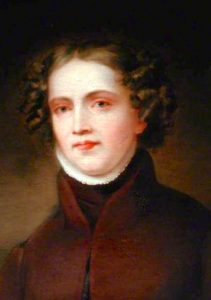
The fascinating and highly transgressive Englishwoman Anne Lister (1791 – 1840) of Shibden Hall in Yorkshire wasn’t a writer of published books, but was a committed diarist with a lot to write about. This introduction to the secret diaries of Anne Lister is excerpted from Killing the Angel: Early Transgressive British Woman Writers by Francis Booth ©2021, reprinted by permission.
Known in her local environs as “Gentleman Jack,” Lister’s enormous journals, only recently published, run to twenty-six volumes and four million words – which possibly makes her in terms of word count one of the most prolific of woman writers in this book – but were never meant to be read by anyone.
These diaries, written primarily between 1817 up until Lister’s death in 1840, are partly in code to hide her lesbian sexuality. Once decoded, they are perfectly unambiguous, at least today. Read More→
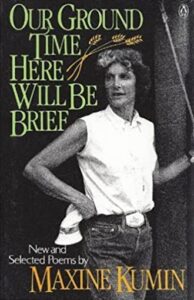
Maxine Kumin (June 6, 1925 – February 6, 2014) is known primarily as a poet, but she was also a prolific writer of children’s books, fiction, and essays.
She was born Maxine Winokur in the Germantown neighborhood of Philadelphia, Pennsylvania, to Reform Jewish parents.
Her father was the largest pawnbroker in the city of Philadelphia; her mother was a socially ambitious woman who loved dressing for nights at the symphony or the theater and discouraged any mannerisms that might, in her view, make her children appear to be immigrants. Read More→
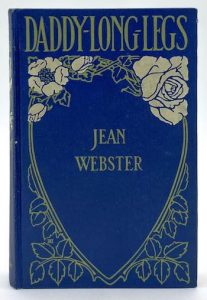
The summer I was twelve, I pulled a well-read and worn book from the shelves of the public library and discovered a story that seemed to be told directly to me.
Behind the deceptively dull cover of Daddy-Long-Legs by Jean Webster (1912) were letters and drawings that pulled me hard and fast into Judy Abbott’s life—an orphan at boarding school.
So many of my favorite things were combined in this book: orphans and lonely childhoods, girls succeeding against the odds with their studious natures, boarding school and class events, and perhaps most of all, the burgeoning writer’s sensibility that I also enjoyed in Louise Fitzhugh’s Harriet the Spy (1964).
I borrowed and devoured Jean Webster’s Daddy-Long-Legs that very afternoon; I’ve revisited it many times. Read More→
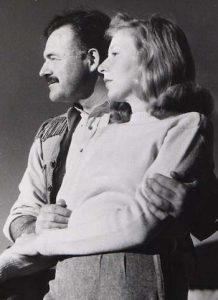
The esteemed war correspondent Martha Gellhorn, Ernest Hemingway’s third wife, famously said, “Why should I be a footnote to somebody else’s life?”
She dreaded being remembered mainly for her doomed marriage to the iconic American author. Hemingway and Gellhorn encouraged each other, supported each other, and once they separated, refused to speak of each other.
It all began when one evening, close to Christmas 1936, the young journalist and writer Martha Gellhorn went to a Key West for a drink. She was with her mother, Edna, and younger brother Alfred, taking a break in the winter sun. Read More→
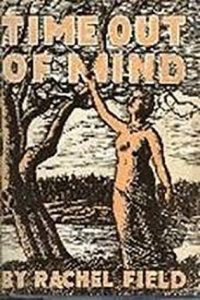
Time Out of Mind by Rachel Field (1894 – 1942) was this American author’s first novel for adults, published in 1935. The following year, it won the National Book Award.
Field had been writing prose and poetry for children and young adults, as well as plays, since 1924. Her major breakthrough, up until Time Out of Mind was released, was the children’s book Hitty: Her First Hundred Years (1929), which won the Newbery Medal.
The story in Time Out of Mind is narrated in the first person by Kate Fernald. Kate, described as a hardy, “square-rigged” girl, comes to the Maine coast home of the Fortune family at the age of ten. She accompanies her mother, who serves as the housekeeper, and grows up with brother and sister Nat and Clarissa Fortune, forging a bond that would last a lifetime. The book begins: Read More→
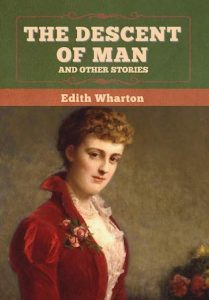
“The Dilettante” by Edith Wharton is a short story first published in Harper’s Magazine in 1903, then was included in The Descent of Man and Other Stories in 1904.
Close on the heels of this short story collection, Wharton’s very successful first novel, The House of Mirth, was published in 1905, establishing her as a major figure in American literature.
The story centers around the relationship of Mrs. Vervain and Thursdale. Mrs. Vervain is in love with him, though he considers her just a friend (this possibly echoes some of Wharton’s own relationships with men). Read More→
Mina Loy’s Feminist Manifesto is considered among her most notable works, though it wasn’t published until well after her death. In this 1914 piece, Loy vehemently asserted women’s need to fight for their selfhood rather than subsuming their personalities and desires to those of the patriarchy.
Mina Loy (1882 – 1966), the English-born modernist poet, playwright, and artist was was lauded by her peers for her dense analyses of the female experience in early twentieth-century Western society. The undercurrent of the Manifesto hints at Loy’s struggles with modernism — the artistic philosophy of her day — and its central aesthetic of impersonality.
Feminist Manifesto was finally published in 1982, in The Last Lunar Baedeker, a posthumous collection of her various works, including essays and poetry. Read More→