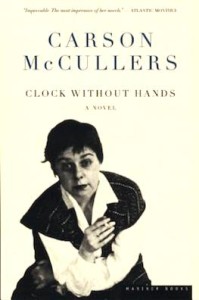
Clock Without Hands by Carson McCullers was this esteemed American author’s final novel, published in 1961. McCullers was known for writing in the Southern Gothic genre, with elements of the grotesque in some of her storytelling.
When her first novel, The Heart Is a Lonely Hunter, was published in 1940 she became the toast of the literary scene. The novel was wildly successful, more so than her next three works, which were all published before her thirtieth birthday.
Clock Without Hands received mixed- to favorable reviews; by the time of its publication, her greatest successes were behind her. Following is a review from the year of its publication, which gives a mixed view of the novel. Read More→
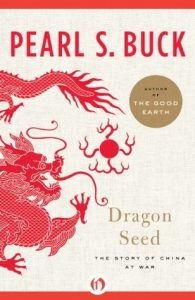
From the 1941 John Day Company edition of Dragon Seed (1941) by Pearl S. Buck: In Dragon Seed, Pearl Buck writes once more in the mood and vein of The Good Earth and The Mother.
Like those two classic novels this new one tells of plain people dwelling close to the Chinese soil, but a soil now sodden by the invader.
The story is of the farmer Ling Tan, and his wife and sons and daughters. The scene is outside and inside the walls of Nanking, the capital city where the author lived for seventeen years. Read More→
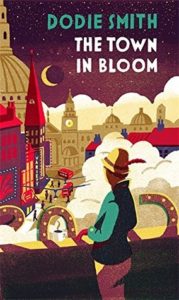
From the original review in The Corpus Christi Caller, July 1965 by Maurice Dolbier: Dodie Smith was born near Manchester, went to London stagestruck, was unsuccessful as an actress, went into business and then wrote plays and novels.
She now has a novel in which the heroine is a stagestruck Manchester girl who goes to London, is unsuccessful as an actress, goes into business, and does some writing.
Authenticity of background, therefore, can be comfortably assumed. The rest is fiction, charming, entertaining, and at times, mildly rueful — cool refreshment in a hot summer, a champagne cocktail from Miss Smith. Read More→
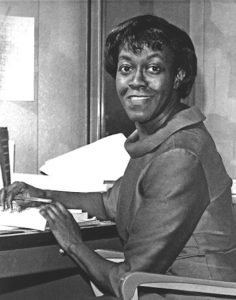
Gwendolyn Brooks (1917 – 2000), the Pulitzer Prize-winning American poet, produced works that included sonnets and ballads as well as blues rhythm in free verse. The Bean Eaters was a well-received collection of poems published in 1960. Critics noted her ability to tap into both specific and universal experiences:
“Her poems are clear, not because they are childishly simple but because they strike at the thought and feelings common to mature people.”
Though Brooks poetry reflects urban African-American life, its underlying themes are universal to the human experience. Following is a review of this collection from the year in which it was published: Read More→
Excerpted from an interview with Edna Ferber in 1924 — early in her career. Originally published in The Brooklyn Daily Eagle; by Ruth Brindze – Sun, Nov 9, 1924. Edna Ferber started writing during a vacation seventeen years ago — and the vacation still lasts!
Like a fairy godmother, she touches her typewriter with her wand and creates cities and people just as she wants them. “I find writing so difficult that I wonder how I ever can do it. And when I finish a novel I try to console myself and say, ‘No one can really write a novel.’”
That is what Edna Ferber thinks of her profession and herself. Read More→
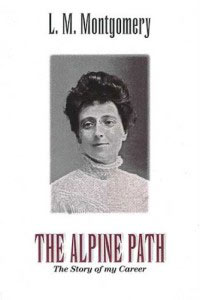
The Alpine Path: The Story of My Career (1917) by L.M. Montgomery, description adapted from the 1974 edition, Fitzhenry and Whiteside, Canada: Lucy Maud Montgomery, the creator of Anne of Green Gables, wrote this charming autobiographical memoir when she was in the middle of her career.
It is the most complete account she ever published of her childhood and early years as a writer. It originally appeared as a series of magazine articles in 1917, and this new edition is its first republication in any form. Read More→
L.M. Montgomery (1874 – 1972), the prolific Canadian author best known for the Anne of Green Gables series, wove personal experiences with marriage and motherhood into her work.
Fiction became a buffer against resentment at the roles she maintained, first as a dutiful granddaughter, then as an upstanding minister’s wife and devoted mother. Though these weren’t entirely facades, her spirited female characters hint at rebellion against limited roles and opportunities.
Montgomery had two sons in whose early childhoods she reveled. Parallel to the standard descriptions of her own mental state that forever peppered her journals (“sleeplessness,” “utter nervous prostration,” “dreadful weariness of spirit,” “restlessness,” ad nauseum), she cooed over her children. Read More→
Here are some helpful writing tips from Katherine Anne Porter (1890 – 1980), novelist and short story writer best known for Ship of Fools and Pale Horse, Pale Rider. Hers was a true American rags to riches story.
Porter often took many years after events to write about and analyze them fully, using her own life as a basis for her work. Her writing was a way to face questions that were left unanswered in her own life, giving her work a passionate, realistic, and sometimes harsh voice. Read More→