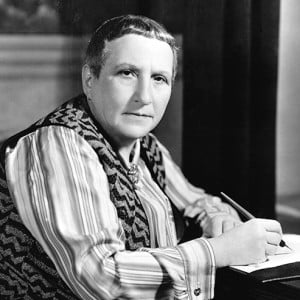
Gertrude Stein (1874 – 1946) had a unique place in twentieth century literature. Following is a selection of Gertrude Stein quotes, offering a window into her mind — some perplex, others delight, and some are a marriage of both.
Though some consider her writing incoherent, others view it as a singular voice, that had never been seen before or since.
In addition to poetry and novels, Stein also wrote plays, operas, and gave many lectures. Her experiments in prose, which may have originated with automatic writings, were highly influential. Some critics considered them “cubism in literature.” Read More→
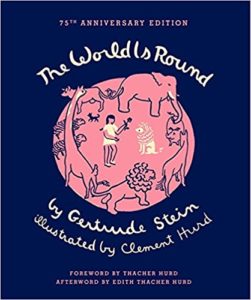
From the 1988 North Point Press edition of The World is Round (1939): Gertrude Stein’s only children’s book tells the story of Rose, a little girl determined to find her place in a “World that was round and you could go on it around and around.”
Rose’s search for identity leads her to friendships with dogs, rabbits, lions, and other children, to carve ‘Rose is a Rose is a Rose’ around the trunk of a tree, and finally on a quest (accompanied only by a blue garden chair) to the top of a mountain, where “everywhere she should see everywhere and she would sit on the chair, yes there.” Read More→
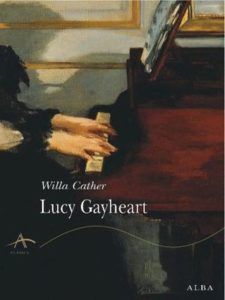
From the original review in The Brooklyn Daily Eagle, August, 1935: Willa Cather’s Lucy Gayheart looks a wistful way back to the time of the horse and buggy, when some men and some women loved deeply and truly, made themselves miserable, and were attached to their misery.
Small towns, no less than Vienna and the Paris Left Bank and a Greenwich Village as dirty and noisy then as it is now, had romances of which they had a right to be proud.
It was long before Theodore Dreiser made every young couple paddling a canoe upon a freshwater lake American Tragedy conscious … it was a time when the rich Harry Gordon might mark Lucy for his own, because he knew she would do him honor is the wife and his home and because he loved her. Read More→
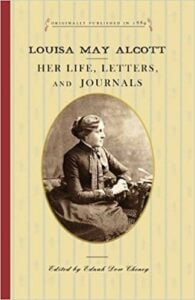
This autobiographical Sketch of Childhood by Louisa May Alcott (1832 – 1888) is filled with memories and observations by the beloved American author.
Best known as the author of Little Women and its sequels (including Jo’s Boys and Little Men), the scope of her work went beyond domestic tales into essays, poems, and pseudonymous thrillers.
It was first printed in Louisa May Alcott: Life, Letters, and Journals, compiled and edited by Ednah D. Cheney (1899). Here are Louisa May Alcott’s first-person recollections of her early life: Read More→
Willa Cather’s love/hate relationship with fame and the press was fierce. She courted fame in her youth, but expressed discomfort with it once it arrived.
Yet Cather left a wealth of public pronouncements, derived mainly from interviews she granted and speeches she made. She also wrote many autobiographical sketches, press releases, and even furtive semi-reviews in the third person as a way to promote her work.
Still, the more known she became, the more irritable she grew with loss of privacy.
For someone as ambivalent about publicity as Cather claimed to be, she granted tons of interviews. Judging by the vigor of her responses, she seemed to relish holding forth on the subject dearest to her heart—her writings. Read More→
Dear Literary Ladies,
How much do you want your stories and novels to be analyzed, rather than enjoyed for their own sake? Sometimes the over-analysis that students have to do destroys the pleasure of reading.
On the other hand, delving into deeper meanings and insights can expand the experience of reading. Where does a reader find the balance?
Last fall I received a letter from a student who said she would be “graciously appreciative” if would tell her “just what enlightenment” I expected her to get from each of my stories. I suspect she had a paper to write. Read More→
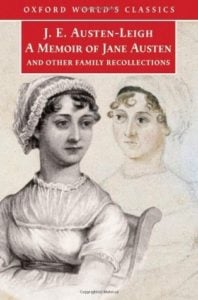
The biggest myth about Jane Austen’s writing life that she was ashamed of her work and hid her manuscripts as she worked on them. This is patently untrue, which we’ll see in the evidence to the contrary.
Can we ever have enough of Jane Austen? From the search for the modern Mr. Darcy (think Mark Darcy in Bridget Jones’s Diary) to the appropriation of her iconic narratives (Sense and Sensibility and Sea Monsters) to fan-fiction sequels (Mr. Darcy Takes a Wife), to using the books themselves as a device for telling a contemporary story (The Jane Austen Book Club), there seems to be no such thing as Too Much Jane.
Although it must be said, other than Bridget Jones’s Diary, these other titles were fairly slammed by readers. And that’s just considering books — counting all the film and TV adaptations of her novels is a topic in and of itself. Read More→
Before attempting to publish novels, Charlotte Brontë undertook the task of finding a home for a collaborative book of poems by herself and her sisters, Anne and Emily Brontë.
Charlotte and Anne are considered fine poets, but Emily Brontë’s poems are considered the most moving and beautiful among the poetic work of the three sisters.
The trio took masculine-ish noms de plume (Charlotte, Emily, and Anne were Currer, Ellis, and Acton, respectively, and shared the surname Bell) when Charlotte undertook the mission of finding a publisher for a collected book of their poems.
Read More→