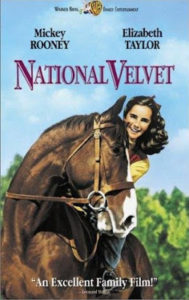
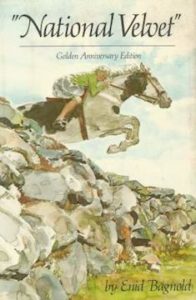
National Velvet is the story of a horse-crazy fourteen-year-old girl, Velvet Brown, who rides her horse, Pi, to win Britain’s Grand National steeplechase.
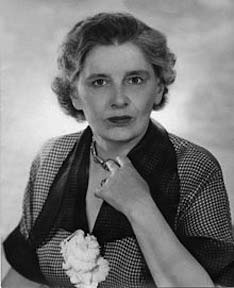
The 1935 novel of the same name by Enid Bagnold (1889 – 1991) was successfully adapted to film in 1944 and featured the young Elizabeth Taylor in her first leading role.
Assisted by Mi, her father’s hired hand, Velvet plots to get the horse ready for what’s considered “the greatest race in the world,” praying to become “the best rider in England,” not for the money but for the glory of the horse she loves so dearly. Read More→
National Velvet by Enid Bagnold is a classic 1935 novel telling the story of fourteen-year-old Velvet Brown, the daughter of a working-class family in England.
Velvet is so horse-crazy that she indulges in both fervent and pedestrian fantasies — going on horseback journeys, leading horses to pastures, and simply grooming them.
“Oh, God, give me horses, give me horses!” Velvet prays early on in the book, “Let me be the best rider in England!” Read More→
Memory plays a central role in fiction — as it does in life. Think of those who lose their memory; the very essence of the self is stolen. “Nothing is ever really lost to us as long as we remember it,” wrote L.M. Montgomery in The Story Girl.
Here, Virginia Woolf, Daphne Du Maurier, Eudora Welty, Rebecca West, and Mary McCarthy offer up lovely thoughts on memory that come from both works of fiction and memoir. Read More→
Dear Literary Ladies,
What’s your best advice for beginning writers, or really, anyone who’s trying to write regularly?
I have advice in just a few words. The first, of course, is to read. It’s surprising how many people think they want to be writers but they don’t really like to read books.
And the second is to write every day, whether you like it or not. Screw inspiration. Read More→
Of her first published collection, The Book of Repulsive Women (1915), Djuna Barnes said: “My first book of poems is a disgusting little item.” The five early poems by Djuna Barnes presented here illustrate the dark, morbid voice that became a hallmark of her writing style.
When, much later (1952) a publisher asked to reprint some of her early work, Barnes responded: “I feel it is a grave disservice to letters to reissue merely because one may have a name for later work — or for that unfortunately praised earlier work, or for the purpose of nostalgia or ‘history’ which might more happily be left interred.”
Read More→
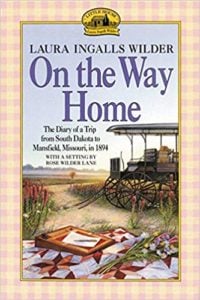
On the Way Home: The Diary of a Trip from South Dakota to Missouri in 1894 by Laura Ingalls Wilder is based on a diary found after the author’s death, detailing her journey with her husband Almanzo from South Dakota to Missouri.
In 1894, The couple and their seven-year-old daughter, Rose, made the trek from their drought-stricken farm in De Smet to a new farm in Mansfield, Missouri, where they settled permanently.
Laura chronicled the journey in these diary entries, which were undiscovered until after her death and remained unpublished until collected in this 1962 book. Read More→
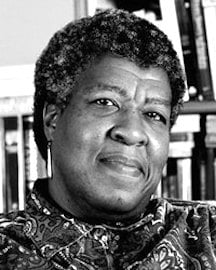
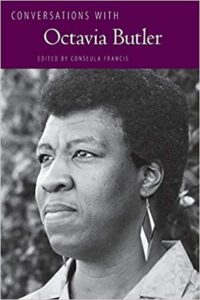
Octavia Estelle Butler (1947 – 2006) broke ground in the white male-dominated genre of science fiction as a Black woman. This selection of quotes by Octavia E. Butler reflects her wise and prescient thoughts on writing and human nature.
The New York Times described her as a writer “whose evocative, often troubling novels explore far-reaching issues of race, sex, power, and ultimately, what it meant to be human.”
After publishing some short stories, Butler’s first novel was Patternmaster (1976). It was the first in what would become a four-volume series. Central to these novels are Patternists, people with telepathic powers. But it was Kindred (1979) that put Octavia Butler on the literary map. Read More→
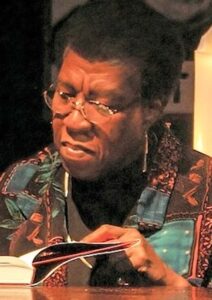
Octavia E. Butler (June 22, 1947 – February 24, 2006) was an American author of science fiction as well as dystopian and speculative novels. This visionary Black woman writer blazed a trail in the white male-dominated genre of science fiction.
In her New York Times obituary, she was described as “an internationally acclaimed science fiction writer whose evocative, often troubling novels explore far-reaching issues of race, sex, power, and ultimately, what it meant to be human.” (photo above right courtesy of Wikimedia Commons)
Born in Pasadena, CA, Octavia Estelle Butler’s father died when she was an infant. Raised by her single mother, Butler was a painfully shy child, and always exceedingly tall for her age. She also struggled with dyslexia, which made schoolwork a torture. She began to believe that she was, as she put it, “ugly and stupid, clumsy, and socially hopeless.” Read More→