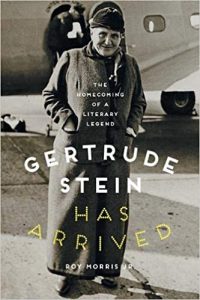
The Autobiography of Alice B. Toklas (1933) is actually Gertrude Stein‘s own memoir. Gertrude Stein Has Arrived by Roy Morris, Jr. chronicles the return of the delightfully perplexing literary figure to her American homeland in 1934.
With Alice in tow, Stein conducted an epic lecture tour to promote what would be her most commercially successful book.
Gertrude appropriated the supposed persona of her longtime companion, Alice B. Toklas, to tell her own tale. Famously, Alice is quoted as saying:
“About six weeks ago Gertrude Stein said, ‘It does not look to me as if you were ever going to write that autobiography. You know what I am going to do? I am going to write it for you. I am going to write it as simply as Defoe did the autobiography of Robinson Crusoe.’ And she has, and this is it.” Read More→
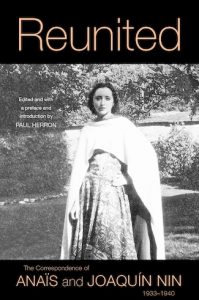
Anaïs Nin (1903 – 1977), an iconic literary figure of the 20th century, was best known for her Diary series. A trove of books by Anaïs Nin has recently been reissued in updated editions by Swallow Press, the premier U.S. publisher of her works.
Swallow Press is a division of Ohio University Press, and many of these updated editions have been edited by Paul Herron. As founder and editor of Sky Blue Press, Herron publishes the journal A Café in Space and digital editions of the fiction of Anaïs Nin, as well as a new collection of Nin erotica, Auletris. Read More→
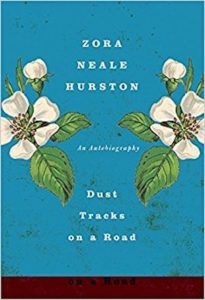
Dust Tracks on a Road, Zora Neale Hurston’s 1942 autobiography, has confounded critics and scholars from the time of its publication, even as it has enthralled and entertained readers.
It was the most commercially successful book she published during her lifetime, though it has since been eclipsed by her 1937 novel, Their Eyes Were Watching God.
Zora (1891 – 1960) studied anthropology at Barnard College in the 1920s, becoming the first African-American student at the prestigious college. With her larger-than-life personality, she quickly became a big name in the Harlem Renaissance movement of the 1920s. Read More→
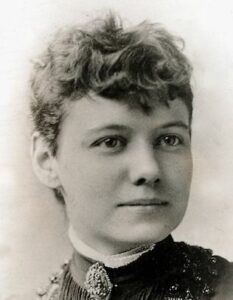
When you think of undercover reporting, what comes to mind? I have to admit that the image that came to my mind was some guy in a trench coat, wearing a fedora. That is, until I learned about the group of late nineteenth and early twentieth century reporters referred to as “stunt girls.”
These intrepid young women, following in the footsteps of Nellie Bly, pioneered the practice of underground investigative reporting in journalism.
Good journalism has always been about presenting the human story behind events large and small. It’s also about holding the powerful accountable for their actions, a cornerstone of democracy (at least in theory). Women have always had the desire, talent, and ability to participate in these endeavors. Read More→
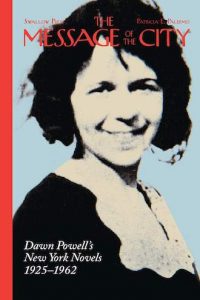
Dawn Powell (1896 – 1965) is considered a “writer’s writer,” though nearly all of her work was out of print by the time she died. Overcoming a hard-knock early life in the American midwest, she moved to New York City in 1918 and fell in love with it. Dawn Powell’s New York novels and stories are among the most enduring of her works.
Though she wrote prolifically throughout her life, producing novels, short stories, poetry, and plays, she didn’t gain much notoriety — for better or worse — during her lifetime. To the joy of devoted fans and new readers alike, many of her works have been rediscovered and rereleased. Read More→
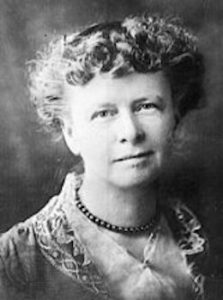
Eleanor H. Porter (December 19, 1868 – May 21, 1920) was best known as the author of Pollyanna, the children’s novel that took America by storm during the World War I years.
Most people today won’t know the name of the author of this classic, but many still understand what it means to be called a “Pollyanna.” According to Merriam Webster’s Dictionary, it’s “a person characterized by irrepressible optimism and a tendency to find good in everything.”
Pollyanna was published in 1913, on the eve of World War I — it would hardly seem the time for the story of a girl who could see the bright side of just about any situation, no matter how dire. But somehow the book struck a nerve and was an immediate hit with children as well as adults, and its popularity endured throughout those years. Read More→
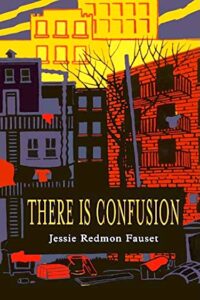
There is Confusion by Jessie Redmon Fauset (1882 – 1961) was the first novel by the American editor, poet, essayist, educator, and author closely associated with the Harlem Renaissance movement.
In addition to her own pursuits, Cornell-educated Fauset was known as one of the “literary midwives” of the movement, someone who encouraged and supported other talents.
Fauset’s poetic bent is reflected in the novel’s title, which comes from lines in “The Lotus-Eaters” by Alfred, Lord Tennyson: Read More→
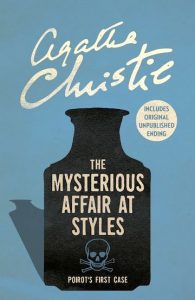
2020 marked one hundred years since Christie’s debut novel, The Mysterious Affair at Styles, was first published.
As the inaugural Hercule Poirot mystery, the story was serialized in The Times (London) weekly edition from February to June 1920 and later published as a complete novel in the U.S. in October, 1920.
The book was written as the result of a challenge between Agatha and her older sister, who bet that Agatha couldn’t write a detective novel. While she was working in a dispensary during World War I, Agatha came up with the idea for the story using her knowledge of poisons. Read More→