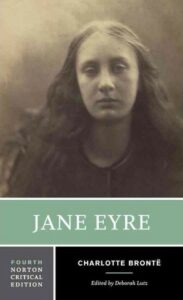
Before she became known for her own novels, Virginia Woolf was a literary critic. It’s fascinating to read her analysis of Jane Eyre and Wuthering Heights, the enduring novels of Charlotte and Emily Brontë.
This dual analysis of Charlotte and Emily’s masterpieces was first published in part in The Times Literary Supplement on April 13, 1916, around the time of Charlotte’s centenary, then appeared again in 1917 and 1922.
The following essay by Virginia Woolf is in the public domain. The text is intact, though Woolf’s long paragraphs are broken up for improved readability, and headings have been added for the same purpose.
Read More→
With its rich history, Cuban literature is considered among the most influential in the Spanish-speaking world, and women have long been an intrinsic part of its development. Here, we’ll take a look at ten inspirational classic Cuban women authors that deserve to be discovered and read.
Cuban literature started its emergence at the start of the 19th century. Gertrudis Gomez de Avellaneda, the earliest of the writers listed here, focused on abolitionist characters.
After the abolition of slavery in Cuba in 1886, the focus of Cuban literature shifted to themes of independence, freedom, social protest, and personal as well as universal issues. Read More→
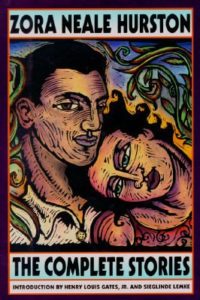
“The Gilded Six-Bits” is a 1933 short story by Zora Neale Hurston, and the one which possibly launched her as a fiction writer. It wasn’t her first story by any means, but the one that caught the attention of the publisher, Bertram Lippincott.
Lippincott read “The Gilded Six-Bits” in an issue of Story magazine, and was so impressed that he wrote Zora to see whether she might be working on a full-length novel. She wasn’t, but told him she was. She got her serious about starting her first novel, Jonah’s Gourd Vine, and it was ready in three months.
Make sure to read the analysis of “The Gilded Six Bits.” In Zora Neale Hurston: A Literary Biography, Robert E. Hemenway encapsulates the story : Read More→
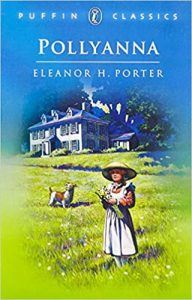
A “Pollyanna,” according to Merriam-Webster’s Dictionary, is “a person characterized by irrepressible optimism and a tendency to find good in everything.” Following is a selection of quotes from Pollyanna — the 1913 novel by Eleanor H. Porter that gave us this enduring term.
You’ll also find some contemporary quotes on what it means to be — or not to be — “a Pollyanna.”
Pollyanna was first published on the brink of World War I (which began in 1914; the U.S. entered in 1917), which segued into the misnamed global pandemic Spanish Flu. Both killed millions worldwide.
It hardly seemed the time for a book whose newly orphaned main character was as sunny and optimistic as they come. But somehow, the book struck a nerve and was an immediate hit with children as well as adults. Or maybe that’s precisely when it was needed, as its popularity lasted for years.
Read More→
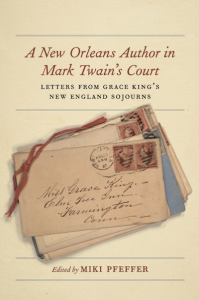
Grace King’s life (1852 – 1932) spanned two wars, various epidemics, disruptive politics, and fluctuating economics. Her literary career began in 1885 when two northern editors came to New Orleans to write up the south and find local writers at the World’s Industrial and Cotton Centennial Exposition.
Richard Watson Gilder of Century Magazine challenged King to write her first short story, and Charles Dudley Warner placed it and then mentored her into the publishing world.
Over almost five decades, King wrote short stories and novellas, biographies and histories, genealogy, and a memoir. Her path reflected the shifting changes in taste. As with other women writers whose works disappeared from the literary canon, she is again receiving attention for her sensitivity and knowledge of a particular time and place. Read More→
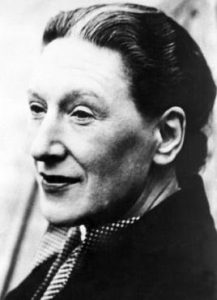
Elizabeth Bowen (June 7, 1899 – February 22, 1973) was an Irish-British novelist and short story writer best known for fictional works that focused on life in wartime London and relationships among the upper-middle class.
Some have referred to her as the “grande dame” of the modern novel, her work characterized by a conscious, concise style.
Bowen’s work reflects her great interest in “life with the lid on and what happens when the lid comes off.” It examines the innocence of orderly life and irrepressible forces that transforms one’s experience. In her stories and novels, she examines the betrayal and secrets beneath the veneer of respectability.
Read More→
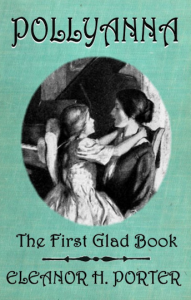
The 1913 novel Pollyanna by Eleanor H. Porter (1868 – 1920) is perhaps less familiar now than the lasting expression that grew from its sentimental story.
Most everyone knows what defines a “Pollyanna” — someone who looks at the bright side of things no matter how dire, or who paints an overly optimistic picture of any situation.
Pollyanna, subtitled “The Glad Book,” was incredibly successful from the start, and inspired many adaptations in other media. Though intended as a children’s novel, it appealed to all ages. Read More→
Marianne Moore (November 15, 1887 – February 5, 1972) was a poet associated with the American Modernist movement. Her poetry was notable for its wit, irony, and use of syllabic verse. She was also a respected translator.
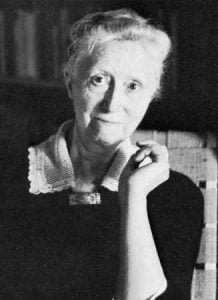
At right, a 1957 photo of Marianne Moore by the noted photographer Imogen Cunningham.
Politically, Marianne was involved in the women’s suffrage movement in the United States, often supporting it anonymously through her writing. She was celebrated throughout much of her life, and she received numerous honorary degrees and awards for her works, including the Pulitzer Prize and the National Medal for Literature. Read More→