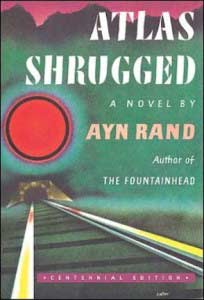
Atlas Shrugged (1957) is a philosophical novel by Russian-born Ayn Rand that examines a multitude of complex issues. Rand, never one for modesty, claimed that it was the most important book ever written.
Critics often felt otherwise. Where Atlas Shrugged was concerned, readers disagreed; it sold millions of copies around the world.
In spite of the fact that many critics at the time considered it, as one wrote,”a stupid and dangerous book,” it later made lists of the most influential books of the twentieth century. Here are two reviews from the time of its publication — the critics can barely contain their sarcasm: Read More→
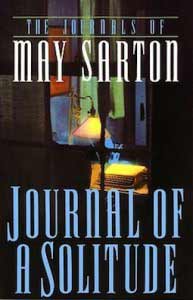
Journal of a Solitude (1973) is May Sarton’s record of a year spent quietly observing her inner world and the natural world around her.
In this record of her sixtieth year, she writes with candor about her self, and shares insightful observations about her home, garden, and seasons, as well as books and ideas in her daily life in New Hampshire.
The reader shares a creative and spiritual journey of a talented writer who was occasionally frustrated by the trajectory of her career. The book begins: Read More→
“Finding your writing voice” is a directive that teeters on cliché. Yet, what’s more important than developing a distinctive personality in print?
It takes a long time for writers, especially women, to raise their writing voices above a proverbial whisper. All those familiar “Who do you think you are …” demons rush in to fill the void where confidence be firmly set into place.
Without a firm grip on voice, you’re left either with whispering shyly, or its flip side, endlessly blathering streams of overwrought prose or poetry, the literary equivalent of nervous chatter. Read More→
Dear Literary Ladies,
Like most writers, I want to be published, and truth be told, I’d love to be successful. But I’ve heard so many stories of long years of toil, false starts, and tons of rejection. Isn’t there an easier way? I’d prefer to become an overnight success, earn fame and fortune, and avoid all the struggle.
I can only say to you as I do to the many young writers who ask for advice—There is no easy road to successful authorship; it has to be earned by long and patient labor, many disappointments, uncertainties and trials. Success is often a lucky accident, coming to those who may not deserve it, while others who do have to wait & hope till they have earned it. This is the best sort and the most enduring. Read More→
Dear Literary Ladies,
While in the midst of writing, how can you gauge if your work is any good? It’s so hard to be objective, and see the forest from the trees. Should I compare my writing with that of other writers I admire?
Since we must and do write each in our own way, we may during actual writing get more lasting instruction not from another’s work, whatever its blessings, however better it is than ours, but from our own poor scratched-over pages. For these we can hold up to life. That is, we are born with a mind and heart to hold each page up to and to ask: Is it valid? Read More→
Dear Literary Ladies,
A book that I’ve toiled on and believe in with all my heart has been rejected by more than a dozen publishers. Am I delusional? Maybe it’s no good after all. I need to hear a great story of a book that was rejected over and over but then became a smash success. Do you have such a story for me?
A Wrinkle in Time was almost never published. You can’t name a major publisher who didn’t reject it. And there were many reasons. One was that it was supposedly too hard for children. Well, my children were 7, 10, and 12 while I was writing it. I’d read to them at night what I’d written during the day, and they’d say, “Ooh, mother, go back to the typewriter!” Read More→
Dear Literary Ladies,
I write and write, sometimes getting compensated for my efforts, but more often not, my efforts are unpaid. I do feel an incredible urge to keep putting words to paper, whether I get paid or not. Am I being foolish or naive? Should I try to do the kind of writing that might bring in a few bucks? Read More→
Dear Literary Ladies,
Sometimes I wonder what I’m more afraid of—failure, or success? In its own way, the prospect of success seems daunting. And I know I’m not alone. Did any of you find the idea of actually succeeding as scary and incomprehensible as I do?
I never expected any sort of success with [To Kill a] Mockingbird. I didn’t expect the book to sell in the first place. I was hoping for a quick and merciful death at the hands of reviewers, but at the same time I sort of hoped that maybe someone would like it enough to give me encouragement. Public encouragement.
I hoped for a little, as I said, but I got rather a whole lot, and in some ways this was just about as frightening as the quick, merciful death I’d expected.
—Harper Lee, from a 1964 interview
. . . . . . . . . .

. . . . . . . . . .
Harper Lee (April 28, 1926 –February 19, 2016) was an American author best known for the Pulitzer Prize-winning novel To Kill a Mockingbird (1960). Born in Monroeville, Alabama, she was originally named Nelle Harper Lee.
Few novels have had the cultural impact of To Kill a Mockingbird, which has sold tens of millions of copies and has been translated into more than forty languages. Lee drew from her upbringing in a small southern town to tell an indelible American story. Read more about Harper Lee.
. . . . . . . . . .
Find lots more writing wisdom from classic authors
in our Dear Literary Ladies feature