Say you’ve gotten a whole slew of great reviews and a tiny number of negative ones. Which ones are you most likely to remember (or more precisely, still be obsessing about) five years hence?
Of course, it’s the nasty reviews. This is actually one of the top clichés of the writing life, right up there with “write what you know.”
I never quite understood why this was until Madeleine L’Engle made it crystal clear in the passage below. It’s the negative comments that reawaken our own self-doubts, the very ones we thought we overcame once our work was in print. Read More→
Who among us time-crunched wordsmiths can’t occasionally relate to L.M. Montgomery’s wistful longing for “enough spare minutes to do some writing,” as she related in her 1910 journal. Here, she muses on finding time to write, and doing so without the luxury of privacy.
She wrote this as a reflection of some years earlier when, as a young woman she needed to earn her keep before her novels (chief among them, the Anne of Green Gables series) made her famous.
Lucy Maud Montgomery (1874 – 1942) discovered that the equation of spare time plus perfect solitude was neither practical nor feasible for her. So when she learned to snatch writing time in the midst of a hectic newspaper office, she was surprised at what she could accomplish. Read More→
“Now I Become Myself” is a beloved poem by May Sarton (1912 – 1995) that captures the spirit of a well-examined life.
How often do we, especially women, show up to life as someone other than our true self? We’re taught to be people-pleasers, so we wear the face and show the demeanor we think others will expect, instead of being who we truly are.
May Sarton was an American poet, novelist, and memoirist who spent a lifetime learning who she was. Read More→
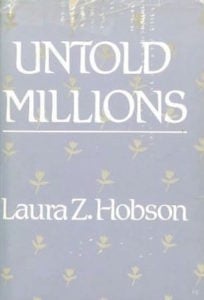
Untold Millions by Laura Z. Hobson was this distinguished (and fairly forgotten) author’s twelfth book. Published in 1982, it was the last novel by Hobson, remembered foremost for Gentleman’s Agreement. It came out nearly four decades earlier, and made a splash both in book form in as an award-winning film the following year (1947).
Untold Millions was described by its publisher as “a warm, touching and beautiful love story, is unlike any other novel she has written, and proves once again that Laura Z. Hobson is a master storyteller, a novelist of fine perceptions and great flair.” Read More→
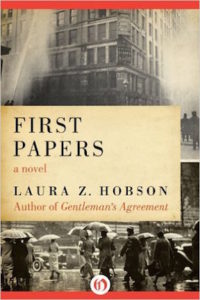
From the 1964 Random House edition of First Papers: This hugely satisfying and moving novel, First Papers by Laura Z. Hobson, author of Gentleman’s Agreement, takes place during the six years that take us into the First World War.
The story centers around the triumphs and tragedies of an unforgettable family living on long Island during those critical years, but its powerful themes of freedom of speech and the ambiguities of patriotism speak more strongly to us today than ever. Read More→
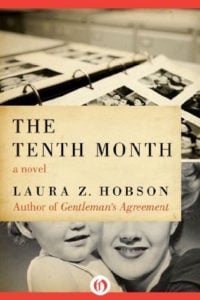
The Tenth Month by Laura Z. Hobson is a 1970 novel telling the story of a single woman who, believing herself to be unable to conceive, becomes pregnant. The story mirrors some elements of the author’s own life as single mother by choice.
In 1937 Laura adopted a son, who she named Michael Z. Hobson. This was quite unusual for an unmarried woman at that time. In 1941 she gave birth to another son, who she named Christopher Z. Hobson.
Not wanting Michael to feel stigmatized as the adopted child of the family, she kept her pregnancy secret, giving birth under an assumed name so she could then adopt Christopher using her own name. Read More→
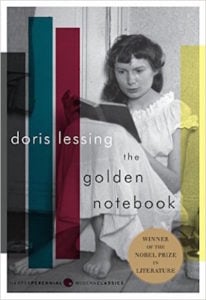
From the original review of The Golden Notebook in the Tucson Daily Citizen by John Barkham, June 1962: Doris Lessing has long impressed as an underrated novelist. Her stories of southern Africa, The Grass is Singing, and of lower-class English life in Five, combine form with expression in a manner perfectly suited to the respective environments.
The Golden Notebook is far and away her most ambitious work to date — a long and complex novel which draws on all the talents and insights of this gifted woman.
It is no ordinary work of fiction, either in manner or matter. The publisher compares its heroine, Anna, with the “new woman” of Ibsen and Shaw. This is going further than I would, but unquestionably The Golden Notebook is going to be debated and analyzed by students of the novel for a long time to come. Read More→
Dear Literary Ladies,
It’s important for someone who wants to be a good writer to be a good reader, right? Do you have any thoughts on becoming a more effective reader?
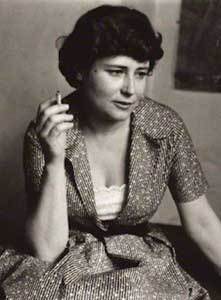
There is only one way to read, which is to browse in libraries and bookshops, picking up books that attract you, reading only those, dropping them when they bore you, skipping the parts that drag — and never, never reading anything because you feel you ought, or because it is part of a trend or a movement. Remember that the book which bores you when you are twenty or thirty will open doors for you when you are forty or fifty-and vise versa. Don’t read a book out of its right time for you. Read More→