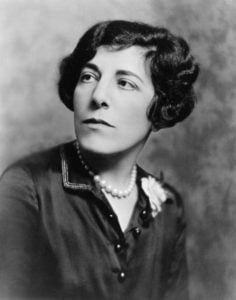
Edna Ferber (1885 – 1968), the prolific American novelist and playwright, began her career as a newspaper reporter in Appleton, Wisconsin. Following is a selection of quotes by Edna Ferber on writing and living.
Her stories were slices of Americana, ranging far from the events and experiences of her own life.
As a Jewish woman and and daughter of immigrants, she didn’t shy away from weaving issues of gender, class, and race into her colorful sagas. Many of her novels were adapted into films and Broadway shows. Read More→
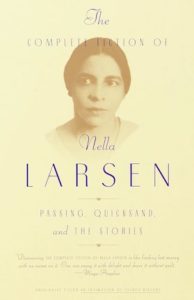
Quicksand is a 1928 novel by Nella Larsen (1891 – 1964) based on the author’s personal experiences with what was called “the color line.” This sensitive novel came just one year before her masterwork, the 1929 short novel Passing.
Helga Crane, the main character, is the mixed-race daughter of a white Danish mother and a black father, as Larsen was. The plot takes her back and forth from Denmark, “Naxos” (a thinly veiled version of the Tuskegee Institute, where Larsen worked briefly), and Harlem.
Wherever Helga goes, she fails to find a community in which she can be comfortable with who she is. Read More→
Though “Sweat” by Zora Neale Hurston is a short story of only 4,743 words long (about 15 pages), the scope of the work reaches farther than most novels. Read the full text of “Sweat” here.
Within this small space, Hurston addresses a number of themes, such as the trials of femininity, which she explores with compelling and efficient symbolism.
Originally published in 1926, it is nuanced and eloquently compact, with Hurston maximizing each word, object, character, and plot point to create an impassioned and enlightening narrative. Read More→
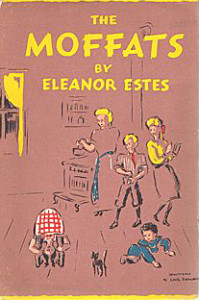
Eleanor Estes was a children’s book author/illustrator, a librarian, and a recipient of the Newbery Medal. Following is a selection of quotes by Eleanor Estes from her best known classic books for kids.
Many of Estes’ stories are based on her personal childhood. experiences. Her first book, The Moffats, was published in 1941, followed closely by The Middle Moffat, and Rufus M.
The Moffats series was an immediate success, both at home and abroad, semi-autobiographical tales of the author’s own childhood. Another of her classics is The Hundred Dresses (1944).
Read More→
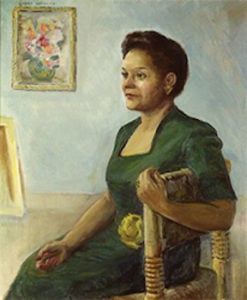
Jessie Redmon Fauset was a novelist and poet associated with the Harlem Renaissance. She was also a teacher of languages and editor for The Crisis magazine of the NAACP.
She also contributed her own writings — editorials, poetry, short stories, translations from the French of writings by black authors from Europe and Africa, as well as accounts of her worldwide travels.
Such was her influence that Fauset has long been considered one of the “midwives” of the Harlem Renaissance literary and artistic movement of the 1920s.
Read More→
Djuna Barnes (1892 – 1982) was a singular voice in the literary world, best know for her experimental novel, Nightwood. Often viewed as eccentric and morbid, it’s no wonder that quotes by Djuna Barnes can be described the same way.
Early in her career, Barnes became a freelance journalist and illustrator for the Brooklyn Daily Eagle, and in just one year she became a renowned feature reporter, interviewer, and illustrator.
She left for Paris in 1920, and continuing her work as a journalist, she interviewed expatriate writers and artists. Continuing to pursue her own writing, she established herself as a literary figure in her own right, producing plays, short stories, and poems. Read More→
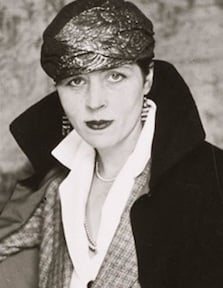
Djuna Barnes (June 12, 1892 – June 18, 1982) was an American writer who became well-known in the Parisian avant-garde literary scene of the 1920s and 1930s.
Born in Cornwall-on-Hudson, New York, Barnes attended Pratt Institute and the Art Students League of New York. Starting in 1913, she wrote and illustrated for newspapers and magazines, both literary and popular (including Smart Set and Vanity Fair).
[photo at right by Berenice Abbott, courtesy of Wikimedia Commons]
Barnes’ first book-length work was The Book of Repulsive Women: 8 Rhythms and 5 Drawings in 1915. It was brief, hardly more than a chapbook. Over the next few years, she wrote plays, a few of which were staged by the Provincetown Players in Cape Cod.
Read More→
Isak Dinesen(1885 – 1962), born Karen Christenze Dinesen, was a Danish author best known for her 1937 memoir, Out of Africa, and her long short story, Babette’s Feast.
Later known as Baroness Karen von Blixen-Finecke, she was published in the United States, after being denied publication in both Denmark and England.
Admired for her poetic prose, her work has endured for her adventurous life as well as her literary talent. Here are quotes by Isak Dinesen hinting at her philosophy on life and her storytelling skills. Read More→