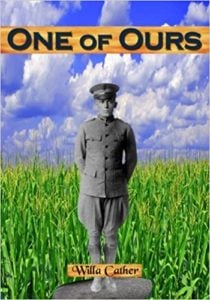
One of Ours by Willa Cather is a 1922 novel telling the story of Claude Wheeler, the son of a Nebraska farmer and a religious mother. He drifts through what seems to be a predictable life, devoid of purpose, until he goes to war in Europe. Though it won the 1923 Pulitzer Prize for the Novel, it received mixed reviews.
Critics panned its idealized view of World War I. Acid-penned literary legend H.L. Mencken, for example, wrote that her depiction of war “drops precipitately to the level of a serial in The Lady’s Home Journal … fought out not in France, but on a Hollywood movie-lot.” Read More→
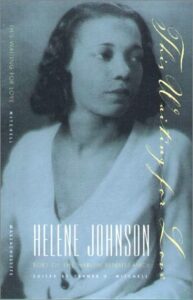
Helene Johnson (July 7, 1906 – July 6, 1995) was an American poet active in the Harlem Renaissance movement. She grew up surrounded by her mother and aunts, strong women who inspired her distinctive poetic voice.
Born in Boston and raised by her single mother in Brookline and Oak Bluffs, Massachusetts, Helene considered herself painfully shy as a child. She found her voice when she turned to writing poetry.
Helene was the cousin of Dorothy West, who would become a respected short story writer and novelist. In the mid-1920s, the two young women, drawn to the energy of Harlem, moved to New York City. Helene took classes at Columbia University, where she met and befriended Zora Neale Hurston., then an ethnology student and budding writer. Read More→
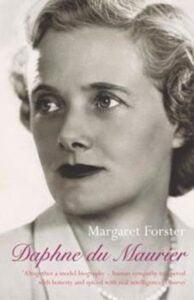
Daphne du Maurier (May 13, 1907 – April 19, 1989) was a prolific British novelist, playwright, and short story writer, best known for Rebecca (1938) and other finely constructed works of suspense.
Her novels and stories were rich in detail, with elements of history, romance, and intrigue. Her works, which were quite popular in their time, were sometimes criticized as lacking in depth or intellect, a view that has since been revised.
Du Maurier is best remembered for a half a dozen or so books and stories that were adapted to film. But her publishing credits went well beyond her more famous works to include nearly forty novels and short story collections. She wrote plays and nonfiction and as well, including memoirs of her own talented family. Read More→
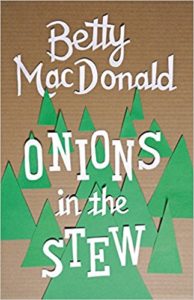
Onions in the Stew by Betty MacDonald (1954) is a humorous memoir about the author’s life in Washington State with her family. The events described in this narrative take place from 1942 to 1954.
Betty, a divorced working mother, lives with her two preteen daughters in her mother’s home. After she meets and marries Donald MacDonald, they find it difficult to find one in Seattle or its suburbs, and finally settle on a property on nearby Vashon Island. Read More→
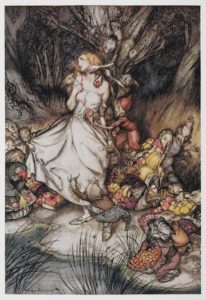
Goblin Market by Christina Rossetti (1830 – 1894) is the best known poem by this Victorian-era British poet. It was published in her first volume of poetry, Goblin Market and Other Poems, in 1863.
This very long narrative poem is set in an imaginary world, describing the strange adventures of sisters Laura and Lizzie and their encounters with evil goblin merchants.
One of the main themes of this poem is temptation, illustrated by Laura’s tasting of enchanted forbidden fruit. It also explores sacrifice, sexuality, and salvation. According to Discovering Literature: Romantics and Victorians: Read More→
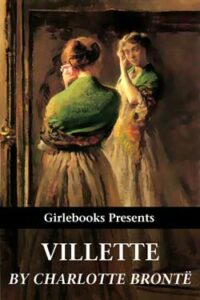
My first impression of Villette by Charlotte Brontë (1853) was the familiarity of the writing — if I had no inclination of the author or book title, but merely “read it blind,” I think I would still know it was Charlotte Brontë. Character reigns supreme over the novel — that of the narrator, Lucy Snowe, as well as those around her.
The focus of the book lies primarily with the development of Lucy’s character. Because I had read Lyndall Gordon’s amazing biography of Charlotte beforehand, I felt prepared for Villette.
I read it with an eye for what it said about Charlotte — her life, her experiences, her opinions — and I think this colored my experience of it. Ultimately, it is a book in which the plot is only secondary. Read More→
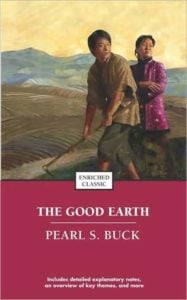
Pearl S. Buck (1892 – 1973) was an American author of fiction and nonfiction, humanitarian, and human rights advocate. She was also the first American woman to win the Nobel Prize in Literature. Following are quotes from The Good Earth, a classic novel that’s still widely read and studied.
Buck had a prolific career, authoring some seventy books, and was also a dedicated human rights advocate, founding the East and West Association in 1941.
The Good Earth,Pearl Buck’s second novel, is her best-known work and remains the one that defined her place in American literature. It received both the Pulitzer Prize and the Howells Medal in 1932.
Read More→
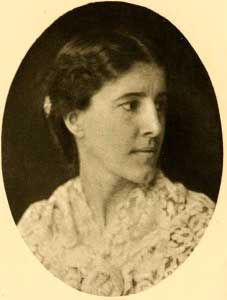
Charlotte Perkins Gilman (July 3, 1860 – August 17, 1935) was an American author of fiction and nonfiction, praised for her feminist works that pushed for equal treatment of women and for breaking out of stereotypical roles.
She’s best remembered for the semi-autobiographical work of short fiction, The Yellow Wallpaper.
She was one of the leading activists in the late 19th and early 20th century American women’s movement, and her nonfiction works detailing how women’s lives were impacted by social and economic bias are still relevant. Read More→