“Renascence” by Edna St. Vincent Millay (1892 – 1950) is the 1912 poem that put this iconic American poet on the literary map. Though it was published when she was just nineteen, it held up as one of the best poems in her canon. You can find an excellent analysis of it on Poetry Foundation.
The 214-line lyric poem consists of rhymed couplets. The overarching theme is the connection of the individual to nature. The narrator of the poem is writing from a mountaintop from which she observes the broad vista; observation becomes a mystical experience.
The poem was written on the summit of Mt. Battle in Camden, Maine, which now has a plaque in the spot that inspired its lines. Read More→
Marjorie Kinnan Rawlings (August 8, 1896 – December 14, 1953) was an American novelist and memoirist best known for The Yearling (1938), the story of a boy who adopts an orphaned fawn, and the hard choices that ensue.
The Yearling won the Pulitzer Prize for Fiction in 1939 and was made into a successful movie in 1946.
Rawlings is also known for her writings about her adopted home in Cross Creek, Florida, where she bought an orange grove in the late 1920s and lived for many decades. Read More→
P.L. Travers (August 9, 1899 – April 23, 1996), full name Pamela Lyndon Travers, was an Australian-born author best remembered as the author of the Mary Poppins series of books.
She had a vivid imagination from childhood on, and was inspired by her love of reading, favoring fairy tales and myths.
Mary Poppins, one of the best-loved characters in children’s literature, came from a little story she made up while babysitting two young children. It first became a book, then a series, and the basis of the renowned 1964 Disney musical film, which greatly displeased the author. Travers wrote other children’s books as well as books for adults focused on mythology. Read More→
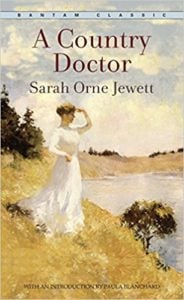
A Country Doctor by Sarah Orne Jewett is an 1884 novel by this American author noted for regional fiction set in Maine. Nan, the main character, is a young woman wants to become a doctor, something that was quite out of the ordinary at the time this story was published.
The story follows a central character in a narrative, unlike the linked sketches in her best-known book, The Country of the Pointed Firs. But like those linked stories, it’s more episodic than plot-driven. Read More→
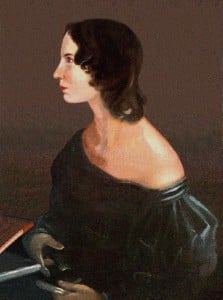
Though Emily Brontë (1818 – 1848), the British only lived to age thirty she left the classic novel Wuthering Heights and a collection of stunning poems as her literary legacy. Here we’ll explore the death of Emily Brontë as told by a 19th century biographer.
The novelist and poet, sister of Charlotte and Anne Brontë, was the fifth child of Maria Branwell Brontë and Reverend Patrick Brontë. In many ways, Emily was a more enigmatic figure than her sisters. An 1885 article in the Chicago Tribune stated:
“Emily Brontë was perhaps the most original of the Brontë children in character; and it is thought by many that she was possessed of an even more striking genius than Charlotte. She was of a peculiarly reserved nature, and never during her life made any friend outside her family.” Read More→
Emily Brontë (1818 – 1848) is best remembered for her haunting and passionate novel Wuthering Heights, but she has also been recognized as a brilliant poet. Among the three sisters, Emily Brontë’s poetry has been acknowledged as more skillful and moving than that of Charlotte or Anne.
In the mid-1840s, Charlotte discovered a stash of Emily’s poems and recognized the genius in them. She undertook the task of finding a home for a collaborative book of poems by herself and her two sisters.
The sisters took noms de plume — Charlotte, Emily, and Anne became Currer, Ellis, and Acton, respectively, and shared the faux surname Bell. Read More→
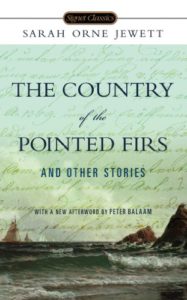
The Country of the Pointed Firs by Sarah Orne Jewett (1896) is often cited as this New England author’s most important work. Neither a novel nor traditional short stories, this book is rather a series of linked sketches of a fictional Maine seaport town called Dunnet Landing.
A quietly evocative writing style conveyed everyday events and quiet emotions, the joys as well as the inevitable losses and hardships experienced the people living in Maine’s coastal fishing villages. Crafting a portrait of a disappearing way of life with this book and the others that she wrote, Jewett helped popularize the genre of regionalism in fiction. Read More→