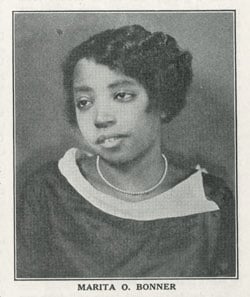
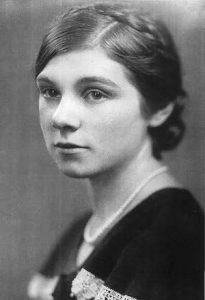
Marita Odette Bonner (1899 – 1971) was a short story writer, playwright, and essayist. Between 1925 and 1927 she produced a great number of short stories featuring characters from varied cultures navigating urban life. She became noted for two prize-winning essays — “On Being Young—A Woman—and Colored” (1925), presented here, and “Drab Rambles” (1927).
One of the earliest Black students at Radcliffe College, she was academically talented as well as a gifted pianist and composer. Upon her 1922, graduation, when she was named “Radcliffe’s Beethoven,” Bonner continued to blossom, becoming a noted figure in the Harlem Renaissance movement.
In the late 1920s, Bonner wrote three plays, the best known of which was The Purple Flower (1928). Her writings often dealt with the challenges of being Black in a racist society, a theme exemplified in the essay that follows. Read More→
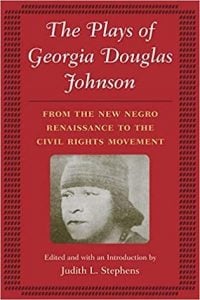
In the heyday of the Harlem Renaissance movement of the 1920s, and the years just before and after, a notable number of Black women made a name for themselves as writers, playwrights, poets, editors, and journalists.
Here, we’ll take a look at eight Black women playwrights of the early twentieth century. For further in-depth overviews of Black women playwrights of the early twentieth century, consult these sources: Read More→
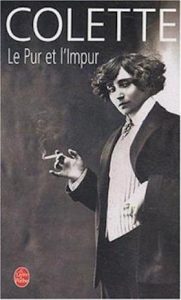
The Pure and the Impure by Colette, a strange work first published in 1932, feels less like a novel and more like a series of loosely stitched together character sketches. Indeed it is just that, of the gay and lesbian demimondaine societies in the Paris of Colette’s time. This deep dive into The Pure and the Impure is excerpted from Text Acts: Eroticism in 20th-Century Literature, volume 2* by Francis Booth. Reprinted by permission.
All but one of the characters are unnamed but are presumably real people that Colette knew. Janet Flanner, who was Paris correspondent for The New Yorker from 1925 onwards, and published plenty of her own sketches of Paris society, said of The Pure and the Impure: Read More→
The Group (1963), is American author Mary McCarthy’s best-known work, though not the one she would have chosen to crown her body of work. Known for the sharp wit and intellectual daring that marked her fiction and nonfiction, McCarthy may not have predicted that this juicy, gossipy novel, with elements of autobiography, would become such a large part of her legacy.
The Group hit the New York Times Bestseller list several weeks after its publication and stayed there for nearly two years. Considered scandalous for its time, it touched on issues of contraception, abortion, mental illness, male chauvinism, and lesbian relationships, as experienced by eight young women from the Vassar College class of 1933.
The book was banned in several countries, but that didn’t deter it from being a huge international hit. The film version of The Group premiered in 1966, featuring a stellar cast (including a breakthrough role for Candice Bergen) and direction by Sidney Lumet. Read More→
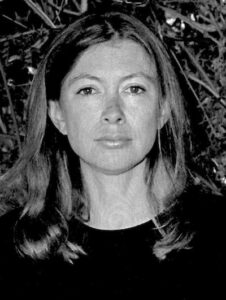
The following selection of quotes by Joan Didion highlights her unique talent at examining life — its joys, sorrows, and challenges.
There are hugely influential writers who inspire others within their lifetimes, and Joan Didion ( 1934 – 2021 ) was certainly one of them. But it’s after her passing that everything she wrote seems to resonate even more, because we realize that there will be no further words of wisdom.
Photo above right by Katherine Ballard, courtesy of Wikimedia Commons. In her tribute to Joan Didion upon her passing, Nancy Snyder wrote,
Read More→
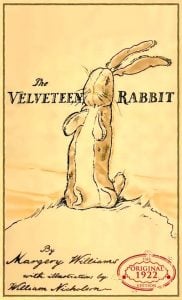
The Velveteen Rabbit (or How Toys Become Real) by Margery Williams was published in 1922 and has been in print ever since. The best-known book by British-born author who was later known as Margery Williams Bianco (1881 – 1944), it has been a children’s classic for generations. In 2022, we celebrate the hundredth anniversary of its publication.
The story is at its heart about the transformative power of love. The original edition was illustrated by William Nicholson, and has been through numerous editions, with artwork by various illustrators.
A 1924 review in The Detroit News observed, “How Toys Become Real is the inner story of The Velveteen Rabbit, but there’s no syrupy moral to it. It’s just that if a toy is loved enough, it finally, through the alchemy of love, becomes real.” Read More→
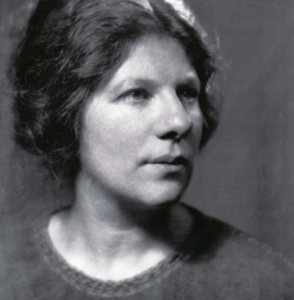
Sydney Taylor (born Sarah Brenner; October 30, 1904 – February 12, 1978) was an American author best known for All-of-a-Kind Family. This series of autobiographical children’s novels portrays the life of an Eastern European Jewish immigrant family in New York City in the early twentieth century.
Though she wrote several other children’s novels, the five books in the All-of-a-Kind Family series proved to be her lasting legacy, earning a devoted audience for their warm and loving depiction of Jewish life in early twentieth-century America.
Photo above right, Sydney Taylor (Sarah Brenner) in the 1920s, from the private collection of her daughter, Jo Taylor Marshall. Read More→
Anzia Yezierska (October 29, 1880 – November 21, 1970) was a Polish-born Jewish-American writer who achieved renown for her fiction on the immigrant experience in the early twentieth century.
Her most notable novel has remained Bread Givers (1925). She also achieved renown with her first short story collection, Hungry Hearts (1920), and her 1923 novel, Salome of the Tenements (1923).
When her family immigrated to the U.S. in 1893, they were among the masses of Eastern European Jews who arrived between 1880 to 1924. Like many Jewish immigrants, they settled and lived in the immigrant neighborhood of the East side of Manhattan. Read More→