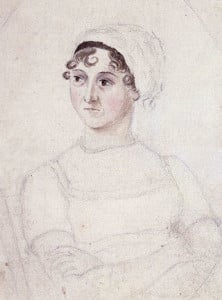
Jane Austen by Sarah Fanny Malden (1889) is a valuable resource on the life and work of the beloved British author from the perspective of the late 19th century. The following excerpt describes her final days —her illness, the courage she displayed, and her death.
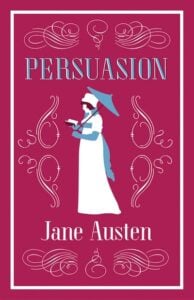
Persuasion, the novel Jane Austen (1775 – 1817) was working on when she took ill, and Northanger Abbey (her first completed novel, still unpublished at the time of her death) were both published six months after her death in 1817.
There has been much speculation on the exact cause of her death, and the nature of her illness; but since no one can go back and prove one theory or another, that’s exactly what they remain — theories. You can explore some of these contemporary conjectures; take them all with a grain of salt: Read More→
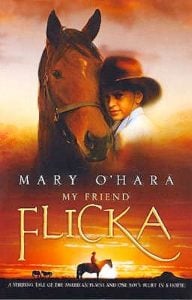
My Friend Flicka, the 1941 novel by Mary O’Hara, is this author’s most enduring work. The ranch living and rugged Wyoming landscape of her personal experience inspired the novel.
A classic that’s for “children of all ages,” My Friend Flicka is the story of Ken McLaughlin, a rancher’s son, and his untamed horse.
Ken’s father, a practical Scotsman, had no patience for his son’s dreaminess, so out of place in the harsh realities of the family’s horse-breeding farm. Ken becomes smitten with a wild colt, who he names Flicka, meaning “little filly.” Read More→
The Greengage Summer by Rumer Godden is a 1958 coming-of-age novel, crackling with suspense, and portraying love and deceit in the Champagne country in France. A memorable passage from this engaging novel based on an incident in Godden’s youth.
“On and off, all that hot French August, we made ourselves ill from eating the greengages. Joss and I felt guilty; we were still at the age when we thought being greedy was a childish fault and this gave our guilt a tinge of hopelessness because, up to then, we had believed that as we grew older our faults would disappear, and none of them did.”
Taking place in the shabby hotel of Les Oeillets, once gloriously elegant, the four children of the Grey family find themselves alone with the shady eccentrics who run the hotel. Like many of Godden’s novels, The Greengage Summer was adapted into film, this one a 1961 British production starring Kenneth More, Jane Asher, and Susannah York. Read More→
The Peacock Spring by Rumer Godden is a 1975 novel by the British-born novelist and memoirist who was raised mainly in India at the height of colonial rule. Margaret Rumer Godden (1907 – 1998) led a life was as dramatic and colorful as her stories.
Inspired by her personal experiences and love for the Indian continent, The Peacock Spring is a beautiful and heartbreaking novel of loss of innocence and coming-of-age from the acclaimed author of Black Narcissus and The River.
Despite Godden’s love for the Indian people and continent, it is certainly time to consider literature written from the perspective of British colonialism from today’s perspective. However, she doesn’t shy away from the harsh realities of wealth, privilege, race, and caste in colonial Indian society. As always, Godden’s prose is vivid and poetic.
Read More→
Jane Austen’s talent was recognized early on and taken seriously by her entire family. Her father and brothers played key roles in getting her works published, as it wasn’t considered proper for a woman to do so herself in the early 1800s. This 19th-century view of Jane Austen’s first attempts at publishing illustrates the difficulties of the pursuit.
Austen longed to see her work in print, regardless of whether or not it would gain her fame or fortune — but getting it published was important to her, contrary to the myth about her extreme modesty.
Her father and brothers took it upon themselves to seek publication opportunities for Jane’s first works. It was clear that she didn’t write merely for her own amusement but was deeply invested in having her work published and read. Read More→
In her lifetime of sixty-nine years, bell hooks (born Gloria Jean Watkins, September 25, 1952 – December 15, 2021) became internationally recognized and highly acclaimed as a prolific writer, beloved poet, university professor, public intellectual, social activist, and cultural critic. Photo at right courtesy of Wikimedia Commons.
Her legacy of written work (which included forty books) and her contributions to the public discourse on the intersectionality of race, gender, love, feminism, and capitalism is inestimable.
Margaret Atwood, author of The Handmaid’s Tale stated, “Her impact extended far beyond the United States; many women from all over the world owe her a great debt.” Read More→
While scrolling through social media, it’s not usual for me to stop because a word or words grab my attention, but sometimes I simply had to go back and read the lines that had caught my eye. More often than not, it turned out to be one of Emily Dickinson’s poems.
They’re light in the sense that she tended to use simple, everyday words, often sparingly. Yet, vivid images spring out from them to capture one’s imagination. Or her deep concepts compressed into a few lines oblige one to delve deeper into her poems.
Her verses aren’t pretentious, though she was as well-read as any man of her era. Yet, it seems she didn’t choose grandiose words to impress anyone, especially as most of her poems went unpublished during her lifetime. Read More→
Jane Austen by Sarah Fanny Malden (1889) offers a detailed 19th-century view of Jane Austen’s life and works. The following analysis and plot summary of Persuasion focuses on the novel that many consider to be Austen’s most mature and accomplished work.
Persuasion, the last novel Austen wrote, and Northanger Abbey, her first completed novel, were both published in 1817, six months after her death.
Mrs. Malden said of her sources, “The writer wishes to express her obligations to Lord Brabourne and Mr. C. Austen Leigh for their kind permission to make use of the Memoir and Letters of their gifted relative, which have been her principal authorities for this work.” Read More→