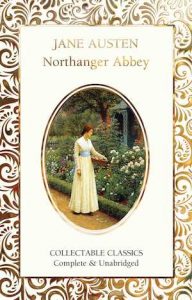
The first novel intended for publication by Jane Austen, Northanger Abbey was originally titled Susan. Completed in 1803, it wasn’t published until 1817, the year of the author’s death.
This coming-of-age novel’s heroine, Catherine Morland, at first young and rather naïve, learns the ways of the world in the course of the narrative.
Set in Bath, England, the fashionable resort city where the Austens lived for a time, Jane Austen critiques young women who put too much stock in appearances, wealth, and social acceptance. Catherine values happiness but not at the cost of compromising one’s values and morals. Read More→
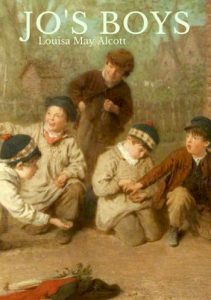
Jo March, the standout sister of Little Women (1868), was the idealized alter ego of her creator, Louisa May Alcott — both were tomboyish, with a bit of a temper. Like Louisa, Jo was completely dedicated to the pursuit of writing and the writer’s life. Or was she? Certainly, that was her stated ambition in Little Women, in which we witness the birth of her first book.
I can’t think of another fictional character who inspired generations of real-life aspiring female writers. It’s almost easier to find writers who weren’t at least a little influenced by Jo, than those who were. Because so, so many young wordsmiths wanted to grown up to be like Jo.
Though Jo longed to be a writer more than anything, she also sought a happy medium between achieving independence and finding love, something that was expected of women of her time. That’s why she felt she had to turn down Laurie’s proposal (much to the chagrin of millions of readers). Read More→
Jane Austen by Sarah Fanny Malden (1889) offers views of Jane Austen‘s life and work from a 19th-century perspective. The following analysis and plot summary of Emma (1815) focuses on what some readers and critics believe to be the author’s finest novel (some might beg to differ, of course).
Mrs. Malden said of her sources, “The writer wishes to express her obligations to Lord Brabourne and Mr. C. Austen Leigh for their kind permission to make use of the Memoir and Letters of their gifted relative, which have been her principal authorities for this work.”
The 1889 publication of Malden’s Jane Austen was part of an Eminent Women series published by W.H. Allen & Co., London. The following excerpt is in the public domain: Read More→
Claudia Emerson (1957 – 2014) won the Pulitzer Prize for poetry for her book Late Wife in 2006. I think she would have been eventually chosen as the United States Poet Laureate if her brilliant career hadn’t been cut short by cancer.
She not only published eight collections of verse, but she was also a gifted teacher and musician. I knew her because we were in the same class at Chatham Hall, an all-girls’ school in Pittsylvania, County, southside Virginia. We were the class of 1975.
Chatham Hall was founded in 1894, originally named Chatham Episcopal Institute, and our most famous graduate was Georgia O’Keeffe. The school’s motto is Esto perpetua – “Let it be perpetual.” Read More→
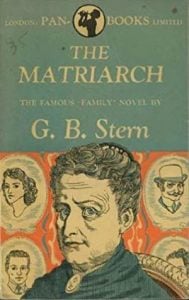
British writer G.B. Stern (1890 – 1973) published a five-volume Jewish family saga collectively entitled, confusingly, both The Rakonitz Chronicles, the first three volumes published together in 1932, and The Matriarch Chronicles in their expanded 1936 form.
This overview of The Matriarch, the first in a series and the best-known work by Stern is excerpted from A Girl Named Vera Can Never Tell a Lie: The Fiction of Vera Caspary by Francis Booth ©2022. Reprinted by permission.
Born in London as Gladys Bertha Stern, she was later Gladys Bronwyn, and wrote mainly under her initials. She was a friend of Somerset Maugham, H.G. Wells, Rebecca West, and Noël Coward, she wrote over forty novels, as well as plays, short stories, criticism. Read More→
Jane Austen by Sarah Fanny Malden (1889) offers an excellent 19th-century view of Jane Austen’s works, along with a handful of chapters on the life of this beloved British author. This excerpt, featuring one such chapter, offers glimpses of Jane Austen’s childhood and what she engaged with as a young woman.
Born in Steventon, Hampshire (England), Jane (1775 – 1817) was part of a convivial middle-class family consisting of five brothers and her sister Cassandra, with whom she was very close. Her father was an esteemed rector. Jane spent the first twenty-five years of her life in Steventon, after which the family moved to Bath.
Mrs. Malden said of her sources, “The writer wishes to express her obligations to Lord Brabourne and Mr. C. Austen Leigh for their kind permission to make use of the Memoir and Letters of their gifted relative, which have been her principal authorities for this work.” Read More→
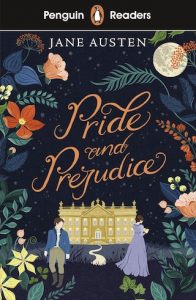
Jane Austen by Sarah Fanny Malden (1889) offers an excellent 19th-century view of Jane Austen’s works. The following analysis and plot summary of Pride and Prejudice (1813) focuses on this beloved novel, which was Jane Austen‘s second to be published.
Pride and Prejudice followed Sense and Sensibility, published two years earlier in 1811.
The 1889 publication of Malden’s Jane Austen was part of the Eminent Women series published by W.H. Allen & Co., London. The following excerpt is in the public domain: Read More→
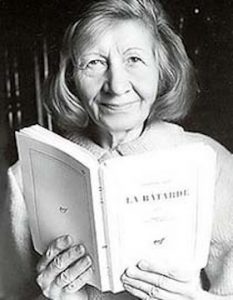
Simone de Beauvoir first met the French author Violette Leduc in 1945. At the time, de Beauvoir and her partner Jean-Paul Sartre were the golden couple of Parisian intellectual circles, while Violette Leduc was a struggling writer mired in poverty.
Their first meeting, in the heady atmosphere of the Café Flore on the Left Bank, came only after Leduc had observed de Beauvoir and Sartre from a distance for several months, gathering the courage to introduce herself.
The resulting friendship seemed unlikely. Yet it lasted for several years, with mutual respect and admiration that survived Leduc’s unrequited attraction to de Beauvoir as well as the differing circumstances of the two women and their wildly diverging experiences of success. Read More→