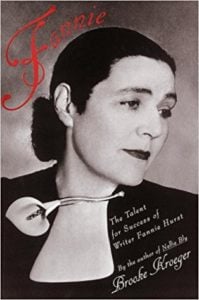
From the 1999 Times Books edition of Fannie: The Talent for Success of Writer Fannie Hurst by Brooke Kroeger: In the first half of the twentieth century, Fannie Hurst was known as such for the startling particulars of her extraordinary life as for writing stories that penetrated the human heart.
Hers is the story of a Jewish girl from the Middle West turned dynamic celebrity author, the kid down the street who spoke her dreams out loud and then managed to fulfill every one of them.
Her name was constant newspaper fodder. It appeared in reviews of her twenty-six books; in reports of her travels, her lifestyle (including the marriage she curiously chose to hide from her friends as well as the public), her diet, and her provocative public statements; and in her obituary, which was front-page news, even in The New York Times. Read More→
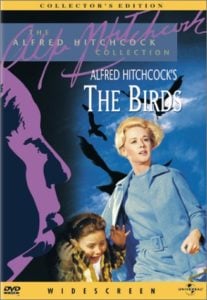
I made the mistake of seeing The Birds, a 1963 film by Alfred Hitchcock when I was young. Not being a fan of all things scary, I never quite recovered enough to give it a second view as an adult, especially since it’s based on a novella of the same name by Daphne du Maurier, an author I admire (Rebecca is one of my favorite classics).
The following article/review about the film from 1963, the year the film came out, reveals the surprising fact that the masses of birds were — real birds! Of course, in today’s world it would have been done digitally. Read More→
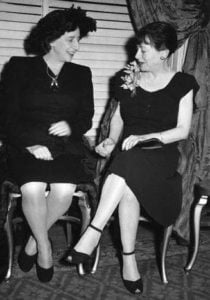
Lillian Hellman, the legendary American playwright, met Dorothy Parker, known for her brittle poetry and acid wit, in 1931. Hellman, not yet famous, was with her longtime partner Dashiell Hammett at a New York party when Parker approached the couple, fell to her knees, and kissed Hammett’s hand.
The scene made the couple uncomfortable, and Hellman never imagined she’d want to see Parker again, let alone befriend her. But when the two women met four years later, they clicked and became lifelong friends.
Here, in Hellman’s own words from her 1969 memoir An Unfinished Woman, some observations about her friend Dorothy Parker: Read More→
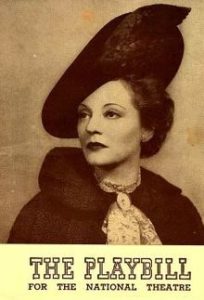
The Little Foxes by Lillian Hellman is a 1939 stage play considered a classic of twentieth century American theater. Set in small Southern town 1900, it centers on Regina Hubbard Giddens, who conspires with her brothers for control of a family business belonging to her husband, in an era when men were seen as the only legal heirs.
The play has been staged and in revival ever since it was first opened on Broadway in 1939. We’ll look at some of those performances (and a film version) after the following description. Read More→
The Estate of Margaret Mitchell is very strict in terms of what they will allow to be done with the intellectual property of Gone With the Wind, one of the biggest blockbusters in American literary history.
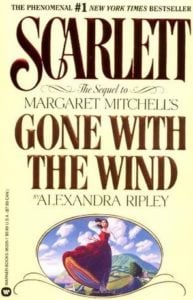
So it was a quite a coup that Scarlett by Alexandra Ripley was published as an authorized sequel to GWTW. Though this book was scorned by critics, it was a commercial success. The following description is from the 1991 Warner book edition:
Gone With the Wind … dramatic, romantic, sweeping in its depiction of a time and place in American history, unparalleled in its portrayal of men and women at once larger than life and as real as ourselves … Read More→
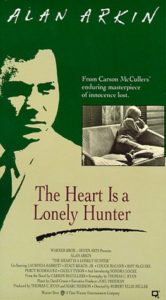
The 1968 film version of The Heart is a Lonely Hunter, based on the 1940 novel by Carson McCullers, aimed for a faithful adaption. Though it had its merits, the film got mixed reviews.
Strong performances, especially by Alan Arkin as Singer and Sondra Locke as Mick (her film debut) earned them both Academy Award and Golden Globe nominations — for Best Actor and Best Supporting Actress, respectively. The film received numerous other nominations and awards, and was generally favorably reviewed.
Still, the film fails to capture the sweep and emotional impact of the book, so I’d recommend reading it before considering the film. Here’s a review that was published when the film premiered in 1968: Read More→
No one more surprised than Margaret Mitchell (1900 – 1949) herself when Gone With The Wind became an immediate smash hit upon its June, 1936 publication. The novel went on to be published in over forty countries and was adapted as the faithful 1939 film.
Here we’ll explore quotes from Gone With the Wind as well as other gems from the pen of Margaret Mitchell. Margaret may have herself been partially the model for Scarlett O’Hara, one of the most complex and charismatic of literary heroines.
For nine agonizing years, Margaret worked and reworked the massive story, sometimes typing, sometimes scribbling by hand. The manuscript piled up here and there, on desks, in drawers, on closet shelves. She showed friends bits and pieces, but never the entire work. Perhaps no one was as amazed by its phenomenal success as its author. Read More→
If you’ve read Margaret Mitchell’s 1,000-plus page magnum opus multiple times but can’t enough of it, consider exploring these prequels and sequels to Gone With the Wind. They expand on the stories of the complicated characters who have gripped the imagination for decades, ever since the book was first published in 1936.
GWTW had already been made a selection of Book of the Month Club, when it burst on the scene and advance sales were remarkable for a first novel by such an unknown author, particularly for a book of this length.
The U.S. was still gripped by the Great Depression, and the public evidently needed some diversion. It’s hard to argue that the book was an instant publishing phenomenon.
Read More→