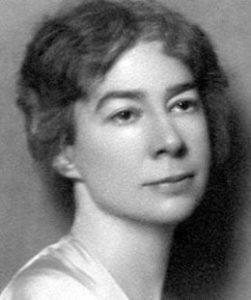
Adrienne Rich (May 16, 1929 – March 27, 2012) was an American poet and essayist known for her radical feminism and activism.
Born in Baltimore, Maryland, she was raised in a family that included a younger sister. Her father who worked as a pathologist at John Hopkins, and her mother was a classical concert pianist. It was her father who first encouraged her literary leanings.
After graduating from Roland Park Country School, Rich attended Radcliffe College (the former women’s college of Harvard University), from which she graduated in 1951. Read More→
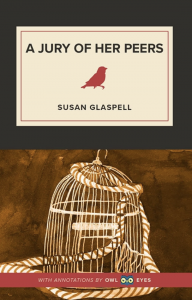
A Jury of Her Peers by Susan Glaspell (1876 – 1948), a 1917 short story, is arguably this American author’s most enduring work. Certainly, it’s one of her most anthologized.
This short story was based on Glaspell’s 1916 one-act play, Trifles (you can also read the full text of Trifles here), also a widely anthologized work.
Both Trifles and A Jury of Her Peers were inspired by a true crime story that Glaspell covered as a reporter for theDes Moines Daily News in 1900. Read More→
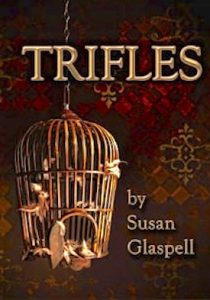
Presented here is the full text of Trifles, a 1916 one-act play by the American author and playwright Susan Glaspell (1876 – 1948), along with a brief theatrical history and plot summary. For your reading convenience, and an ad-free experience, link to the pdf of Trifles here.
This playlet one of Glaspell’s most anthologized works, along with the 1917 short story she based upon this play, A Jury of Her Peers.Trifles was first performed at the Wharf Theater in Provincetown, Massachusetts in August of 1916. The author herself performed as Mrs. Hale, the wife of a neighboring farmer.
Read More→
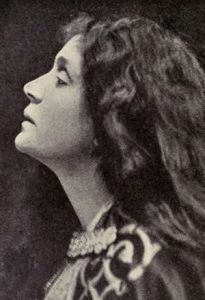
Sara Teasdale (1884 – 1933) was well known in her time for lyric poetry that celebrated the beautiful things in life, even as she herself struggled with perpetual illness and loneliness. Here we’ll explore a grouping of early poetry known as Sonnets to Duse, which served as Teasdale’s entry into the literary world.
Born in St. Louis, Missouri, she was the daughter of wealthy parents. In her young adult years in St. Louis, she was part of a group of creative, talented young women who called themselves the Potters. They hand-printed a magazine called The Potter’s Wheel, where Sara’s early poems were first published.
This led to the publication of her first book, Sonnets to Duse and Other Poems in 1907. She was twenty-three at the time of its publication. Read More→
Sara Teasdale (August 8, 1884 – January 29, 1933) was an American poet known for her deceptively simple lyric poetry that emphasized life’s beauty.
Born and raised in St. Louis, Missouri, she was the youngest of four children of wealthy parents. In delicate health throughout her childhood, she was tutored at home until the age of ten.
Despite her privileged background, and being spoiled and petted, Sara’s childhood was often lonely. She lived in a separate suite in her family’s grand homes, often left alone. The ill health of her childhood followed her throughout much of her adult life, and she often had to have a nurse-companion. Read More→
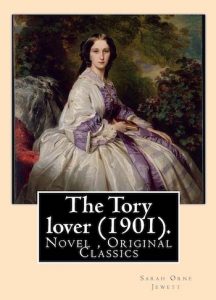
The Tory Lover by Sarah Orne Jewett is a 1901 novel by this esteemed New England author best known for The Country of the Pointed Firs (1896). The story is partly set in Berwick, Maine, where Jewett grew up and spent much of her life, and takes place during the Revolutionary period.
Roger Wallingford, a gentleman of Tory ancestry joins the cause of the Patriots through his love for the beautiful Mary Hamilton.
Mary urges Captain Paul Jones, a compatriot of her brother, to give a commission to Wallingford. A nefarious shipmate contrives to have Wallingford arrested for treachery and desertion, and he virtually disappears. Mary believes that the charges are false, so she and his mother set sail for England to find him and clear his name. Read More→
Emma Lazarus (July 22, 1849 – November 17, 1887), American poet, translator, and immigrant advocate. She’s best known for the poem “The New Colossus” (1883), whose lines beginning with “Give me your tired, your poor …” are inscribed at the base of the Statue of Liberty.
As touching and world-famous as this poem has remained, it’s but a tiny portion of her body of work. The life of Emma Lazarus, brief as it would be, was filled with accomplishment, not only as a writer, but as an advocate for immigrants (especially Jewish immigrants) and refugees.
Read More→
How to select quotes from Mrs. Dalloway by Virginia Woolf, when almost every sentence in the book is quotable? It’s a tough choice, indeed.
The 1925 novel whose narrative is built on the inner consciousness of its characters, particularly Clarissa Dalloway, was groundbreaking in its time. Often called “a novel of one day,” it was almost universally praised for its innovative format. One 1925 review stated:
“Mrs. Woolf makes one aware of one’s own mental experiences in a way no other contemporary writer has ever achieved. Her characters appear upon the scenic screen of Clarissa Dalloway’s consciousness in proportion to her personal reaction to them; and then appear again in a swift soul-probing analysis as they really are. Read More→