5 Classic Novels by Women Writers that Became Oscar-Winning Films
By Nava Atlas | On March 18, 2026 | Updated June 22, 2026 | Comments (0)
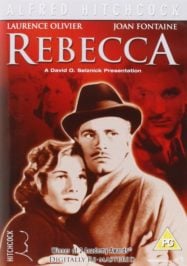
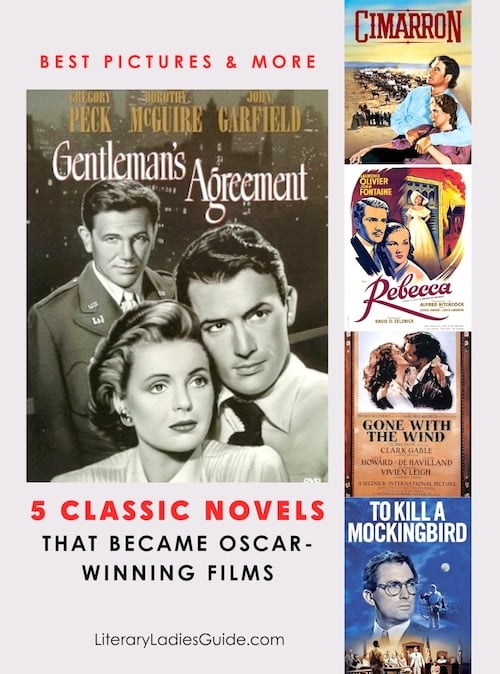
Here’s a look at five Academy Award-winning films based on now-classic novels by women writers: Cimarron, Gone with the Wind, Rebecca, Gentleman’s Agreement, and To Kill a Mockingbird.
Novels have long provided rich narrative material for film, though it seems that this practice is less common that it was in the past. At least in the first part of the 20th century, well-regarded bestsellers were regularly adapted to film. This could be relative, though; so many more books are being published and vying for attention in the present.
Following these, you’ll find a list of a dozen more Oscar-nominated and winning films that helped cement their original novels in the public imagination, even if some of their authors are not well remembered today.
. . . . . . . . . .
Cimarron (1931)
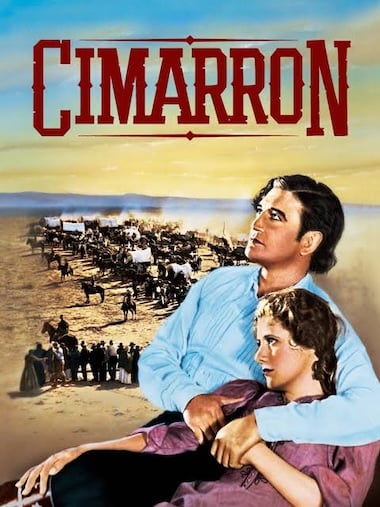
Cimarron was a 1930 novel by the prolific Edna Ferber. It was quickly adapted to film, earning accolades and winning the Academy Award for Best Picture (then called Best Production) in 1931 It was the first (and remained one of only a handful of) western to win this major award.
Though it wasn’t the first of Ferber’s novels to be adapted to film, it was a far more expansive (and expensive) production. It paved the way for more Hollywood blockbusters based on other Ferber novels, including Showboat, Giant, and others.
Cimarron takes on the subject of the Oklahoma territory Land Run of 1889. The film was nominated for Best Actor, Best Actress, and Best Director, though it won only in the categories of Adaptation and Art Direction, other then the top award of Best Production.
Cimarron was remade in 1960, but failed to receive the same level of accolades as the original. Learn more about Cimarron — the book and film.
. . . . . . . . . .
Gone with the Wind (1939)
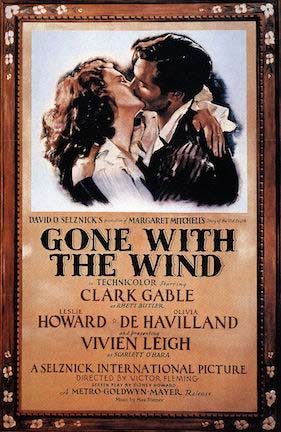
Gone With the Wind — the 1936 novel by Margaret Mitchell — was a publishing phenomenon from the moment it rolled off the presses. MacMillan published GWTW at a time when the book industry was still suffering from the results of the Great Depression.
At least one person was concerned about the enterprise: Mitchell herself. “I do hope they sell five thousand copies,” she remarked, “so they don’t lose money.” She needn’t have worried: its first day, GWTW sold 50,000 copies. No wonder Hollywood snapped it up.
Over time, Gone With the Wind’s revisionist view of the antebellum South and enslaved people has been, to put it mildly, reconsidered. At the time, the faithful adaptation was a box-office blockbuster. It was nominated for 15 Academy Awards, and won for Best Picture, Best Actress, Best Supporting Actress, Best Director, Best Screenplay, Best Cinematography, Best Art Direction, and Best Editing.
There’s much to critique about the book and film, and even how the awards played out — Hattie McDaniel, the first Black actress to win Best Supporting Actress — was made to sit at a separate table from her colleagues at the award ceremony.
There’s no excuse for romanticizing slavery, but Margaret Mitchell (who died at age 48 after being struck by a car in Atlanta) burnished her legacy in one surprising way. With her earnings, she secretly funded the medical school education of some twenty Black students at Morehouse College. They had no idea who their benefactor was until decades later.
. . . . . . . . . .
Rebecca (1940)

The 1940 film version of Rebecca, based on Daphne du Maurier’s 1938 novel of the same name, is a psychological thriller with a nod to the literary gothic tradition. The black-and-white film, which captured the moody, mysterious feel of the book, was the first American film by director Alfred Hitchcock.
Joan Fontaine starred in the role of the naïve young woman who marries the brooding widower Maxim de Winter, portrayed by Laurence Olivier. Rebecca, the deceased first wife of Maxim de Winter, is never seen in the film. Yet she casts a powerful shadow over the inhabitants of Manderlay castle. The suspense builds until we learn just why she continues to have such a grip on the living.
This film classic is a faithful adaptation of du Maurier’s masterpiece. Because of the Hayes Code, one important detail was changed; it would be a spoiler to reveal it here, so as always, it’s recommended to read the book before seeing the film.
Rebecca was nominated for eleven Academy Awards and won two — Best Picture and Cinematography (black and white). Notably, it was nominated for Best Director (Hitchcock), Best Actress (Joan Fontaine), Best Actor (Laurence Olivier), and Best Adapted Screenplay. It appears on numerous best film lists, including the American Film Institute’s (AFI) 100 Years, 100 Thrills.
. . . . . . . . . .
Gentleman’s Agreement (1947)
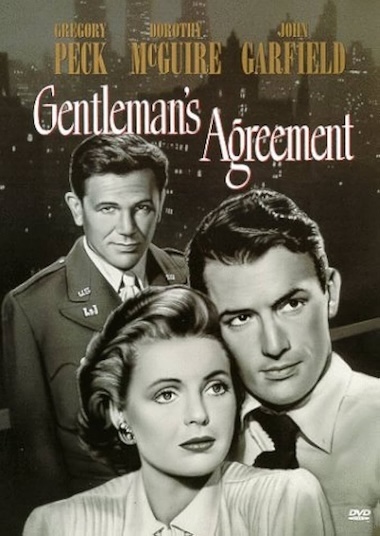
Gentleman’s Agreement, the classic 1947 film, was based on the novel of the same name by Laura Z. Hobson, which was published the same year. Hobson doubted any publisher would want to take it on, let alone that it would become an award-winning film.
It’s the story of Philip Schuyler Green, a journalist who poses as a Jew in order to investigate antisemitism in post-World War II New York City and environs. Though it showed only a narrow slice of what was sometimes considered “genteel” antisemitism centered in New York City’s upper class, the film sensitively explores the topic and is quite true to the book.
Gentleman’s Agreement won Best Picture of 1947, with Elia Kazan, getting the award for Best Director. Gregory Peck won for Best Actor, Dorothy Maguire for Best Actress. Though the film seems tame by today’s standards, it smashed Hollywood taboos by dealing with the topic of antisemitism.
. . . . . . . . . .
To Kill a Mockingbird (1960)
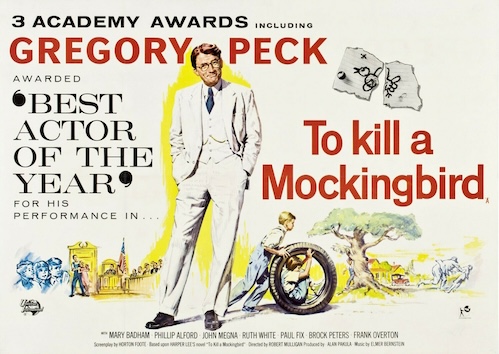
The 1962 film version of To Kill a Mockingbird cemented Harper Lee’s 1960 classic reputation as a Great American Novel. With Gregory Peck as Atticus and two children from Alabama — Mary Badham and Phillip Alford — as Scout and Jem, the film was completely true to the spirit of the novel.
Harper Lee originally wanted the role of Atticus Finch to go to Spencer Tracy, even writing him a letter to ask that he star in the film. He was unavailable, but as it turned out, there couldn’t have been a more fitting actor to portray Atticus than Gregory Peck. Lee came to came to adore him, and the two remained friends until Peck’s death in 2003.
In recent years, TCAM has been viewed with a different lens, especially after the publication of Go Set a Watchman (2015), which was originally promoted as a sequel. Now it has come to be viewed as a first draft of TCAM. Watchman follows the twenty-something Scout as she return home to Alabama to visit her father, Atticus. Watchman upset readers who were displeased to find that Atticus, TCAM’s heroic and beloved lawyer and widowed father, was actually a bigot.
It’s interesting to ponder whether the new framing has affected the stature of the film, as it has the book. The film was nominated for 8 Academy Awards and won 3: Best Actor, Adapted Screenplay, and Art Direction.
. . . . . . . . . . .
. . . . . . . . . . .
More Oscar-nominated films based on novels by women writers
Here are a dozen more entries, is by no means an exhaustive list!
1931 – Bad Girl (based on the 1928 novel by Viña Delmar) – nominated for 3 awards, including Best Picture; won for Best Director and Best Adapted Screenplay.
1942 – Now, Voyager (based on the 1941 novel by Olive Prouty) – nominated for 3 awards, won for Best Score.
1944 – Laura (based on the 1943 novel by Vera Caspery) – nominated for 5 awards, won for Best Cinematography, B&W.
1945 – A Tree Goes in Brooklyn (based on the 1943 novel by Betty Smith) – nominated for 3 Academy Awards, won 2: Best Supporting Actor James Dunn, Special Juvenile Award, Peggy Ann Garner.
1956 – Giant (based on the 1952 novel by by Edna Ferber) – nominated for 9 awards, won for Best Director, George Stevens.
1956 – The King and I (based on the 1944 novel Anna and the King of Siam by Margaret Langdon – nominated for 9 Academy Awards, won 5, including Best Actor for Yul Brynner, and several technical awards.
1957 – Peyton Place (based on the 1956 novel by Grace Metalious) – nominated for 9 awards, won none.
1959 – Gigi (based on the 1944 novella by Colette) – nominated for 9 awards, won all of them, including Best Picture, Direction, and adapted screenplay.
1994 – Little Women (based on the 1868 novel by Louisa May Alcott) – nominated for 3 Academy wards, including Winona Ryder for Best Actress; won none.
1975 – Murder on the Orient Express (based on the 1934 novel by Agatha Christie) – nominated for 6 academy awards, won one, Best Supporting Actress Ingrid Bergman.
2019 – Little Women (again! based on the 1868 novel by Louisa May Alcott) – nominated for 6 academy awards, including Best Picture, Actress, Adapted Screenplay; won for Best Costume Design.
2022 – Women Talking, based on the 2018 novel by Miriam Toews – nominated for Best Picture and Best Adapted Screenplay; won for the latter.
Leave a Reply