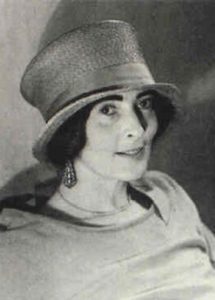
Though not as well known today, Mina Loy was well entrenched in the modernist circles that included leading figures of arts and letters of the 1920s. This musing on Mina Loy and the “Crowd” is excerpted from Everybody I Can Think of Ever: Meetings That Made the Avant-Garde by Francis Booth. Reprinted by permission.
Mina Loy (1882 – 1966), who practiced both as a writer and visual artist, was a vital member of the group of creatives that launched the modernist movement. Born in Hampstead, London, she was a painter, poet, novelist, and playwright, and also achieved some renown as a lamp designer. Read More→
This year, as spring approached I took on the perspective of Emily Dickinson and slowly, tentatively, began to believe that hope — “the thing with feathers, that perches in the soul” — is real and possible.
The poet that I instinctively read, and read again, was Edna St. Vincent Millay (1892 – 1950) and her observations on the spring season.
This bouquet of spring poetry chosen from Millay’s poems seems to have a common thread: She is annoyed at spring’s exuberant beauty coming yearly, and becomes indifferent and slightly angry that it does so when her heart is in torment. She experiences this blossoming as something of an intrusion upon her grieving. Read More→
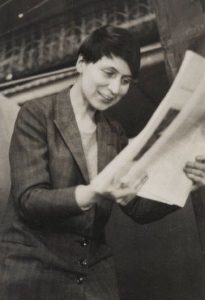
Towards the end of World War I, the American expatriate writer and poet Hilda Doolittle, H.D. met Annie Winifred Ellerman, known as Bryher. H.D. and Breyher became lovers and would remain intimate for the rest of H.D.’s life, supporting and sustaining each other and sharing the responsibility of parenting H.D.’s daughter Perdita.
However, theirs was not an exclusive partnership. Both took other lovers, and in 1921 Bryher entered into a marriage of convenience with the American writer and publisher Robert McAlmon. This arrangement enabled Bryher to keep her traditional family at arm’s length, and allowed McAlmon to use her wealth to set up his own press.
This excerpt, detailing the complex relationships of a circle of modernist literary figures, is from Everybody I Can Think of Ever: Meetings That Made the Avant-Garde by Francis Booth. Reprinted by permission. Read More→
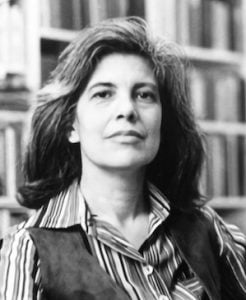
Quotes by Susan Sontag have the capability to change the reader’s perception about how we view our lives — especially in regards to art and our own cultural limitations and vanities.
To contemplate a quote, or a line from one of Susan Sontag’s (1930 – 2004) many essays or novels, will invariably have the reader pause and read the line or paragraph again. Photo at right, Lynn Gilbert, ©1979, courtesy of Wikimedia Commons, creative commons license.
My own literary daydream has been to visit a bookstore, most likely The Strand on Broadway and 12th Street in New York City, and Sontag would be my guide as we strolled the aisles. Read More→
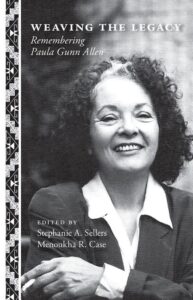
Paula Gunn Allen (October 24, 1939 – May 29, 2008) was an award-winning Indigenous American poet, novelist, activist, and professor.
She is widely considered a founding figure of contemporary indigenous literature, defining its canon and bringing it to the greater public eye at a time when many denied its existence. She is remembered for her engaging fictional work and groundbreaking critical essays.
Known as one of the key intellectual minds of indigenous literature and history, Paula bridged the literary gap between indigenous writing and feminism. In her lifetime, she published seventeen works, many are still frequently anthologized.
Read More→
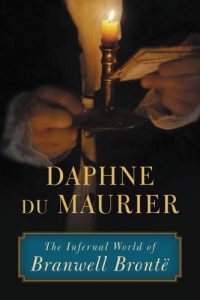
The three Brontë sisters — Charlotte, Emily, and Anne — cherished literary ambitions from an early age, and despite lives cut short by illness, earned a prominent place in the English literary canon. The same can’t be said for their brother, Branwell Brontë (1817 – 1848), whose dissipated life ended at age thirty-one, with little to show for his early talent other than thwarted ambition.
The children of Maria Branwell Brontë and Reverend Patrick Brontë, the Brontë siblings grew up in Haworth, England, located in Yorkshire. Maria Branwell Brontë died while the children were still very young, and the two oldest sisters, Maria and Elizabeth, died of illness before reaching adolescence. Read More→
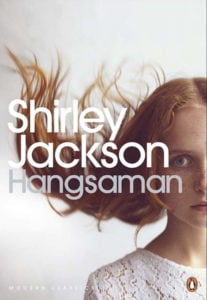
This analysis of Hangsaman, Shirley Jackson’s chilling and thought-provoking 1951 novel, is excerpted from Girls in Bloom: Coming of Age in the Mid-20th Century Woman’s Novel by Francis Booth, reprinted by permission.
In a 1956 book called Sex Variant Women in Literature, the academic critic, Jeanette H. Foster referred to Hangsaman as “an eerie novel about lesbians.’ This is a bizarre reading of the novel and Shirley Jackson was incensed. Her biographer, Judy Oppenheimer, quoted her as saying:
“I happen to know what Hangsaman is about. I wrote it. And dammit it is about what I say it is about and not some dirty old lady at Oxford. Because (let me whisper) I don’t really know anything about stuff like that. And I don’t want to know… I am writing about ambivalence but it is an ambivalence of the spirit or the mind, not the sex. My poor devils have enough to contend with without being sex deviates along with being moral and romantic deviates.” Read More→
Discover some of the best-known classic women Pakistani novelists and poets who challenged society’s norms and made invaluable contributions to literature.
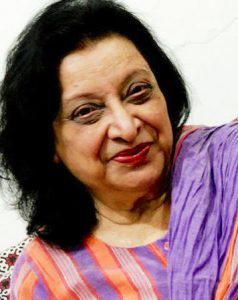
Many classic Pakistani women authors were born before the partition and lived through the horrors of migration. They had to adjust to a new life in the new country, and these extraordinary life experiences seep into their writings. (Pictured here, Fahmida Riaz.)
With their fiery words, they bent social norms and challenged patriarchy and debauchery long before the concept of feminism or human rights became a part of living room discussions. Read More→