By Anna Fiore | On October 18, 2021 | Updated August 19, 2022 | Comments (2)
Marguerite Henry (April 13, 1902 — November 26, 1977), was a beloved American author of animal stories for children. She authored more than fifty children’s books, capturing especially the dreams and fantasies of horse-loving children everywhere.
Many of Marguerite Henry’s books are based on true stories of horses (and occasionally other animals), and have since been translated into twelve languages. Her best-known novels are Misty of Chincoteague (the basis for the 1961 movie Misty) and its sequels.
King of the Wind (1948) is another of her most popular novels, recognized as “the most distinguished contribution to American literature for children,” by the American Library Association. Both it and Misty of Chincoteague won the highest accolade a children’s book can garner, the Newbery Medal Award; King of the Wind won the Young Reader’s Choice Award in 1951 as well.
Read More→
By Francis Booth | On October 16, 2021 | Updated May 15, 2024 | Comments (0)
Passing by Nella Larsen (1929) has staked an important place as a classic fictional work of race, class, sexuality, and identity. Thematically similar, and published the same year, The White Girl by Vera Caspary, a white Jewish novelist and screenwriter, was published earlier that same year and is all but forgotten.
This analysis of how this now-obscure novel relates to Nella Larsen’s enduring classic is excerpted from the forthcoming A Girl Named Vera Can Never Tell a Lie: The Novels of Vera Caspary by Francis Booth:
In a career spanning 1929 to 1979, prolific novelist and screenwriter Vera Caspary wrote a series of compelling strong and amoral women. Her two most famous titular anti-heroines – Laura and Bedelia – were turned into successful Hollywood films of the noir genre in the 1940s. Read More→
By Anna Fiore | On October 14, 2021 | Updated August 25, 2022 | Comments (3)
Marguerite Henry (1902–1997) was an American children’s book author who wrote some fifty-nine novels inspired by true stories of horses and other animals. Her most famous novel, Misty of Chincoteague (1947), was the first in a series of six stories centered around a wild palomino pony named Misty.
Set in the island town of Chincoteague, Virginia, the novel stars Misty and her mother (Phantom) along with brother and sister Paul and Maureen Beebe. While the book is a work of fiction, the story is based on real people and ponies of Chincoteague Island.
In 1948, Misty of Chincoteague received the Newbery Honor Award and went on to become a classic children’s horse story, right up there with Black Beauty. The book was a bestseller, reprinted numerous times, and is still in print.
Read More→
By Rochelle Melander | On October 13, 2021 | Updated June 9, 2024 | Comments (2)
Jan Morris (October 2, 1926 – November 20, 2020), the historian and travel writer, was born and mostly raised in England, but identified as Welsh. Renowned for the Pax Britannica trilogy, a history of the British Empire, she was also esteemed for her intimate and insightful portraits of several great cities of the world.
Jan published under her birth name, James, before completing her transition to female in 1972. She was one of the first public figures to come out openly as transgender, making her a pioneer to the generations of trans writers (and others) who came after her.
This introduction to the ideas and accomplishments of Jan Morris is excerpted from Mightier Than the Sword; Rebels, Reformers, and Revolutionaries Who Changed the World Through Writing by Rochelle Melander, illustrated by Melina Ontiveros. Copyright © 2021 Beaming Books. Reproduced by permission. Read More→
By Nava Atlas | On October 8, 2021 | Updated June 19, 2026 | Comments (4)
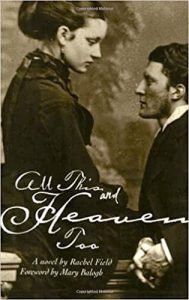
All This, and Heaven Too is the evocative title of Rachel Field’s 1938 historical novel, based on the life of her great-aunt Henriette Deluzy Desportes.
Though she passed away prematurely, Field manage to produce a prodigious array of works in several genres, including children’s books (notably the award-winning Hitty: Her First Hundred Years), poetry, plays, and novels.
If the title seems familiar, it may be in part thanks to the widely praised 1940 film of the same name starring Bette Davis in the role of the novel’s heroine. Read More→
By Melanie P. Kumar | On October 6, 2021 | Updated August 25, 2022 | Comments (2)
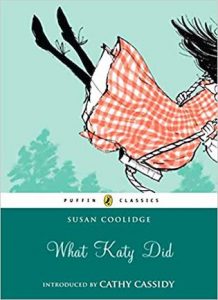
There are some books from one’s schoolgirl years that stay with you, and the What Katy Did series by Susan Coolidge (1835–1905) certainly falls into that category for me.
I read and re-read those books through many vacations. Before realizing it, the actions of favorite characters begin to have an effect on me, as the reader.
The American author of the What Katy Did series (five books in all) was born Sarah Chauncey Woolsey but gained fame with her pen name, Susan Coolidge. The first book of her Katy Did series was published in 1872. Read More→
By Francis Booth | On October 4, 2021 | Updated January 9, 2026 | Comments (2)
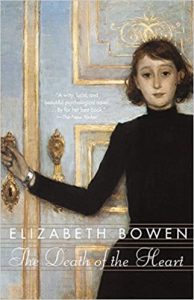
The Death of the Heart (1938) by Elizabeth Bowen is in many ways a traditional English 1930s novel, and a comedy of manners — the manners of pre-war, upper-middle-class London which Bowen (1899 – 1973) knew well. This analysis of The Death of the Heart is excerpted from Girls in Bloom: Coming of Age in the Mid-20th Century Woman’s Novel by Francis Booth, reprinted by permission.
The Death of the Heart is a coming-of-age novel, and its heroine, Portia Quayne, undoubtedly belongs in the literary realm of adolescent girls and their sexual experiences.
Portia does, in her way, come of age in the course of the story though she does not have the novel to herself. She is just one of a cast of unappealing characters examined in forensic detail by the witty, sardonic, and ruthless Bowen in this darkly witty chamber piece. Read More→
By Nancy Snyder | On October 1, 2021 | Updated November 14, 2024 | Comments (0)
The extraordinary feminist and Beat generation poet Diane di Prima (August 6, 1934 – October 5, 2020) was an active participant in the cultural and political movements of the last half of the twentieth century. She embodied the awareness of a poet’s sensibility required for these political fights to evolve. Photo at right: Estate of Diane di Prima.
Di Prima wrote the poem following when she was named as the San Francisco Poet Laureate in 2009. In eight seemingly simple lines, she brings the credo of her life’s visionary work: Read More→