In September 1856, the 36-year-old woman heretofore known as Mary Ann Evans (alternatively Marian) wrote in her journal that she had “made a new era” in her life, “for it was then I began to write fiction.”
It was a new era in another way, as well, because it was soon after this that Mary Ann Evans began to transform herself into the author we know as the eminent British novelist and essayist, George Eliot (1819 – 1880).
Mary Ann Evans was in the process of reinventing herself in several ways. A few months after she began writing fiction, she sent a letter to her beloved brother Isaac in which she announced, “You will be surprised to learn … that I have changed my name and have someone to take care of me in the world.” Read More→
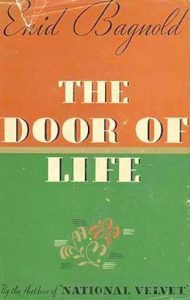
It’s surprising to discover that Enid Bagnold, the author best known for the classic horse story National Velvet, wrote what is considered one of the first novels centered on pregnancy and childbirth. Oddly titled The Squire when first published in England in 1938, it was retitled The Door of Life for the American audience.
This semi-autobiographical novel is an almost meditative reading experience from the perspective of an expectant mother who is soon to give birth to her fifth child. A review from the time of its publication observed: Read More→
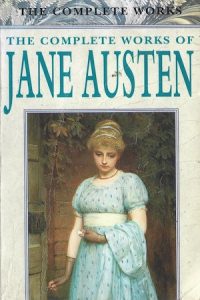
Like most teenagers in India who enjoyed the English classics, Pride and Prejudice came into my life. It prompted me to borrow the Complete Works of Jane Austen from the library and to read all her novels. But if you were to ask me to recall the plots today, Pride and Prejudice is the one that has etched itself most clearly in my mind.
This could also be because I had to study this novel as part of my English Honors program in college. I recall the name of the teacher who took up this book but can’t remember many insights that she left me with.
What comes to mind is that she spoke of it as a “drawing room novel,” as a lot of the action indeed takes place in these various home settings, starting with that of the Bennet family in Pride and Prejudice. Read More→
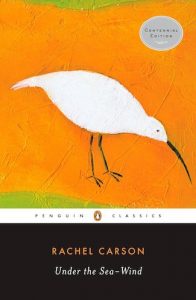
Under the Sea Wind by Rachel Carson was the noted naturalist’s first book, published in 1942. Even in her debut publication, reviewers noted the lyrical quality she applied to scientific prose to make it compelling and readable.
Though not nearly as renowned as Carson’s classic Silent Spring (1962), Under the Sea Wind has in its quiet way stood the test of time. it has been reissued in several editions by various publishers since its debut. It was the first in what became known as Rachel Carson’s “Sea Trilogy.”
The 2007 Penguin Classics encapsulated it:
“Rachel Carson—pioneering environmentalist and author of Silent Spring—opens our eyes to the wonders of the natural world in her groundbreaking paean to the sea. Read More→
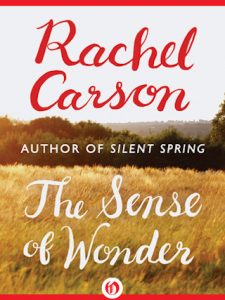
The Sense of Wonder by Rachel Carson, best known for the environmental classic Silent Spring (1962) was published in 1965, a year after her death.
This widely praised book was intended to be enjoyed by children and parents together, was expanded from an essay Carson wrote in the 1950s. It’s designed to inspire families to explore and appreciate the wonders of nature together.
The book was originally embellished with black & white as well as color photographs by Charles Pratt, many of which were taken along the Maine coast, where Carson enjoyed spending summers. Read More→
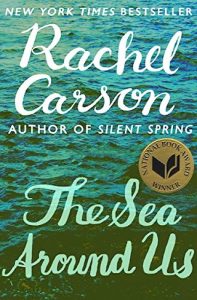
Rachel Carson’s legacy rests on her environmental classic, Silent Spring (1962), so it may be surprising to learn that a decade earlier, she had another smash bestseller. The Sea Around Us by Rachel Carson (1951) is a gracefully written, meticulously researched work of nonfiction making the case for the primacy of the oceans, a plea that has gone unheeded.
In 1948, she completed the first chapter of The Sea Around Us. Marie Rodell, a fledgling agent, took Carson on as her first client. Portions of the book were first published as a series of long articles for The New Yorker.
By July of 1951, the entire book had been published and made its appearance on The New York Times’ bestseller list, where it stayed for 86 weeks. It won the National Book Award, in January 1952. It was the second book in what became known as Carson’s “Sea Trilogy.”
Read More→
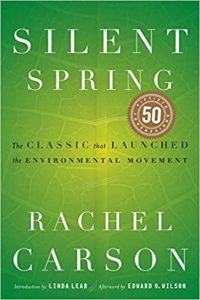
Silent Spring (1962) is the most enduring work of nonfiction by Rachel Carson (1907–1964), the noted American marine biologist and groundbreaking environmentalist.
In this book, Carson made a passionate argument for protecting the environment from manmade pesticides. Written with grace as well as passion, it’s an indictment of the pesticide industry that arose in the late 1950s. It lays out a disturbing view of the damage these chemicals can cause to birds, bees, wildlife, and plant life.
Rachel Carson’s official website recognizes how prescient she was: “Silent Spring inspired the modern environmental movement, which began in earnest a decade later. It is recognized as the environmental text that changed the world.” Read More→
In the third chapter of Pull Devil, Pull Baker, “Oho, What Next? …” Stella Benson questions her role in this book: “Sometimes, I wonder whether I am editing the Count de Savine or he me. What seems to me the extreme remoteness of his point of view makes me quite giddy.”
This excerpt is from Nicola Darwood’s Afterword to Pull Devil, Pull Baker, originally published in 1933 and reissued by Boiler House Press (2022). All quotations come from the latter edition. Reprinted by permission of the publisher. Read More→