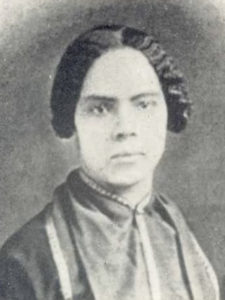
Launching The Provincial Freeman, an abolitionist newspaper, in Windsor, Ontario, gave Mary Ann Shadd Cary (1823 – 1893) the distinction of being the first woman publisher of any race or background in Canada, and the first Black woman publisher in all of North America.
In her role as editor and writer forThe Provincial Freeman, Mary Ann advocated for the Black community in the U.S. and Canada. She worked tirelessly to break down the dual barriers of race and gender.
Later an active participant in the women’s suffrage movement in the U.S., she also lectured widely on education and self-reliance. Later in life, she earn a law degree, becoming the second Black American woman attorney.
Read More→
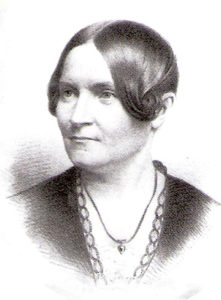
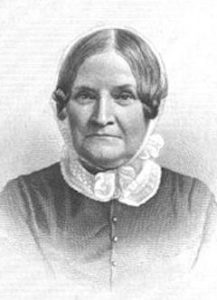
Lydia Maria Francis Child (1802 –1880) was an American author, social reformer, journalist, and abolitionist. Later in life, her views became a bit muddled, but as a mid-19th-century author, she’s still considered influential. Here’s a compilation of honest and insightful quotes by Lydia Maria Child.
A native of Medford, Massachusetts, she was educated despite her father’s disapproval. Child’s passion for learning led to her writing many works of fiction and nonfiction, as well as her dedicated advocacy of the rights of women and Native Americans. Read More→
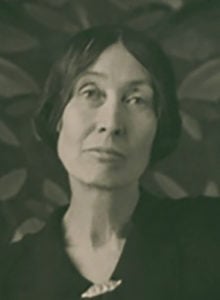
Lola Ridge (born Rose Emily Ridge (December 12, 1873 – May 19, 1941) was an Irish-American radical poet and editor.
“Anything that burns you” was the advice she gave English critic Alice Hunt Bartlett when she asked what poets should be writing in 1925. “I write about something that I feel intensely. How can you help writing about something you feel intensely?”
The New York Times declared her “one of America’s best poets” when she died, but her interest in radicalism, feminism, and experimental poetry wrote her out of literary history. Read More→
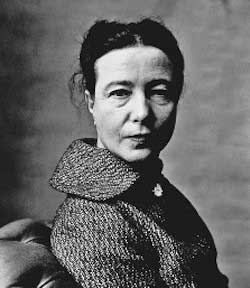
Simone de Beauvoir (1908 – 1986) was a French author, existential philosopher, political activist, feminist, and social theorist. The sampling of quotes from The Second Sex (1949) presented here will make you question how far women have come, and how far there is still to go.
As de Beauvoir’s most enduring work, The Second Sex is still read and studied as an essential manifesto on women’s oppression and liberation.
In addition to this nonfiction masterwork, she was also the author of memoirs, essay collections, and novels, all drawing on her sharp observations of human nature and reflecting her particular philosophical views. Read More→
Lydia Maria Francis Child (February 11, 1802 – October 20, 1880) was a prolific American author, social reformer, journalist, and abolitionist.
Born in Medford, Massachusetts, she was educated despite the disapproval of her father, a baker, who thought she ought not to read at all.
But Lydia’s appetite for learning was voracious, and the books she devoured were supplied primarily by her brother Convers Francis, who later became a Unitarian minister and professor at Harvard Divinity School. Read More→
Zora Neale Hurston (January 7, 1891 – January 28, 1960), was a novelist, memoirist, and ethnographer best known for Their Eyes Were Watching God, her 1937 novel. (Photo at right by Carl Van Vechten.)
Her love of story would lead her not only to create her own, but to collect tales from the oral traditions of the African American South and the Black cultures of the Caribbean.
With her determined intelligence and irrepressible personality, she quickly became a big name in the Harlem Renaissance movement of the 1920s. She pursued a dual career as a writer (producing fiction, plays, and essays) and as an anthropologist.
Read More→
Harriet Beecher Stowe (June 14, 1811 – July 1, 1896), American author and abolitionist, is best known for the anti-slavery novel Uncle Tom’s Cabin.
She grew up in a large, socially progressive family of ministers, authors, reformers, and educators who were well known in their time.
Among Harriet’s siblings were the prominent minister Henry Ward Beecher, and educator Catharine Beecher. She showed an early talent for writing and in her early twenties had a steadily paying profession, contributing articles to numerous publications. Read More→
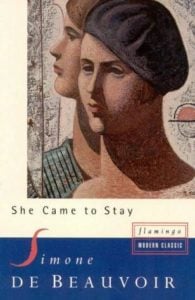
She Came to Stay by Simone de Beauvoir was originally published in France in 1943 as L’Invitee. The autobiographical, philosophical novel was based on de Beauvoir’s open relationship with Jean-Paul Sartre, and takes place just before and during World War II.
The novel’s main character, Françoise, is based on de Beauvoir herself, and Pierre is a thinly veiled Sartre. A younger woman, Xaviere, enters their lives as they form a ménage a trois. Xaviere is a mash-up of sisters Olga and Wanda Kosakiewicz. Read More→