By Taylor Jasmine | On November 12, 2017 | Updated January 1, 2023 | Comments (2)
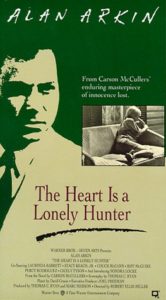
The 1968 film version of The Heart is a Lonely Hunter, based on the 1940 novel by Carson McCullers, aimed for a faithful adaption. Though it had its merits, the film got mixed reviews.
Strong performances, especially by Alan Arkin as Singer and Sondra Locke as Mick (her film debut) earned them both Academy Award and Golden Globe nominations — for Best Actor and Best Supporting Actress, respectively. The film received numerous other nominations and awards, and was generally favorably reviewed.
Still, the film fails to capture the sweep and emotional impact of the book, so I’d recommend reading it before considering the film. Here’s a review that was published when the film premiered in 1968: Read More→
By Nava Atlas | On November 11, 2017 | Updated January 1, 2023 | Comments (0)
No one more surprised than Margaret Mitchell (1900 – 1949) herself when Gone With The Wind became an immediate smash hit upon its June, 1936 publication. The novel went on to be published in over forty countries and was adapted as the faithful 1939 film.
Here we’ll explore quotes from Gone With the Wind as well as other gems from the pen of Margaret Mitchell. Margaret may have herself been partially the model for Scarlett O’Hara, one of the most complex and charismatic of literary heroines.
For nine agonizing years, Margaret worked and reworked the massive story, sometimes typing, sometimes scribbling by hand. The manuscript piled up here and there, on desks, in drawers, on closet shelves. She showed friends bits and pieces, but never the entire work. Perhaps no one was as amazed by its phenomenal success as its author. Read More→
By Nava Atlas | On November 11, 2017 | Updated January 1, 2023 | Comments (3)
If you’ve read Margaret Mitchell’s 1,000-plus page magnum opus multiple times but can’t enough of it, consider exploring these prequels and sequels to Gone With the Wind. They expand on the stories of the complicated characters who have gripped the imagination for decades, ever since the book was first published in 1936.
GWTW had already been made a selection of Book of the Month Club, when it burst on the scene and advance sales were remarkable for a first novel by such an unknown author, particularly for a book of this length.
The U.S. was still gripped by the Great Depression, and the public evidently needed some diversion. It’s hard to argue that the book was an instant publishing phenomenon.
Read More→
By Taylor Jasmine | On November 10, 2017 | Updated May 14, 2023 | Comments (0)
From the 1976 Farrar, Straus and Giroux edition of Dragons in the Waters by Madeleine L’Engle: Readers of Madeleine L’Engle’s novel The Arm of the Starfish will recall Poly and Charles O’Keefe and their amateur detective friend, Canon Tallis. In Dragons in the Waters, the O’Keefes are traveling with their scientist father by freighter to Savannah, Georgia, to Venezuela.
Among their fellow passengers are Simon Renier, who quickly becomes their friend, and his enigmatic cousin Forsyth Phair, who with Simon is returning a family heirloom to Venezuela — a portrait of Simon Bolivar. When Forsyth Phair is murdered and the portrait stolen, all the passengers and crew become suspect. Read More→
By Nava Atlas | On November 9, 2017 | Updated March 14, 2023 | Comments (2)
Prolific though she was, Pearl S. Buck wasn’t known as a poet. She produced only a limited number of poems, collected for publication as a slender illustrated volume, Words of Love (1974). Her verses are brief and direct, offering fleeting glimpses of the author’s inner world.
Following is a description from Words of Love (John Day Company, 1974) along with three poems. (photo at right courtesy of Wikimedia Commons)
Pearl S. Buck wrote no poetry for the public eye (though she permitted a few verses to appear in her biography). In her lifetime she published scores of novels, short stories, and essays. Her poetry, however, was her private domain, and the verses she wrote — her Words of Love — were inscribed in her treasure book, the journal she kept for her most intimate words and thoughts. Read More→
By Nava Atlas | On November 9, 2017 | Updated March 25, 2026 | Comments (0)
From the 1972 Farrar, Straus and Giroux edition of A Circle of Quiet (The Crosswicks Journals) by Madeleine L’Engle: The title of Madeleine L’Engle’s book comes from the text itself:
“Every so often I need out — away from all of these people I love most in the world — in order to regain a sense of proportion. My special place is a small brook in a green glade, a circle of quiet from which there is no visible sign of human beings … there I move slowly into a kind of peace that is indeed marvelous, ‘annihilating all that’s made to a green thought in a green shade.’”
This book is the attempt of a gifted woman to define and explore the meaning of her life, a life which, like many women today, is complex —that of wife, mother of three children, grandmother of two, teacher, frequent public speaker, practicing Christian, and writer who has published seventeen books. Read More→
By Nava Atlas | On November 8, 2017 | Updated September 26, 2025 | Comments (13)
How many of these classic children’s books by women authors have you read? Which did you miss reading? Which should I have included in the top 10? (Make sure to see the runners-up list at the end.)
Some of the books listed here were written for all ages, but have been adopted by younger readers as favorites.
Not long ago, when the latest film adaptation came out, my book group read Little Women by Louisa May Alcott. About half had never read it; the other half hadn’t picked the book up since adolescence.
While Alcott reluctantly wrote it when urged to pen a “girls’ story” by her publisher, Little Women far exceeded their expectations. It has been beloved by generations of readers of all ages ever since it came out in 1868.. Read More→
By Taylor Jasmine | On November 7, 2017 | Updated August 7, 2026 | Comments (0)
For fans of the Moffats series, The Moffat Museum (1983) by Eleanor Estes is an extra-special treat, since this fourth (and last) installment in the series was published more than forty years after the first book (The Moffats) appeared in 1941.
The four Moffat children were raised in the small (fictional) Connecticut town of Cranbury by their single mother in the early 1900s. In this story, they decide to start a museum to preserve the memories and objects belonging to their childhood, now that they are growing up. Read More→