Not-so-Famous Last Lines from Classic Novels by Women Writers
By Nava Atlas | On March 11, 2026 | Updated June 15, 2026 | Comments (0)
There have been plenty of roundups of famous first sentences from beloved novels. I even did one here. But famous last lines? Or more accurately, not-so-famous last lines — it’s time to take a look at how eleven women writers chose to tie up their iconic works. Don’t be afraid to look, there are no spoilers here.
The best first lines surely are evocative, and set the stage for what’s to come, like this one from Rebecca by Daphne du Maurier. “Last night, I dreamt I went to Manderley again.”
And what devoted reader isn’t familiar with the first line of Jane Austen’s Pride and Prejudice — “It is a truth universally acknowledged, that a single man in possession of a good fortune, must be in want of a wife.”
Compared with this memorable opening, P and P ends with a thud: “With the Gardiners they were always on the most intimate terms. Darcy, as well as Elizabeth, really loved them; and they were both ever sensible of the warmest gratitude towards the persons who, by bringing her into Derbyshire, had been the means of uniting them.”
Say what? It reads as if the usually brilliant Jane Austen ran out of steam when it came to the last sentence of her most iconic work. It’s quite a run-on, too!
. . . . . . . . . .

. . . . . . . . . .
We can say the same for the end of Jane Eyre by Charlotte Brontë. In my memory (and I reread the novel just a few years ago), the end revolved around the memorable line “Reader, I married him.”
While that iconic line is indeed in the last section, it continues to meander for a bit before ending with: “My Master,” he says, “has forewarned me. Daily He announces more distinctly,—‘Surely I come quickly!’ and hourly I more eagerly respond,—‘Amen; even so come, Lord Jesus!’”
I honestly didn’t remember this last line at all. I’ll have to take Charlotte to task when I see her in heaven.
Here I am, critiquing two of the most iconic writers in the English language. It follows from noodling over how a novelist (or memoirist for that matter) decides how to end a story — it must be a torturous decision! The best last lines, to my mind, pull the narrative together and cement the reading experience, whether we later consciously remember them or not.
I’ve read all but one of the novels whose last lines I’ve collected here (that would be Middlemarch by George Eliot — I’ve yet to get through this tome!), but reading these last lines presented following makes me want to turn back to the beginning of these books and start anew.
. . . . . . . . . .
Frankenstein by Mary Shelley (1818)

“… my ashes will be swept into the sea by the winds. My spirit will sleep in peace, or if it thinks, it will not surely think thus. Farewell.”
He sprang from the cabin-window as he said this, upon the ice raft which lay close to the vessel. He was soon borne away by the waves and lost in darkness and distance.
. . . . . . . . . .
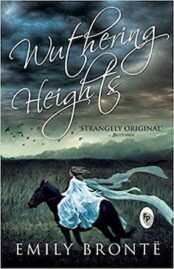
Wuthering Heights by Emily Brontë (1847)

I lingered round them, under that benign sky; watched the moths fluttering among the heath, and hare-bells; listened to the soft wind breathing through the grass; and wondered how any one could ever imagine unquiet slumbers for the sleepers in that quiet earth.
. . . . . . . . . .
Little Women by Louisa May Alcott (1868)

Touched to the heart, Mrs. March could only stretch out her arms, as if to gather children and grandchildren to herself, and say, with face and voice full of motherly love, gratitude, and humility…
“Oh, my girls, however long you may live, I never can wish you a greater happiness than this!”
. . . . . . . . . .
Middlemarch by George Eliot (1871)

But the effect of her being on those around her was incalculably diffusive: for the growing good of the world is partly dependent on unhistoric acts; and that things are not so ill with you and me as they might have been, is half owing to the number who lived faithfully a hidden life, and rest in unvisited tombs.
The Awakening by Kate Chopin (1899)

Edna heard her father’s voice and her sister Margaret’s. She heard the barking of an old dog that was chained to the sycamore tree. The spurs of the cavalry officer clanged as he walked across the porch. There was the hum of bees, and the musky odor of pinks filled the air.
. . . . . . . . . .
The Secret Garden
by Frances Hodgson Burnett (1911)

Across the lawn came the Master of Misselthwaite and he looked as many of them had never seen him. And by his side with his head up in the air and his eyes full of laughter walked as strongly and steadily as any boy in Yorkshire—Master Colin!
. . . . . . . . . .
The Age of Innocence by Edith Wharton (1920)

He sat for a long time on the bench in the thickening dusk, his eyes never turning from the balcony. At length a light shone through the windows, and a moment later a man-servant came out on the balcony, drew up the awnings, and closed the shutters.
At that, as if it had been the signal he waited for, Newland Archer got up slowly and walked back alone to his hotel.
. . . . . . . . . .
Mrs. Dalloway by Virginia Woolf (1925)

“I will come,” said Peter, but he sat on for a moment. What is this terror? what is this ecstasy? he thought to himself. What is it that fills me with extraordinary excitement?
It is Clarissa, he said.
For there she was.
. . . . . . . . . .
Their Eyes Were Watching God
by Zora Neale Hurston (1937)

The kiss of his memory made pictures of love and light against the wall. Here was peace. She pulled in her horizon like a great fish-net. Pulled it from around the waist of the world and draped it over her shoulder. So much of life in its meshes! She called in her soul to come and see.
. . . . . . . . . .
Rebecca by Daphne du Maurier (1938)

The road to Manderley lay ahead. There was no moon. The sky above our heads was inky black. But the sky on the horizon was not dark at all. It was shot with crimson, like a splash of blood. And the ashes blew towards us with the salt wind from the sea.
. . . . . . . . . .
A Wrinkle in Time by Madeleine L’Engle (1962)

Mrs Whatsit said breathlessly, “Oh, my darlings, I’m sorry we don’t have time to say good-bye to you properly. You see, we have to—” But they never learned what it was that Mrs Whatsit, Mrs Who, and Mrs Which had to do, for there was a gust of wind, and they were gone.
Leave a Reply