Herland by Charlotte Perkins Gilman (1915): An Analysis
By Jillian McKeown | On April 25, 2017 | Updated August 20, 2026 | Comments (0)
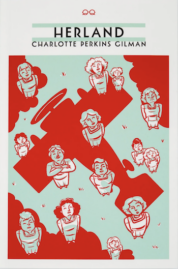
This analysis of Herland, the 1915 utopian novel by Charlotte Perkins Gilman is excerpted from an in-depth review from Exploring Feminisms by Jillian McKeown.
Years ago, I bought Herland after reading The Awakening by Kate Chopin, craving that same satisfied woman-centered feeling that I was left with as I closed Chopin’s book. As I read the first few pages of Gilman’s Utopian text about a land of only women, I noticed that it was from a man’s point of view and immediately lost interest.
I had very little interest in a man’s perspective, even if it was written by a woman. Recently, Herland has been on my mind and decided to pick it up again.
This time around, I decided to read the preface, which is what I hear adults do and was delighted to learn that it was satirical in nature. Within a first few pages, I was hooked and looking back, maybe at twenty-one I just wasn’t ready.
A female-only society
Herland begins with three American men exploring through an unknown continent and during their travels, they hear of a land where only women, female children and babies live and additionally, men go and never come back.
While there, the men are discovered and imprisoned so that the two cultures can learn from one another. The men are in the aptly named “Herland” for over a year and we go on this journey with them as the narrator describes their interactions with the women, the land, and how each one of the three men navigates and adjusts to their surroundings.
Differing views of the women
One of them comes to idolize the women, one acclimates but always keeps a critical eye, and the third rejects the customs of a gender-neutral land completely, feeling himself without identity if he cannot exude masculinity.
The writer of Herland is a woman, but the story is told from a man’s and therefore a masculine point of view and through him, Gilman relays her own social commentary on America in the early twentieth century. When the narrator describes his own country and what he thinks of women, much of what he relays seems comical.
Here, Gilman takes the liberty of poking fun at how she believes men view women. For example, when the three men discuss what lies ahead in this woman-only land, uber-masculine Terry fantasizes that he will be fawned over and doted on by the women, and that he’ll “be elected king.”
. . . . . . . . . .
Critiquing the patriarchy
In this instance Gilman critiques patriarchy by suggesting that all women need a man to take charge. The narrator and also the more scientific of the group suggests that it will be a savage and undeveloped society.
His point of view is that women need to be studied as objects, and this mirrors Gilman’s The Yellow Wallpaper, which is semi-autobiographical. Gilman’s husband sent her to a doctor after she gave birth who subsequently prescribed her a “rest cure” where he eschewed any creative expression.
What’s interesting about the three men’s fantasies is that they reinforce the old saying, “the more things change, the more they stay the same.”
When I read this, I immediately thought about the modern-day equivalent of men thinking women only pillow fight in their brassieres when they get together, or otherwise they are inherently meek and helpless. Gilman’s interpretation of the masculine and feminine gender has not changed over the past hundred or so years, proving that it’s not so far from the gender assumptions that persist today.
. . . . . . . . . .
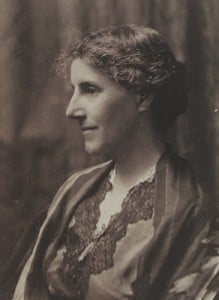
Charlotte Perkins Gilman on Feminist Ideals
. . . . . . . . . .
Charlotte Perkins Gilman’s feminist ideals
In addition to Gilman’s feminist ideals, you can see the presence of her socialist beliefs as well. In a conversation between some of the men’s tutors, they exchange information about the society of the “bisexual” men.
The men glorify industrialization and competition, while the women question its usefulness with regard to educating only some while many suffer.
When certain groups of people are favored in a society and others are not, such as the poor, then everyone suffers; all groups of people should be working as a cohesive unit for the benefit of all people who live within the same society.
Read the rest of this analysis of Herland by Charlotte Perkins Gilman on Exploring Feminisms. This excerpt was contributed by Jillian McKeown.
. . . . . . . . . .
A new edition of Herland
from Quite Literally Books
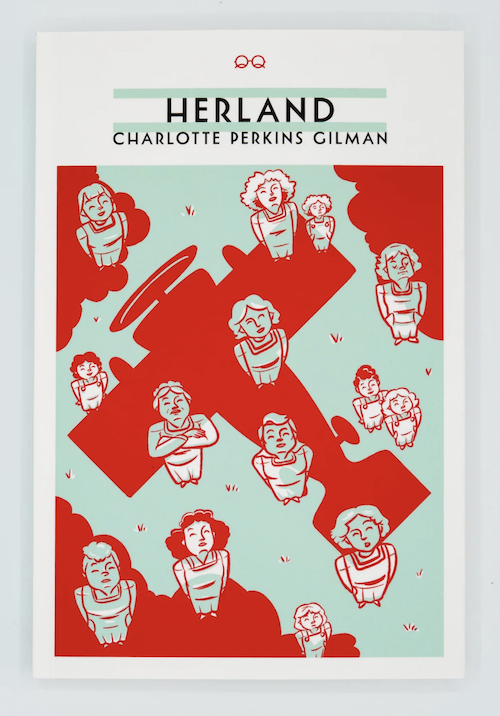
Quite Literally Books new edition of Herland (2025) comes complete with a thoughtful, thorough foreword by Nicole Adair. Adair celebrates Gilman’s vision, highlighting the author’s skewering of systems that continue to oppress women. Yet Adair doesn’t shy away from the author’s darker side. “Core to Gilman’s feminism as she wrote about it here and in her other works is her white supremacy and her belief in the theory of eugenics.”
From the Publisher: Everybody wants to rule the world … but women might actually be better at it.
What happens when three strapping, manly explorers quite literally drop from the sky into a two-thousand-year-old thriving utopia of women? Hell-bent on “discovering” this mythical civilization, Van, Jeff, and Terry come brandishing bravado, condescension, and pretty trinkets known to charm and pacify women everywhere. But they’re in Herland now, and everything they ever thought they knew about femininity is just plain wrong. Despite the men’s growing but grudging appreciation of this world and its creators, reconciling new revelations with old habits may not be so easy…
If it’s possible to separate the art from the artist (a persistent question, and one that be applied to many writers past and present), Herland continues to be a thought-provoking and eminently readable novel that imagines the possibilities of a female-centric society.
Though Herland is arguably the most famous book in a trilogy, it’s actually the middle volume. It was preceded by Moving the Mountain (1911) and followed by With Her in Ourland (1916).
. . . . . . . . . .

BeyondThe Yellow Wallpaper:
Books by Charlotte Perkins Gilman
. . . . . . . . . .
More about Herland by Charlotte Perkins Gilman
- Reader discussion on Goodreads
- Herland: The Forgotten Feminist Classic About a Civilisation Without Men
- Listen to Herland on Librivox
- Herland on Public Radio International
Leave a Reply