Presented here is an overview of five novels by Carson McCullers (1917 – 1967), representing her body of long form fiction. Though known primarily for these books, she also wrote two plays, a number of short stories, children’s poetry, and other works.
Carson McCullers has earned a place among classic southern writers, along with William Faulkner, Flannery O’Connor, and Tennessee Williams. Following each brief overview of these major works is a link to more in-depth reviews or analyses.
Most of McCullers’ work is set in the American South, centering on characters who struggle with loneliness and isolation. Her writing is associated with the genre known as Southern Gothic, defined by the Oxford Research Encyclopedia: Read More→
Reflections in a Golden Eye (1941) by Carson McCullers suffered a fate common to sophomore efforts that follow hugely successful first novels. Just twenty-three when her first novel, The Heart is a Lonely Hunter, came out the year before (1940), it established her as a literary wunderkind.
Reflections in a Golden Eye, conversely, received mostly poor reviews, critics unsure of what to make of the young author’s use of the literary device termed “the grotesque” in fiction — a hallmark of fellow Southern author Flannery O’Connor and others.
McCullers’ work was primarily associated with the genre of Southern Gothic, which the Oxford Research Encyclopedia defines as follows: “Characteristics of Southern Gothic include the presence of irrational, horrific, and transgressive thoughts, desires, and impulses; grotesque characters; dark humor, and an overall angst-ridden sense of alienation.”
Read More→
Daniel Deronda (1876), the last novel completed by British author George Eliot (pen name of Mary Ann Evans, 1819 – 1880), is widely regarded as a proto-Zionist work, and one of the first works of literature sympathetic to Jews in 19th-century Britain.
Like many of George Eliot’s novels, Daniel Deronda is considered a masterpiece. The examination of the novel’s Jewish themes presented here is from George Eliot by Mathilde Blind. Eliot wasn’t Jewish, but as this essayist points out:
“When she undertook to write about the Jews, George Eliot was deeply versed in Hebrew literature, ancient and modern. She had taught herself Hebrew when translating the Leben Jesu, and this knowledge stood her in good stead.” Read More→
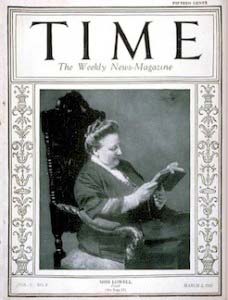
It’s not easy to choose a few of best or most famous poems by Amy Lowell (1874 – 1925), the influential American imagist poet. She was quite prolific, so choosing just ten iconic poems from her vast trove to represent her large body of work is no easy task.
The poems presented here are among Lowell’s most iconic and anthologized. She defined Imagist poetry as the “concentration is of the very essence of poetry” which aimed to “produce poetry that is hard and clear, never blurred nor indefinite.”
Amy Lowell was also a practitioner of “vers libre,” or free verse poetry (here’s the poet herself on vers libre). Her contemporary reconsideration reflects her rediscovery as a lesbian poet (“A Decade”), and she was also an antiwar poet (“Patterns”) of some distinction. Read More→
Penelope Fitzgerald (December 17, 1916 – April 28, 2000) was a novelist, essayist, and biographer widely regarded as one of the greatest British writers of her generation.
She began her career later in life — her first successful novel (The Bookshop, 1978) was published when she was sixty-one — and went on to win the Booker Prize in 1979. It was also adapted into a 2017 feature film starring Emily Mortimer and Bill Nighy.
Penelope Fitzgerald’s novels have been described as “strange and original masterpieces” by her biographer, Hermione Lee, and her final work, The Blue Flower, is widely regarded as one of the best historical novels ever written. Read More→
The American poet Amy Lowell (1874 – 1925) was best known for a form of poetry called Imagism. She dedicated her career to perfecting her craft as a poet, and was practically an evangelist for the art of poetry writing. Lowell produced poetry prolifically and spoke widely about its art and craft.
Lowell defined Imagism as the “concentration is of the very essence of poetry,” and she aspired to “produce poetry that is hard and clear, never blurred nor indefinite.”
The following is from the preface of her 1914 collection, Sword Blades and Poppy Seed, in which she argues that a poet is not born but made. The writer of poetry must learn what she called their “trade,” comparable to how a cabinet-maker or any other craftsperson first learns technique and then builds upon it. Read More→
Seraph on the Suwanee, Zora Neale Hurston’s fourth and last published novel (1948), was an outlier among her works, which included numerous short stories and ethnographic collections. The reason: it was her only book that was written about white people — specifically, Florida’s “white crackers.”
Exploring the cultural differences between the meek and colorless heroine, Arvay and her handsome, enterprising husband Jim, the novel received mixed-to-positive reviews by the white press.
Some reviewers bent over backwards to praise the fact that a Black writer produced a novel that wasn’t about race issues, bringing to light the lives and dialect of the turpentine people of Florida. Read More→
American author Shirley Jackson (1916 – 1965) was known for fiction and nonfiction works that have influenced generations of writers who came after her. Presented here are the six novels by Shirley Jackson that were published in her lifetime. If you’re looking for where to begin with Shirley Jackson’s books, start anywhere — they’re all engrossing reads.
Jackson remains best known for “The Lottery” (1948), her widely anthologized (and also widely banned) short story. This controversial work, published the same year as her first novel, put her on the literary map.
It’s not easy to categorize Jackson’s work. Psychological terror or thriller may come close, if one considers that Stephen King and Neil Gaiman have cited her as an influence. Her six novels and scores of short stories uncover the evil and ugliness that lurk just under the surface of propriety and social mores. Read More→