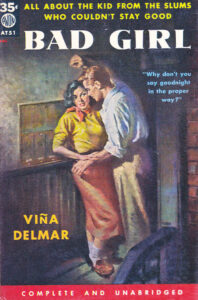
Despite its provocative title, the heroine of the forgotten bestselling 1928 novel, Bad Girl by Viña Delmar, wasn’t at all as naughty as the pulp cover or film poster would suggest.
In the 1920s, urban American women experimented with sexual freedom more openly than ever. Popular novels by writers — male and female — held up a mirror to the times.
Dorothy, or “Dot,” as she’s familiarly called, succumbs to one instance of premarital sex and quickly marries Eddie (who’s not a bad sort, but not the sharpest tool in the shed) after he offers to make her “respectable.” Read More→
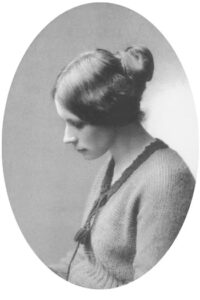
Flora Thompson (December 5, 1876 – May 21, 1947), was an English novelist and poet, best known for her semi-autobiographical trilogy Lark Rise to Candleford.
The commercial and critical success of the books — Lark Rise, Over to Candleford, and Candleford Green — is such that they have never been out of print, and were adapted by the BBC for a four-season series in 2008. Read More→
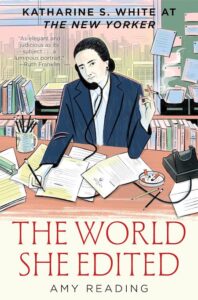
In the summer of 1925, Katharine Sergeant Angell walked into The New Yorker’s midtown office and left with a job as an editor. The magazine was only a few months old. Over the next thirty-six years, White would transform the publication into a literary powerhouse.
This towering but behind-the scenes figure in the history of 20th-century literature finally gets the first-rate biography she deserves in The World She Edited: Katharine S. White at The New Yorker by Amy Reading (Mariner Books, September 3, 2024; thanks to Mariner Books for supplying the content of this post).
In The World She Edited, Amy Reading brings to life the remarkable relationships White fostered with her writers and how these relationships nurtured an astonishing array of literary talent. Read More→
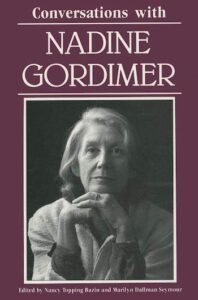
Nadine Gordimer (1923–2014) was one of South Africa’s foremost authors and anti-apartheid activists. Gordimer’s writing is internationally known for providing a rare window into politics, the human condition, and how they intersect. Mentions of her work can still spark fiery discussions today.
Following are some fascinating facts about Nadine Gordimer, whose work was recognized with the Nobel Prize for Literature in 1991.
Gordimer published her first short story collection, Face to Face, in 1949; her debut semi-autobiographical novel, The Lying Days, was published in 1953. She continued writing prolifically until her death. Read More→
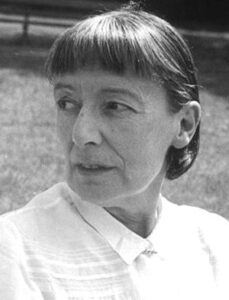
Stevie Smith (September 20, 1902 – March 7, 1971) was known for satirical poetry as well as novels (including her best known, Novel on Yellow Paper) suffused with black humor, acid wit, and unorthodox contemplations of death.
Vastly different cultural epochs bookended her life. She was born the year after the end of the conservative Victorian Era and died the year after the turbulent “Me Decade”of the 1970s, as author Tom Wolfe dubbed it — began. (Photo above courtesy of Wikimedia Commons)
As The British Empire lost its colonies and women gained independence, Smith’s poetry tapped into the era’s emotional and societal upheaval. Read More→
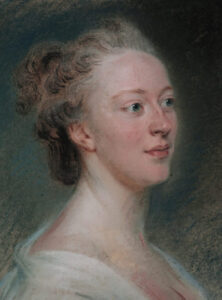
What Belle de Zuylen did in 1763 was inexcusable for a young woman. She wrote a novel.
I discovered Belle de Zuylen (1740 – 1805), Dutch-Swiss writer in the age of Enlightenment (also known as Isabelle de Charriére, Belle van Zuylen, Isabella Elisabeth van Tuyll van Seeroskerken, and Zélide) via James Boswell, the 18th-century biographer (The Life of Samuel Johnson) and diarist.
The second book of Boswell’s papers, Boswell in Holland, included his correspondence with de Zuylen. Boswell, a Scot, was studying law in Holland (Scottish and Dutch law apparently being related) and had made her acquaintance. Read More→
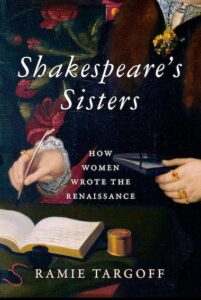
Ramie Targoff begins Shakespeare’s Sisters: How Women Wrote the Renaissance (Knopf, 2024), her fascinating exploration of four female writers of the English Renaissance, not with a reference to a 16th-century woman, but to Virginia Woolf.
The title of Targoff’s book comes from Woolf’s assertion that if Shakespeare had had a sister, whom she names Judith Shakespeare, who shared his talent for writing, she never would have been able to achieve anything like her brother’s success, given the oppressive conditions women faced in sixteenth and seventeenth century England.
In fact, Woolf claims, she would have “gone crazed, shot herself, or ended her days in some lonely cottage outside the village, half witch, half wizard, feared and mocked at … so thwarted and hindered by other people … she must have lost her health and sanity.” Read More→
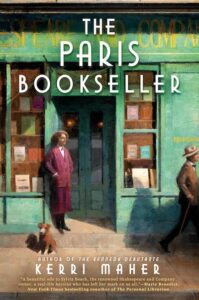
The Paris Bookseller by Kerry Maher is a novelization of the life of Sylvia Beach, who in 1919 cofounded the legendary bookstore Shakespeare and Company. She’s also known for publishing Ulysses by James Joyce in 1922, at great personal and financial risk.
This review of The Paris Bookseller is contributed by N.J. Maher, from her site, Herstory Revisted: Biofiction Book Reviews. Reprinted by permission.
Certain people stick with you, whether you meet them in person, or, as with historical fiction, you meet them on the page. Such is the case for me with the protagonist in The Paris Bookseller, by Kerri Maher. It isn’t often a reader gets a front-row seat to a period in literary history, but Maher gives us one through Sylvia Beach, an American living in post-World War I Paris.
Read More→