Books by Charlotte Perkins Gilman: Beyond “The Yellow Wallpaper”
By Aiyana Edmund | On February 15, 2018 | Updated August 20, 2026 | Comments (0)
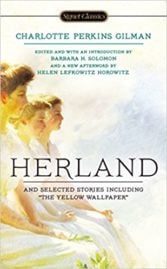
Charlotte Perkins Gilman (1860 – 1935) was an American novelist, poet, and pioneering feminist. Outspoken in conveying her strong beliefs about women’s equality and independence, Gilman’s works have influenced generations of feminist writer and theorists.
Following is a sampling of the best known books by Charlotte Perkins Gilman. It’s a concise guide to where to start with the works of this dynamic writer and thinker.
Though best remembered for her semi-autobiographical work of short fiction, The Yellow Wallpaper, Gilman’s fiction and nonfiction works both addressed the ways in which women’s lives were impacted by social and economic bias, and are still relevant today.
. . . . . . . . . .
The Yellow Wallpaper

Let’s start with what is arguably Gilman’s best-known work — “The Yellow Wallpaper” though in and of itself, it’s doesn’t approach even the length of a novella. Still, it’s hard to argue that it’s foundational to her canon.
First published in The New England Magazine in 1892 as a 6,000-word short story albeit a lengthy one, it’s an influential early work of American feminist literature. Gilman illustrates the 19th century societal and medical attitudes towards women’s physical and mental health.
Written in a first-person narrative, the story is a collection of journal entries by a woman who is slipping into a deep depression; quite possibly what today is referred to as post-partum depression. The unnamed narrator and her husband are spending the summer at a colonial mansion where her he believes she should take time to rest and recuperate after the birth of their child.
The unnamed character grows obsessed with the yellow wallpaper in the room in which she is confined, supposedly to recover. She slowly slips into madness with visions of women creeping behind the paper whom she soon imagines herself to be one. More about “The Yellow Wallpaper”:
- “The Yellow Wallpaper” by Charlotte Perkins Gilman: an analyisis
- “Why I Wrote the Yellow Wallpaper by Charlotte Perkins Gilman
- Full text of “The Yellow Wallpaper”
. . . . . . . . . .
Women and Economics (1898)
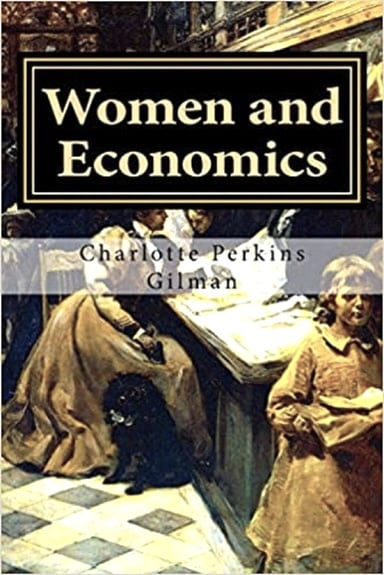
Recognized as Gilman’s most influential work of nonfiction, Women and Economics (1898) skillfully weaves the themes she favored, considered radical for their time, into a compelling narrative.
Women and Economics examines marriage, the home, and social inequality, emphasizing her continued argument of “the economic independence and specialization of women as essential to the improvement of marriage, motherhood, domestic industry, and racial improvement.”
Gilman introduces the concept of women hiring cooks and housekeepers, one of the first public works to suggest professionalizing the “normal” duties of women. Gilman’s encouragement for women to enter the workforce and lead a more worldly life developed her image as a leading intellectual in the first-wave women’s movement.
Read an excerpt from Women and Economics. or the work in full on Project Gutenberg.
. . . . . . . . . .
What Diantha Did (1909)
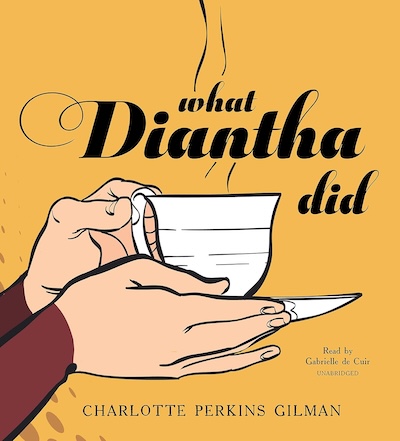
Published serially in Gilman’s magazine, The Forerunner, in 1909, What Diantha Did is a novel about Diantha Bell, a young woman who leaves her home and her fiancé to start a housecleaning business. Following the author’s consistent theme of women’s independence and empowerment, the protagonist’s business quickly booms and expands successfully.
The businesswoman soon develops branch businesses that include a maid service, food delivery service and a hotel. Ever the visionary, Gilman once again skillfully writes to her passion for inspiring women to be independent and to uplift their own economic status. Read a brief review, and the full text on Project Gutenberg.
. . . . . . . . . .
The Man-Made World (1911)

Another example of Gilman’s revolutionary works to support feminism, The Man-Made World (originally subtitled Or, Our Androcentric Culture) appeared as a serial in her magazine in 1911. As she did with Herland and What Diantha Did, Gilman analyzes the negative effects of a male dominated world. From the description on Project Gutenberg:
“The Man-Made World; Or, Our Androcentric Culture is a sociological critique written in the late 19th century. The book examines the pervasive influence of male-centered ideology on society and culture, arguing that this androcentric perspective has shaped human understanding and institutions, leading to a systemic undervaluation of women’s roles and contributions in various fields.
The opening of this work sets the stage for Gilman’s exploration of human nature by employing an analogy with sheep to discuss the instincts that guide males and females in the animal kingdom. She elaborates on the distinctions between masculine and feminine traits, suggesting that societal norms have artificially positioned masculinity as the default standard for all human characteristics.
Gilman contends that this misunderstanding has distorted the perception of human qualities, emphasizing the need to recognize and appreciate the full spectrum of both sexes’ contributions to society. Additionally, she hints at the consequences of this male dominance on aspects such as family structures, roles, and broader social dynamics, paving the way for her detailed analysis in subsequent chapters.”
Read The Man-Made World in full on Project Gutenberg.
. . . . . . . . . .
Herland (1915)
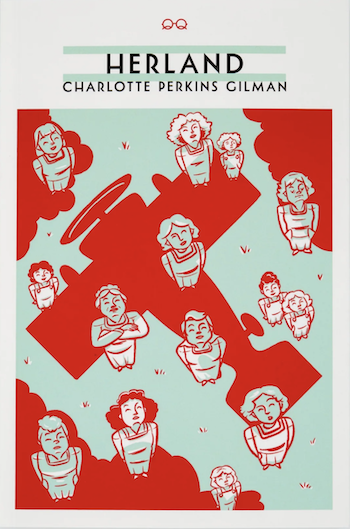
Herland is the story of an isolated utopian society composed entirely of asexual women. In 1915, the stories first appeared published in serial form in The Forerunner, a magazine edited and published by Gilman. Since then, the book has gone through many editions. The most recent is a handsome edition published by Quite Literally Books, which includes a thought-provoking new forward.
The book explores the social construct of gender roles and how it is viewed as unchangeable by both genders. The story is told from the perspective of three male sociology students who are embarking on a journey to find a rumored mysterious society populated only by women.
The men find themselves held captive by the women, but are treated well and assigned tutors to assist them in learning their language. Gilman intellectually explores and promotes her beliefs on motherhood, gender roles, individuality and reproductive rights. Her words through Herland have stood the test of time, her themes highly popular through the feminist generations.
Herland is part two, and the best known of a trilogy that begins with Moving the Mountain and is completed by With Her in Ourland. For more, see Herland: an analysis.
Leave a Reply