A Selection of Poems by Gabriela Mistral on Life, Love & Death (in Spanish)
By Skyler Gomez | On March 4, 2019 | Updated September 15, 2026 | Comments (7)

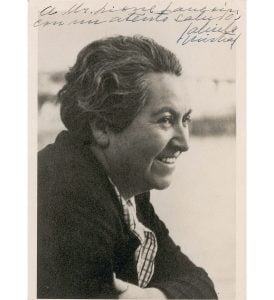
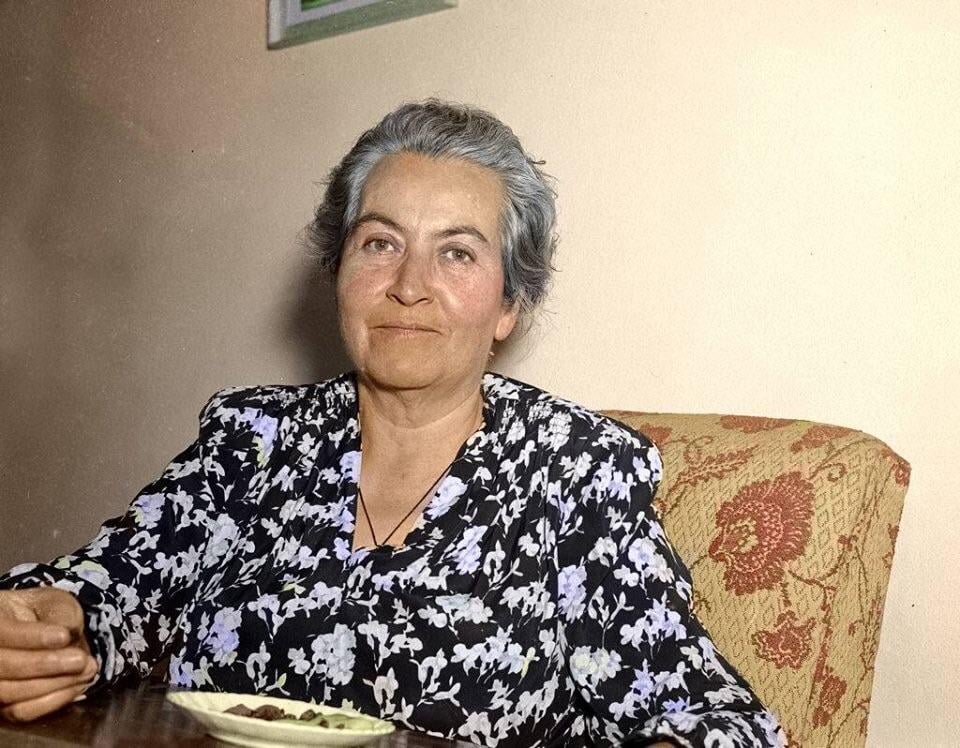
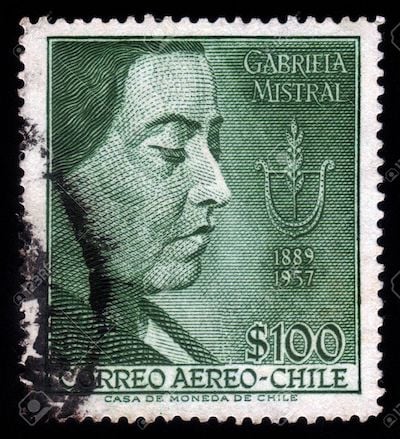
Gabriela Mistral (April 7, 1889 – January 10, 1957, born Lucila Godoy Alcayaga) was a Chilean poet, educator, diplomat, and feminist. Here you can sample nine poems by Gabriela Mistral about life, love, and death, both in their original Spanish (poemas de Gabriela Mistral), and in English translation.
In 1945, Mistral became the first Latin American to win the Nobel Prize for Literature.
Mistral stopped formally attending school at the age of fifteen to care for her sick mother, but continued to write poetry. Just two years later, her heart broke after the sad deaths of her lover, Romeo Ureta, and a close nephew.
These early losses would figure into her work for many years to come, the heartbreak leading her to create some of her best works, including Sonetos de la Muerte. Much of her later poetry was focused on the theme of death.
Here are the poems (in Spanish and English) you’ll find in this post:
- Canción de la Muerte / Song of Death
- Dame la Mano / Give me Your Hand
- Canto que Ambas / The Song You Loved
- Eligio de la Sal / In Praise of Salt
- Los Cabellos de los Niños / Children’s Hair
- Poemas de las Madres /Poems of the Mothers
- El Arte / Art
- El Girasol / The Sunflower
- Pan / Bread
First Latin American to win the Nobel Prize in Literature
Gabriela Mistral was the first Latin American author to receive the Nobel Prize in Literature. For more on the overarching themes in her work, see the analysis, “Beyond the Mythic Mistral.” She said of her own need to write:
“I write poetry because I can’t disobey the impulse; it would be like blocking a spring that surges up in my throat. For a long time I’ve been the servant of the song that comes, that appears and can’t be buried away.
How to seal myself up now? … It no longer matters to me who receives what I submit. What I carry out is, in that respect, greater and deeper than I, I am merely the channel.”
. . . . . . . . . . .
The Poetry of Gabriela Mistral: A Brief Overview and Analysis
. . . . . . . . . . .
Summing up Gabriela Mistral’s poetic journey
In Gabriela Mistral: The Poet and Her Work, Margot Arce de Vazquez summed up the life and work of this remarkable poet beautifully:
“This was the kind of woman she was: attentive to the present, dominated by the conscience of her deeds and of the course that history takes, incapable of refusing the claims of those who suffer from hunger or thirst for justice and love.
If we read her work carefully, we will find embodied there the same concepts and attitudes, and it would almost be impossible to distinguish between art and life or to say if there is more authentic poetry in her verses that in her acts.
Everything she did, said, and wrote was in some way saturated with that poetic air, revealing the marvelous, if somewhat delicate balance between the ‘is’ and the ‘should be.'”
In her Introduction to A Queer Mother for the Nation: The State and Gabriela Mistral, Licia Fiol-Matta observed:
“Mistral’s poetry is resolutely hermetic and often has a nightmarish quality. Even her nominally straightforward verses — those having to do with elements of nationalism, such as national symbology or national landscapes — contain a surreal quality.
Mistral surrounded herself with and was surrounded by metaphors of silence, shame, and secrecy. Much of her poetic oeuvre revolves around a private world difficult to decipher, a world of loss and despair, of fantasy escapes into other realities.”
Published poetry collections
Gabriela Mistral’s body of work includes six collections of her poetry (four of which were published in her lifetime) in addition to several volumes of letters and prose. Her first book, Desolación, was published in 1922 in New York City. It gained her an almost instant audience. This was followed by Ternura (Tenderness), published in 1924 in Spain.
Tala (Felling), published in 1938, is considered her most important book, at least on a par with Desolación. The last book published in her lifetime was Lagar (Wine Press), published in Chile in 1954.
The two posthumous collections were Poema de Chile (Poem of Chile), 1967, and Lagar II (Wine Press II), 1991, both published in Santiago, Chile.
Note: In cases where the poem and/or translation are not in the public domain, a stanza or so will be presented followed by a link to the poem in full. Did you know that two of Gabriela Mistral’s translators were literary legends themselves? One was noted science fiction and fantasy author Ursula K. Le Guin, and earlier, beloved poet Langston Hughes.
. . . . . . . . . . .
Canción de la Muerte (Song of Death)
La vieja Empadronadora,
la mañosa Muerte,
cuando vaya de camino,
mi niño encuentre.
La que huele a los nacidos
y husmea su leche,
encuentre sales y harinas,
mi leche no encuentre.
La Contra-Madre del Mundo,
la Convida-gentes,
por las playas y las rutas
no halle al inocente.
El nombre de su bautismo
la flor con que crece –
lo olvide la memoriosa,
lo pierda, la Muerte.
De vientos, de sal y arenas
se vuelve demente,
y trueque, la desvariada,
el Oeste, y el Este.
Niño y madre los confunda
los mismo que peces,
y en el dia y en la hora
a mi sola encuentre.
— First published in Tenura (Tenderness), 1924
. . . . . . . . . .
See also: Fascinating Facts about Gabriela Mistral
. . . . . . . . . .
Dame la Mano (Give Me Your Hand)
Dame la mano y danzaremos
dame la mano y me amarás.
Como una sola flor seremos,
como una flor, y nada más…
El mismo verso cantaremos,
al mismo paso bailarás.
Como una espiga ondularemos,
como una espiga, y nada más.
Te llama Rosa y yo Esperanza:
pero tu nombre olvidarás,
porque seremos una danza
en la colina, y nada más.
— First published in Tenura (Tenderness), 1924
. . . . . . . . . .
Canto que Amabas (The Song You Loved)
Yo canto lo que tú amabas, vida mía,
Por si te acercas y escuchas, vida mía,
por si te acuerdas del mundo que viviste,
al atardecer yo canto, sombra mía.
Yo no quiero enmudecer, vida mía.
¿Cómo sin mi grito fiel me hallarías?
¿Cuál señal, cuál me declara, vida mía?
Soy la misma que fue tuya, vida mía.
Ni lenta ni trascordada ni perdida.
Acude al anochecer, vida mía,
ven recordando un canto, vida mía,
si la canción reconoces de aprendida
y si mi nombre recuerdas todavía.
Te espero sin plazo y sin tiempo.
No temas noche, nebline ni aguacero.
Acude con sendero o sin sendero.
Llámame a donde tú eres, alma mía,
y marcha recto hacia mí, compañero.
— Published in Fala (Telling), 1938
. . . . . . . . . .
Learn more about Gabriela Mistral
. . . . . . . . . .
Elogio de la sal (In Praise of Salt, 1926)
La sal que, en los mojones de la playa de Eva del año 3000,
parece frente cuadrada y hombros cuadrados,
sin paloma tibia ni rose viva en la mano
y de la roca que brilla
más que la foca de encima,
capaz de volver toda joya.
La sal que blanquea,
vientre de gaviota y cruje en la pechuga del pingüino
y que en la madreperla juega
con los colores que no son suyos.
La sal es absoluta y pura como la muerte.
La sal que clavetea en la corazón de los buenos
y hasta el de N.S.J. hará que no se disuelvan en la piedad.
— First published in El Mercurio (Chilean newspaper), 1926
. . . . . . . . . .
Los cabellos de los niños (Children’s Hair)
Cabellos suaves, cabellos que son toda la suavidad del mundo:
Que seda gozaría yo si no os tuviera sobre el regazo?
Dulce por ella el dia que pasa, dulce el sustento,
dulce el antiguo dolor, solo por unas horas que ellos resbalan entre mis manos.
Ponedlos en mi mejilla;
Revolvedlos en mi regazo como las flores;
dejadme trenzar con ellos, par suavizarlo, mi dolor;
aumentar la luz con ellos, ahora que es moribunda.
Cuando ya sea con Dios, que no me de el ala de un ángel,
para frescar la magulladura de mi corazón;
extienda sobre el azul las cabelleras de los niños que ame,
y pasen ellas en el viento sobre mi rostro eternamente!
—First published in Desolación (Desolation), 1922
. . . . . . . . . .
Poemas de las madres (Poems of the Mothers)
Me ha besado y yo soy otra;
por el latido que duplica el de mis venas;
otra; por el aliento que se percibe entre el aliento.
Mi vientre ya es noble como mi corazón …
Y hasta encuentro en mi hálito una exhalación de flores:
¡todo por aquel que descansa en mis entrañas blandamente,
como el rocío sobre la hierba!
—First published in Desolación (Desolation), 1922
. . . . . . . . . .
El Arte (Art)
I. La belleza
Una canción es una herida amor que nos abrieron las cosas.
A ti, hombre, basto, solo te turba un vientre de mujer,
un montón de carne de mujer. Nosotros vamos turbados,
nosotros recibimos la lanzada de toda la belleza del mundo,
porque la noche estrellada nos fue amor tan agudo como un amor de carne.
Una canción es una respuesta que damos a la hermosura del mundo.
Y la damos con un temblor incontenible,
como el tuyo delante de un seno desnudo.
Y de volver en sangre esta caricia de la Belleza,
y de responder al llamamiento innumerable de ella por los caminos,
vamos más febriles, vamos más flagelados que tú,
nosotros, los puros.
—First published in Desolación (Desolation), 1922
. . . . . . . . . .
El girasol (The Sunflower)
“Ya se el de arriba. Pero las hierbas enanas no lo ven
y creen que soy yo quien las calienta
y les da la lamedura de la tarde”.
Yo –ya veis que mi tallo es duro– no les contestado
ni con una inclinación de cabeza.
Nada engaño mio, pero las dejo encarnarse
porque nunca alcanzarán a aquel que, por otra parte,
las quemaría, y a mi en cambio hasta me tocan los pies.
Es bastante esclavitud hacer el son. Este volverse al Oriente y al ocaso
y ester terriblemente atento a la posición de aquel,
cansa mi nunca, que no agil.
Ellas, las hierbas, siguen cantando allá abajo:
“El sol tiene cuatrocientos hojas de oro,
un gran disco oscuro al centro y un tallo soberano”.
Las oigo, pero no les doy señal de afirmación con mi cabeza.
Me callo; pero se, para mi, que es el de arriba.
—First published in Desolación (Desolation), 1922
. . . . . . . . . .
Pan (Bread)
Vicio de la costumbre. Maravilla de la infancia,
sentido mágico de las materias y los elementos:
harina, sal, aceite, agua, fuego.
Momentos de vision pura, de audicion pura, de palpacion pura.
La conciencia de la vida en un momento.
Todos los recuerdos en torno de un pan.
Una sensación muy fuerte de vida trae consigo
por no se que aproximacion interior, un pensamiento igualmente poderoso de la muerte.
El pensamiento de la vida banaliza desde el momento en que no se mezcla al de la muerte.
Los vitales puros son grandes superficiales o pequeños paganos.
El pagano se ocupó de las dos cosas.
—Published in Tala (Felling) , 1938
. . . . . . . . . .
Skyler Isabella Gomez is a 2019 SUNY New Paltz graduate with a degree in Public Relations and a minor in Black Studies. Her passions include connecting more with her Latin roots by researching and writing about legendary Latina authors.
. . . . . . . . . . .
More about Gabriela Mistral
On Literary Ladies Guide
- Fascinating Facts About Gabriela Mistral, Latina Nobel Prize Winner
- Poems by Gabriela Mistral on Life, Love, and Death
- Endearing Quotes by Gabriela Mistral
- The Poetry of Gabriela Mistral: A Brief Overview and Analysis
- The Early Poetry of Gabriela Mistral (Lucila Godoy Alcayaga)
Great choices, Skyler 🙂
Thank you…
Thank you for posting these wonderful poems. Gabriela Mistral is my most favorite poet. I am originally from India but lives in Chicago for most of my life. I read a lot of poetry but have never been so passionate about any other poems except Gabriela Mistral’s.
Thank you, Lakshmy … she should be read and appreciated more!
Congratulations!
Muchísimas gracias por publicar estos poemas. They are devastatingly beautiful. Me encantan las traducciones también.
You’re very welcome! I wish Gabriela Mistral would be better known by readers. I only learned of her last year!