Mary Hays, English Biographer and Novelist
By Marie Lebert | On December 28, 2025 | Updated September 6, 2026 | Comments (0)
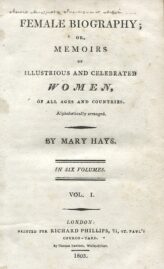
Mary Hays (1759–1843) was an English writer whose main work was the six-volume compendium Female Biography; or, Memoirs of Illustrious and Celebrated Women of All Ages and Countries, featuring the biographies of 300 notable women (in 294 entries) from ancient figures to nearly contemporaries.
Originally published in England in 1803, it was published in the United States four years later. Hays was also a poet and novelist.
Mary Hays was born into a family of Protestant dissidents who rejected the practices of the Church of England, the established church at the time.
She was an autodidact who read poetry and novels and attended religious and political debates. After her fiancé John Eccles died of a sudden fever, she decided to stay single, earn a living in order to be independent, and dedicate her life to writing.
. . . . . . . . .
. . . . . . . . .
Beginnings as a writer
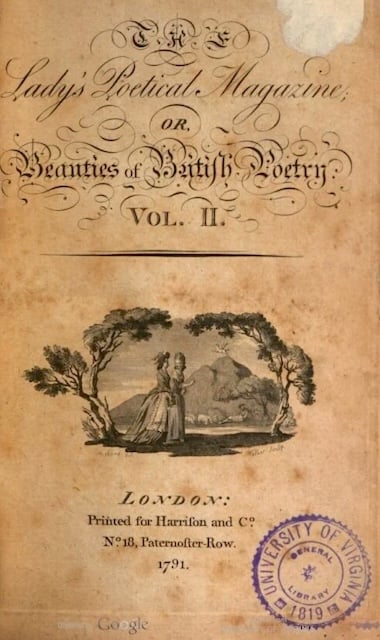
Her first published poem was “Invocation to a Nightingale,” published in the Lady’s Poetical Magazine in 1781, followed by two other poems in 1785 and a short story in 1786.
After reading the English philosopher Mary Wollstonecraft’s seminal book A Vindication of the Rights of Woman shortly after its publication in 1792, she contacted Joseph Johnson, the publisher of the book, and requested a meeting with the author, which led to a lifelong friendship.
She also befriended Mary Wollstonecraft’s husband William Godwin, who was a political philosopher, and other radical thinkers.
. . . . . . . . . . . .
. . . . . . . . . . . .
A shocking first novel: Memoirs of Emma Courtney
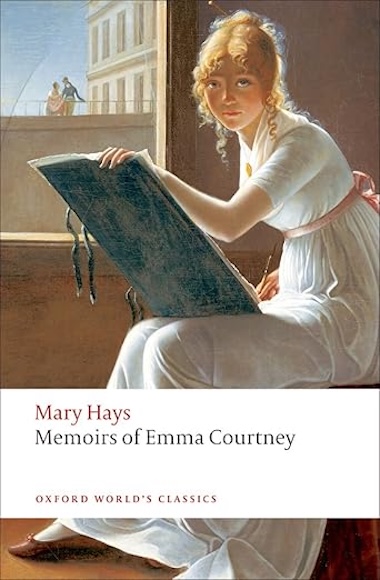
Mary Hays’ epistolary novel Memoirs of Emma Courtney was published in 1797. The semi-autobiographical novel was based on Mary’s love for the English social reformer William Frend, which wasn’t reciprocated. The publication of the novel was followed by a swift backlash. Readers were shocked by the fact that the original letters she exchanged with Frend were included in the novel. Moralists were scandalized by her description of female sexual passion, adultery, infanticide and suicide.
Mary doubled down in her essay “An Appeal to the Men of Great Britain in Behalf of Women,” published anonymously in 1798 and calling for an end to the tyrannical rule of men over women.
. . . . . . . . . . . .
. . . . . . . . . . . .
Later Works by Mary Hays
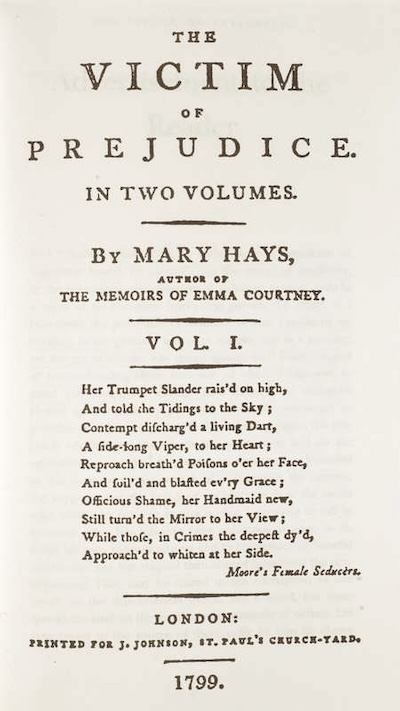
The Victim of Prejudice, published in 1799 under her real name, was her second novel. It describes the tribulations of a woman who spends her whole life fighting against social prejudice. After being raped by the local landowner, she unsuccessfully tries to seek legal redress. Unable to find work and accommodation, she is sent to a debtors’ prison. After her stay in prison, she attempts to lead an independent and virtuous life but is left ostracised by society. Despite her ordeal, she never loses her own sense of value and self-respect.
Hays is best known for the six-volume compendium Female Biography; or, Memoirs of Illustrious and Celebrated Women of All Ages and Countries, published in London by Richard Phillips in 1803. It includes 300 notable women (in 294 entries) from ancient figures to nearly contemporaries. A six-volume facsimile edition was published in London by Pickering & Chatto in 2013–14.
A three-volume American edition was published in Philadelphia by Birch & Small in 1807 with minor typographical corrections.
Mary Hays’ last book was Memoirs of Queens, Illustrious and Celebrated, published in 1821. It is also a biographical compilation. The last years of her life were difficult, with little income and moderate praise for her work. Her writings were rediscovered later on as part of the emerging feminist movement.
. . . . . . . . .
Contributed by Marie Lebert. Reprinted by permission. Marie is a bilingual French-English translator. She has worked as a translator and/or librarian for international organizations and has written ebooks, articles and essays about translation and translators, ebooks, libraries and librarians, and medieval art. She holds a doctorate of linguistics (digital publishing) from the Sorbonne University, Paris, and a master of social science (society and culture) from the University of Caen, Normandy. See more entries by Marie Lebert, most profiling women translators, on Literary Ladies Guide. Find more about women translators of the past at Marie Lebert.
Leave a Reply