By Emma Ward | On September 1, 2017 | Updated August 18, 2026 | Comments (0)
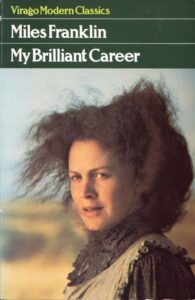
Miles Franklin (1879 – 1954) was an Australian writer best known for her 1901 novel, My Brilliant Career. The following selection of quotes from My Brilliant Career help us to know the author better, for it has elements of autobiography.
Franklin may not be as well remembered by readers worldwide as she is in her native land, but her works are well worth exploring.
This description is from the St. Martin’s Press edition of My Brilliant Career by Miles Franklin:
“Originally published in 1901, My Brilliant Career was written when Stella Maria Sarah Miles Franklin was only sixteen years old. But Miles Franklin was decades ahead of her time, and this book was written for an audience not yet born.
For the character of Sybilla Melvyn, Miles Franklin created someone who voices with incredible charm but deadly accuracy the fears, conflicts, and torments of every young woman coming of age in a man’s world. Red-haired, impetuous, sharp-tongued, Sybilla has ambitions that reach far beyond here small-town life in the Australian outback.”
Read More→
By Nava Atlas | On August 31, 2017 | Updated June 12, 2023 | Comments (0)
We Have Always Lived in the Castle (1962) was the last published work by Shirley Jackson during her lifetime. The narrator, Mary Katherine “Merricat” Blackwood, lives with her sister and uncle on an isolated estate in rural Vermont.
The Blackwoods have been shunned by the neighbors in the nearby village due to a tragedy — murder by poisoning — that occurred some years earlier.
This critically acclaimed novel is considered one of Jackson’s masterpieces; and it has been an inspiration to authors that came after who write in the thriller and mystery genres. Read More→
By Nava Atlas | On August 31, 2017 | Updated November 18, 2022 | Comments (0)
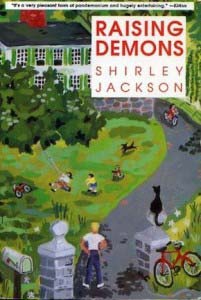
Raising Demons by Shirley Jackson is a 1957 memoir of motherhood and domestic tribulations. Wry and humorous, it serves up an idealized version of this author’s family’s life in North Bennington, Vermont, and is a departure from her fictional tales of psychological terror — notably, The Lottery (1949).
How much of the depiction of this family’s life reflects reality is an open question. Jackson’s husband, Stanley Edgar Hyman, a literary critic and professor, was chronically unfaithful, controlling, and belittling.
Jackson herself was a heavy smoker, overweight, and may have been addicted to prescription barbiturates due to anxiety. She was only 48 when she died of heart failure in her sleep in 1965. Read More→
By Nava Atlas | On August 30, 2017 | Updated June 24, 2026 | Comments (0)
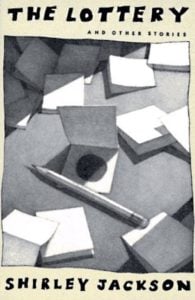
“The Lottery” (1948) is Shirley Jackson‘s best-known short story; it could be argued it’s her most famous classic — even more widely read than The Haunting of Hill House or We Have Always Lived in the Castle.
Once published, the story quickly catapulted her to fame— or, more accurately, notoriety. Its most potent theme — scapegoating —is all too relevant in today’s world, and so, the story continues to resonate.
Jackson, just in her early thirties, wrote it only three weeks before its publication in The New Yorker (full text as it appeared in 1948),“on a bright summer morning as I was pushing my daughter up the hill in her stroller.” And the story begins, rather benignly: Read More→
By Taylor Jasmine | On August 30, 2017 | Updated November 18, 2022 | Comments (0)
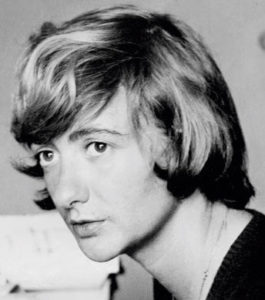
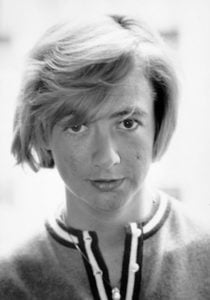
Françoise Sagan (1935 – 2004), the French novelist, playwright, and screenwriter, was always best know for her debut novel, Bonjour Tristesse, published when she was just 18. Following is a selection of quotes by François Sagan on love, life, and writing.
Sagan went on to have an incredibly prolific career after her freshman effort, coupled with a wild and turbulent life that featured fast cars, drugs, and many love affairs.
Her turbulent life eventually caught up with her health; she spent her last few years ill and and she died in 2004 of a pulmonary embolism at the age of sixty-nine. Read More→
By Taylor Jasmine | On August 29, 2017 | Updated November 18, 2022 | Comments (0)
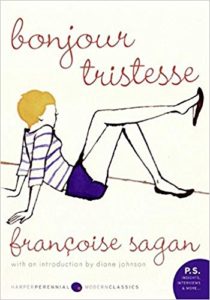
Bonjour Tristesse by Françoise Sagan (1954) is the story of Cecile, an amoral seventeen-year-old, who goes on vacation to the south of France with her father, Raymond.
Raymond is a widower who leads a life revolving around multiple affairs with women, usually short-lived. Cecile, despite her age, is fully aware of her father’s love life.
Raymond has rented a well appointed villa, and Cecile, her father, and her father’s mistress of the moment, Elsa, depart for a month of sun and relaxation. Read More→
By Nava Atlas | On August 29, 2017 | Updated November 18, 2022 | Comments (0)
Gone With the Wind — the book — was a publishing phenomenon. Not within memory had an American novel been so long (1,037 pages, a half-million words) or weighed so much (3.5 pounds).
The following narrative was originally published in The Story of Gone With the Wind by Bob Thomas, © 1967 Metro-Goldwyn-Mayer Inc., National Publishers, Inc., New York.
MacMillan published GWTW at a time when the book industry, like all others in the U.S., was still suffering from the results of the Depression. At least one person was concerned about the enterprise: Margaret Mitchell. Read More→