This brief survey of notable South African women poets presents eminent writers in the genre that are well worth exploring, with links to samples of their poetry if English translation is available.
The landscape of Southern Africa is sometimes harsh and unforgiving. The same may be said about much of the country’s history. Still, it is impossible to experience the country without feeling inspired by its culture, nature, and sheer spirit.
The country’s literary legacy has produced legendary authors like Olive Schreiner, Nadine Gordimer, and Elsa Joubert. There are just as many poets, like Ingrid Jonker, Elisabeth Eybers, and the others listed here, who have forever etched their words and phrases in world literature. Read More→
Presented here is the full text of “John Redding Goes to Sea,” the first story by Zora Neale Hurston to be published.
Launching what would become her typical style, with characters speaking in dialect, the story was first published in the May, 1921 issue of Stylus, Howard University’s literary magazine. A slightly edited version in the January, 1926, issue of Opportunity, a prominent literary journal associated with the Harlem Renaissance.
More recently, the story is included in Hitting a Straight Lick with a Crooked Stick (2020) a collection of Zora’s rediscovered short stories. Read More→
The Chosen Place, The Timeless People, was the second full-length novel by Paule Marshall (1929 – 2019). Following her first novel, Brown Girl, Brownstones (1959), she published a collection of four novellas in Soul Clap Hands and Sing (1961).
In its recognition of the intersectionality of race, class, and colonialism,The Chosen Place, The Timeless People was ahead of its time.
A New York Times reviewer called it “the best novel to be written by an American Black woman” when it was published in 1969. Such praise sounds patronizing in the present day, but let’s discount the reviewer’s limitations and focus on the recognition the comment represented. Read More→
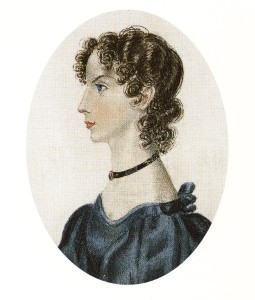
Walking with Anne Brontë: Insights and Reflections (edited by Tim Whittome, 2023) makes a passionate case for elevating the youngest of the Brontë sisters to her rightful place in English literature.
A collection of essays and personal reflections by Anne Brontë scholars and aficionados, this book will go a long way to the understanding and appreciation of Anne’s fortitude as a woman and her genius as a writer.
The following is excerpted from Tim Whittome’s Introduction to Walking with Anne Brontë, reprinted with permission. Read More→
Thus Far and No Further by Rumer Godden is this prolific midcentury novelist and memoirist’s first memoir, published in 1946. It chronicles her brief sojourn in Kashmir India, where she lived briefly with her two young daughters on a tea plantation.
Though not as enduring as her novels nor her other memoirs, this slim book, her sixth overall, was well received by readers and critics.
Godden’s characteristically evocative writing captures the time she spent in Rungli Rungliot in Darjeeling in Northeast India. Some of the editions of this now rather obscure book are, in fact, titled Rungli Rungliot. Read More→
This insightful analysis of Agnes Gray by Anne Brontë (1847) discusses the significance of the first novel by the youngest Brontë sister (1820 – 1949).
Originally published in the Brontë Society Transactions (now titled Brontë Studies, Volume 21, 1993). Reprinted by permission of Timothy Whittome (Walking with Anne Brontë, 2023).
“It leaves no painful impression on the mind — some may think it leaves no impression at all.” Thus wrote one reviewer in the Atlas on January 22, 1848. I suspect that few of Anne Brontë’s readers would easily sympathize with this view, and it is the purpose of this essay to illustrate why I disagree with the Atlas. Read More→
Female protagonists in 19th-century novels were customarily used to facilitate the marriage plot. So the single woman, then commonly referred to as a spinster, wasn’t traditionally given heroine status. Here we’ll look at the concept of literary spinsters, and how they presaged the New Woman novels of the early twentieth century.
Towards the end of the nineteenth century, the single heroine begins to emerge in her own right. Some authors began to challenge the marriage plot and experiment with single female protagonists. Giving the single woman agency in the novel helped alter the traditional narrative trajectory for heroines.
Before the twentieth century, single female protagonists in novels were typically young and socially or financially powerless until “rescued” by marriage. Read More→
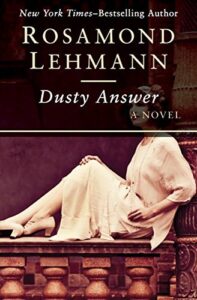
The Well of Loneliness (1928) by Radclyffe Hall is often cited as the first published lesbian novel written in English, but Dusty Answer by Rosamond Lehmann (1927) preceded it by a year.
As in Hall’s novel there is no explicit lesbianism but a strongly implied relationship between two girls at college. This was noted by outraged critics of the time, one of whom wrote an article in the London Evening Standard titled “The Perils of Youth,” addressing what he presumed to be the degenerate readers of Lehman’s novel: Read More→