Quotes by Edna Ferber on Writing and Living
By Emma Ward | On June 8, 2017 | Updated September 25, 2026 | Comments (0)
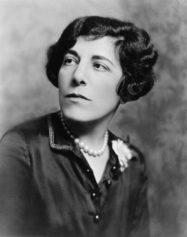
Edna Ferber (1885 – 1968), the prolific American novelist and playwright, began her career as a newspaper reporter in Appleton, Wisconsin. Following is a selection of quotes by Edna Ferber on writing and living.
Her stories were slices of Americana, ranging far from the events and experiences of her own life.
As a Jewish woman and and daughter of immigrants, she didn’t shy away from weaving issues of gender, class, and race into her colorful sagas. Many of her novels were adapted into films and Broadway shows.
These quotes are from A Peculiar Treasure, 1939 and A Kind of Magic, 1963.
. . . . . . . . . . .
Quotes from A Peculiar Treasure (1939)
“This is certain: I never have written a line except to please myself. I never have written with an eye to what is called the public or the market or the trend or the editor or the reviewer. Good or bad, popular or unpopular, lasting or ephemeral, the words I have put down on paper were the best words I could summon at the time to express the thing I wanted more than anything else to say.”
. . . . . . . . . . .
“Success stimulates the glands, revivifies the spirits, feeds the ego, fills the purse. Failure is a depressing thing to face. The critics rip your play to ribbons, audiences refuse to come to it; reviewers say your book is dull, or trite, readers will not buy it. You read these things, you hear them, you face them as you would face any misfortune, with as much good grace as you can summon.”
. . . . . . . . . . .
“Awake and asleep the novel is with you, dogging your footsteps. Strange formless bits of material float out from the ether about you and attach themselves to the main body of the story as though they had hung suspended in air for years, waiting.”
. . . . . . . . . . .
“Your idea of bliss is to wake up on a Monday morning knowing you haven’t a single engagement for the entire week. You are cradled in a white paper cocoon tied up with typewriter ribbon.”
. . . . . . . . . . .

Learn more about Edna Ferber
. . . . . . . . . . .
Quotes from A Kind of Magic (1963)
“Is this, they ask, the story of your life? … Yes. My inner life. The life of imagination and creative ability. Writing is a lonely work but the creative writer is rarely alone. The room in which one works is peopled with the men and women and children in the writer’s imagination. Often they are difficult—but rarely boring—company. This is a fortunate thing, for they are with one day and night, they never leave while the book or play is in progress …”
. . . . . . . . . . .
“Writing is lonely work but the creative writer is rarely alone. The room in which one works is peopled with the men and women and children of the writer’s imagination. Often they are difficult—but rarely boring—company. This is a fortunate thing, for they are with one day and night, they never leave while the book or play is in progress. One wishes sometimes that they would go away. Just leave me alone for an hour—a minute—won’t you! Often they are so much more fascinating to the writer than the living people one actually encounters that to go to a party, a dinner, even to the theatre is an anti-climax.”
. . . . . . . . . . .
“The writer is a writer because [she] cannot help it. It is a compulsion. Sometimes it is called a gift, but actually, it is an urge for expression that simply cannot be denied.”
. . . . . . . . . . .
“Life can’t ever really defeat a writer who is in love with writing, for life itself is a writer’s lover until death — fascinating, cruel, lavish, warm, cold, treacherous, constant.”
. . . . . . . . . . .

5 Great Tips for the Writing Life by Edna Ferber
. . . . . . . . . . .
“What can a writer wish for more splendid than to know that by putting those little black marks on a sheet of blank white paper there have been accepted in the mind of the reader human beings with three dimensions who walk talk breathe live suffer exult die, much as the reader has done or will do, or has observed in his fellow men.”
. . . . . . . . . . .
“Only amateurs say that they write for their own amusement. Writing is not an amusing occupation. It is a combination of ditch-digging, mountain-climbing, treadmill, and childbirth. Writing may be interesting, absorbing, exhilarating, racking, relieving. But amusing? Never!”
. . . . . . . . . . .

. . . . . . . . . . .
“Every day for hours one is shut up in a room with the company of chosen people created by oneself. It is a pattern of self-immolation familiar to any writer worth reading. The writer does not even remotely look upon this as a hardship. It is a way of life; a necessary and chosen way of life. Witty conversation, purposely dull dialogue, love, murder, marriage, birth, violence, triumph, failure, death — anything can happen in that room.”
. . . . . . . . . . .
“To be a professional writer one must be prepared to give up almost everything except living … The first lesson to be learned by a writer is to be able to say, ‘Thanks so much. I’d love to, but I can’t. I’m working.’”
. . . . . . . . . . .
The writer’s discipline
“The born writer goes to (her) desk daily and remains there throughout certain fixed hours each day. Sometimes ten words manage to get themselves down on paper, sometimes a page or two, sometimes (rarely) five or even more… If, after months and sometime years of research, of notes, of a first rough copy, you begin to try to assemble this amorphous body into some semblance of form, begin the actual long process of writing in order and in sequence, it is better (for me, at least) to think of it only in terms of one day; today’s work only.
Each day three pages, two pages, even but one on a bad day; and sometimes all of it to be rewritten next day and often rewritten and rewritten. It is better to think of a novel or any long piece of work as a day to day task to be done, no matter how eagerly you may think ahead (when you’re not actually putting words to paper) to the chapters not yet written. It is a long journey, to be undertaken sometimes with hope and confidence and high sprits; sometimes with despair.
If one thinks of it in terms of four hundred—four hundred and fifty-five hundred pages one can drown in a morass of apprehension. So one step after another, slowly, painfully, but a step. And so it grows. You have felt or observed in life something that you want terribly to say, and you want to say it more than you want to do anything else in the world.”
. . . . . . . . . .

Show Boat by Edna Ferber
. . . . . . . . . . .
More about Edna Ferber
- Edna Ferber’s Quotes on Writing and Life
- 5 Great Tips for the Writing Life
- Edna Ferber Writes Fiction Because She Can’t Help Herself
- The Unanticipated Success of So Big (1924)
- A Peculiar Treasure is Testimony to the Glorious Career of a Writer
- Dorothy Parker’s Review of Ice Palace
- Success or Failure, All’s to Do Again
- Developing the Discipline to Write Regularly
- Classic Women Authors Tackle Writer’s Block
- Edna Ferber’s Show Boat from Stage to Screen
- Ferber’s Inner Life of the Imagination
- Giant, the 1956 Film Based on Edna Ferber’s Epic Novel
Leave a Reply