Christine de Pizan and The Book of the City of Ladies
By Marie Lebert | On April 10, 2026 | Updated September 4, 2026 | Comments (0)
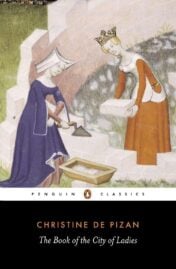
Christine de Pizan (alternatively Pisan) 1364–1430), an Italian-French court writer, is best remembered for The Book of the City of Ladies and its follow-up, The Treasure of the City of Ladies, two manuscripts dated 1405.
A prolific writer of poetry, novels, biography and commentary in vernacular French, she earned a living with her writing and is considered the first professional woman writer in Europe.
Christine de Pizan’s husband died of the plague in 1389, a year after her father’s death, leaving her to support her children and her mother as a court writer. This was considered a male occupation.
She skillfully used patronage in turbulent political times, with royalty commissioning her work, and became a prolific writer, with forty known works which include poetry, novels and biography, as well as literary, historical, philosophical, political and religious commentary.
Christine was personally involved in the production of her books, supervising the production of beautifully illustrated manuscripts that were acquired by fellow intellectuals for their own libraries.
. . . . . . . . . . . .
 . . . . . . . . . . . .
The Book of the City of Ladies
Why did Christine de Pizan write The Book of the City of Ladies (Le Livre de la Cité des Dames)?
It began with a literary controversy known as “The Debate of the Rose” (“La Querelle de la Rose”) involving several intellectuals. As the only woman involved, she questioned some parts of Jean de Meun’s long poem “Le Roman de la Rose” (1275), a continuation of an earlier medieval poem (1240) with the same title written by the French poet Guillaume de Lorris.
Jean de Meun is often considered the greatest of French medieval poets, and “Le Roman de la Rose” was possibly the most read work in Europe in medieval times and beyond, hence its influence on society. It also criticized women, courtly love, and marriage, depicting at length the supposed vices of women and the means by which men could outwit them.
In The Book of the City of Ladies, Christine takes aim at the misogynistic views expressed by Jean de Meun in “Romance of the Rose” by defending female virtues through many examples of famous biblical, historical and mythological women.
Christine first criticized Jean de Meun’s misogynistic views in her three essays “Epistle to the God of Love” (“Épître au Dieu d’Amour,” 1399), “The Tale of the Rose” (“Le Dit de la Rose,” 1402) and “Letters on the Debate of the Rose” (“Querelle du Roman de la Rose,” 1403).
. . . . . . . . . . . .
 . . . . . . . . . . . .
Then she wrote The Book of the City of Ladies (Le Livre de la Cité des Dames, 1405) to give a passionate and well-organized defense of women by showing their many contributions to society.
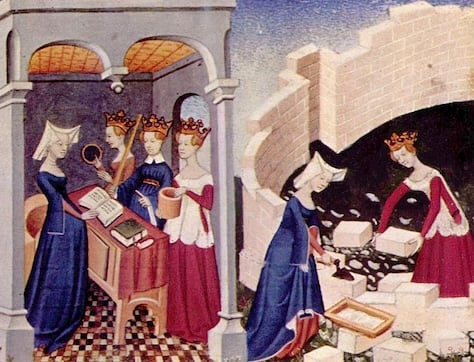
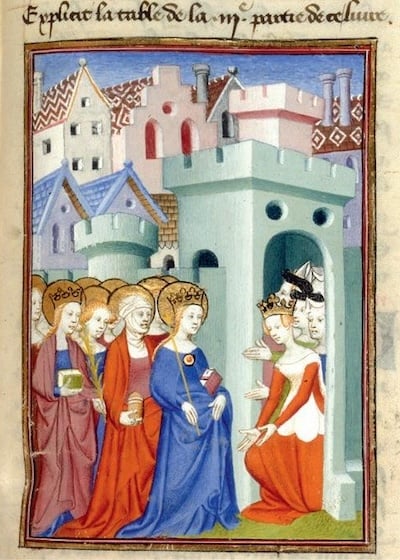
In this work, she builds up a symbolic city named the City of Ladies (hence the title) by dialoguing with the three allegorical figures Reason, Justice and Rectitude sent to help her in this task. Step by step, Christine chooses 165 famous biblical, historical and mythological women as the building blocks for the outside walls, the inside walls and the buildings of the City of Ladies.
Her main source of inspiration was De Mulieribus Claris (Concerning Famous Women, 1361–62), an earlier collection of women’s biographies written in Latin prose by the Italian poet Giovanni Boccaccio. It was the first compilation devoted exclusively to women in medieval western literature, with the biographies of 106 historical and mythological women.
After the invention of the printing press by Gutenberg in 1450, The Book of the City of Ladies was printed several times in the 15th and 16th centuries. It became a major source of inspiration for several French women writers, including Gabrielle de Bourbon, Anne of France, Marguerite de Navarre and Georgette de Montenay.
Christine’s book, written in vernacular French, was translated into English by Brian Anslay, an English administrator to King Henry VII and King Henry VIII, and published in 1521 as the Boke of the Cyte of Ladies. Some early printed editions didn’t reference Christine de Pizan as the author, which was unfortunately quite common for women’s writings at the time and beyond.
. . . . . . . . . . . .
. . . . . . . . . . . .
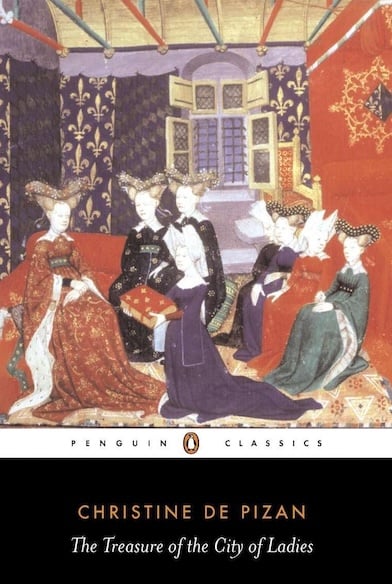
Christine wrote a follow-up titled The Treasure of the City of Ladies (Le Trésor de la Cité des Dames), a manuscript dated 1405, also known as The Book of the Three Virtues (Le Livre des Trois Vertus). It is meant as a manual of education for women, with advice about how to cultivate useful qualities, including a good education.
These two works are now considered some of the earliest feminist writings. They have drawn the fascination of modern feminists such as French philosopher Simone de Beauvoir.
. . . . . . . . . . . .
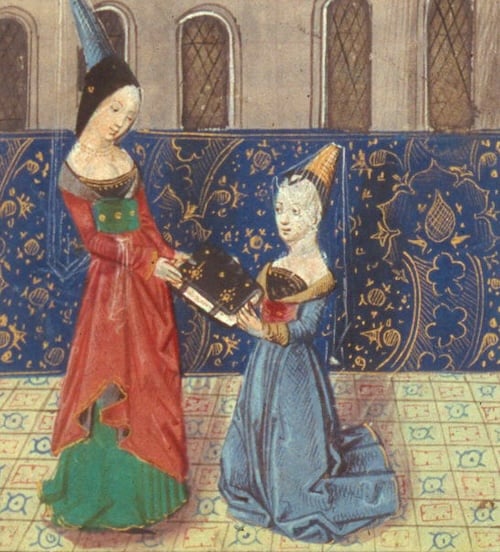
Christine de Pizan presents her Book to Margaret of Burgundy
from The Treasure of the City of Ladies
. . . . . . . . . . . .
Contributed by Marie Lebert. Reprinted by permission. Marie is a bilingual French-English translator. She has worked as a translator and/or librarian for international organizations and has written ebooks, articles and essays about translation and translators, ebooks, libraries and librarians, and medieval art. She holds a doctorate of linguistics (digital publishing) from the Sorbonne University, Paris, and a master of social science (society and culture) from the University of Caen, Normandy. See more entries by Marie Lebert, most profiling women translators, on Literary Ladies Guide. Find more about women translators of the past at Marie Lebert.
Leave a Reply