By Nava Atlas | On November 27, 2024 | Updated November 3, 2026 | Comments (8)
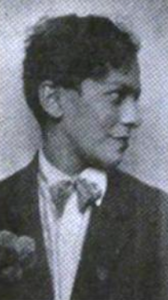
Mae Virginia Cowdery (also known as Mae V. Cowdery; January 10, 1909 – November 2, 1948) is a forgotten poetic voice of the Harlem Renaissance era of the 1920s. A selection of her earlier poems is presented here.
Mae was the only child of professional parents who were part of Philadelphia’s Black elite. They instilled in her their values of racial pride, equality, and respect for the arts.
Above right, Mae in 1928 at age nineteen, sporting an androgynous look.
Read More→
By Tyler Scott | On November 18, 2024 | Comments (0)
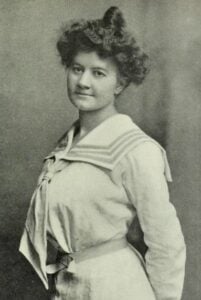
Ellen Glasgow (April 22, 1873 – November 21, 1945) was one of the South’s most eminent writers of her day. Today she’s far less known than contemporaries like Edith Wharton and Willa Cather, despite having created an impressive body of work.
Ellen’s output included novels, collections of short stories and poems, a treatise on how to write fiction, and an autobiography. She was also the recipient of the Pulitzer Prize in 1942. Today, if she is remembered for anything, it’s more for her influence than her literary talent.
It’s well worth rediscovering this often overlooked writer.
Read More→
By Taylor Jasmine | On November 14, 2024 | Updated June 15, 2026 | Comments (0)
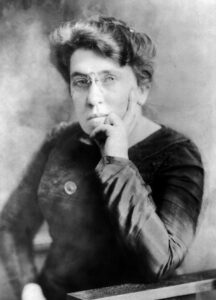
Emma Goldman (1869 – 1940) was a noted political activist and promoter of the anarchist philosophy. She was best known for her role in the development of its theories in the early twentieth century.
As such, “Anarchism: What it Really Stands For” is a 1911 essay that crystalizes her views. Anarchism, in brief, argues against all forms of authority the abolishment of institutions of government, advocating for replacing them with stateless societies.
Goldman’s views seem particularly resonant — and relevant — in this age of government overreach into privacy and personal freedom. Read More→
By Elodie Barnes | On November 8, 2024 | Updated March 15, 2025 | Comments (0)
Lee Miller (April 23, 1907 – July 21, 1977) was an American photographer and war correspondent. For many years she was known as the muse and lover of Surrealist artist Man Ray.
She was extraordinarily talented in her own right, moving with ease from the fashion circles of New York, to the Surrealist circles of Paris, to front-line photography in World War II.
Her life and work has been painstakingly documented and promoted by her son Antony Penrose, and most recently has been the subject of a 2023 film produced by and starring Kate Winslet. Read More→
By Taylor Jasmine | On November 2, 2024 | Updated November 14, 2024 | Comments (0)
Presented here is an analysis by James Weldon Johnson of Phillis Wheatley’s poetry. She was one of the first women to be published in colonial America, and the first person in the U.S. to have a book of poetry published while enslaved.
James Weldon Johnson (1871–1938) was a writer, educator, poet, diplomat, and civil rights activist. He helmed the NAACP from 1920 to 1930. He was a significant figure in the Harlem Renaissance movement, or as it was then called, The New Negro movement.
The Book of American Negro Poetry (1922), chosen and edited by Johnson, was one of a handful of significant anthologies of Black literature to be published in the 1920s. The segment following, in which he provides and analysis of Phillis Wheatley’s poetry, is a portion of the Johnson’s Preface to this collection. It is in the public domain.
Read More→
By Nava Atlas | On October 22, 2024 | Comments (0)
Women translators in history have been forgotten for too long before being recently acknowledged in Wikipedia thanks to its many contributors. Marie Lebert has compiled brief biographies on women translators of the past into pdfs in three languages:
Read More→
By Taylor Jasmine | On October 20, 2024 | Updated May 9, 2025 | Comments (0)
Georgia Douglas Johnson (1880 – 1966) was a prominent poet associated with the Harlem Renaissance movement. Following is the full text of Bronze: A Book of Verse (1922), her second collection of published poetry.
Bronze was preceded by The Heart of a Woman and Other Poems (1918). Next came An Autumn Love Cycle (1928), and many years later, Share My World (1962). Her poems were also published in numerous periodicals and anthologies, particularly in the 1920s.
In her poetry, Georgia addressed issues of race as well as universal themes of love, motherhood, and being a woman in a male-dominated world. Of all her works, Bronze most directly addressed issues of race and racism. Bronze: A Book of Verse is in the public domain. Read More→
By Nava Atlas | On October 14, 2024 | Updated December 16, 2024 | Comments (0)
Effie Lee Newsome (1885–1979), a writer associated with the Harlem Renaissance, wrote poetry that was widely published in journals and anthologies of the 1920s. Notably, these included NAACP’s The Crisis and the Urban League’s Opportunity, and Caroling Dusk: An Anthology of Verse by Negro Poets, edited by Countee Cullen.
Mary Effie Lee was born in Philadelphia, Pennsylvania and raised in Wilberforce, Ohio. She took classes at Wilberforce University, Oberlin College, the Philadelphia Academy of the Arts, and the University of Pennsylvania, exploring her dual interests in writing and art. Effie and her sister Consuelo both did illustration for children’s magazines.
As the editor of the children’s column “Little Page” in The Crisis, Effie Lee was one of the first to write poems expressly for Black children. Her poetry encouraged younger readers to appreciate their worth and beauty. Read More→